| Back OpEdNews | |||||||
|
Original Content at https://www.opednews.com/articles/Could-This-Be-the-New-Covi-Animals_Covid-Censorship_Covid-Testing_Covid-19-240402-879.html (Note: You can view every article as one long page if you sign up as an Advocate Member, or higher). |
|||||||
April 2, 2024
Could This Be the New Covid?
By Martha Rosenberg
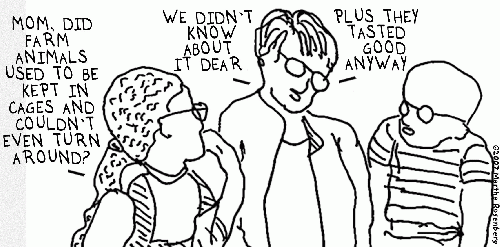
Crowded and unsanitary animal venues whether U.S. factory farms or overseas wet markets are the source of zoonotic pandemics which people only seem to notice when humans start dying.
::::::::
Many who do not remember the 2003 SARS outbreak ignore the animal origins of such viruses which are called "zoonotic." Wet markets in which cats, dogs, birds, wild mammals and more are squeezed together and slaughtered on site explains the "jump" of a virus from one species to another including to humans.
Now, this week in Texas, we are seeing bird flu (which cost the lives of over 50 million "euthanized" birds) jumping to cows and to humans. Watch this space.
"The most plausible source of mammal infection"appears to be close contact with infected birds, including their ingestion," reads a paper in the journal Emerging Infectious Diseases. "Continuous surveillance is essential to mitigate the risk for a global pandemic."
Such viral outbreaks are directly linked to the "intensive confinement of animals" in factory farms, according to the Journal of Public Health Policy.
The novel H1N1 virus (originally called swine flu until hog farmers objected to the bad PR) responsible for the 2009 - 2010 pandemic, was a new and ominous combination of five viruses--North American swine flu, North American avian flu, two swine flu viruses from in Asia and Europe and a human flu virus.
Five months after its identification, H1N1 had spread to 43 countries according to the World Health Organization (WHO), which declared it a pandemic in June 2009. Between 151,700 and 575,400 people died worldwide, according to the CDC.
In 1997, a strain of avian flu called H5N1 surfaced in Hong Kong, and for eight years had much of the world fearing a pandemic. Like H1N1, H5N1 was novel pathogen never before encountered with clear animal/zoonotic origins. By 2004, H5N1 had spread to more than 50 countries in Asia, Europe, the Middle East and Africa.
Risks Should Not Be Ignored
Many who have not seen the piles of "euthanized" birds think bird flu only affects the price their poultry or eggs. "Big Ag," since its outlets are major media advertisers, successfully suppresses news and photos of such animal disease outbreaks-- again it is bad PR. For example, who realizes that African swine fever (ASF), caused by the African swine fever virus (ASFV), killed one-fourth of the world's pigs by 2019, including half of all China's factory farm pigs.
Who realizes that China bought and owns the biggest hog slaughterhouse in the world in the U.S., Tar Heel, North Carolina-- to keep pork flowing to its pork loving populace? Their purchase of U.S. land for "food" has sparked acrimony of how much-- if any-- U.S. land outside countries can purchase.
Big Meat also suppressed the facts about porcine epidemic diarrhea virus (PEDv) which had killed 10 percent of all pigs confined in factory farms in the U.S. by 2014. Who heard that? Thanks mainstream media!
The PEDv scourge was so devastating, a Kentucky farm fed dead pigs to other pigs in an attempt to induce "immunity" in survivors.
Viral mutations and viruses jumping species could portend the next Covid. Bird viruses related to H5N1, such as H5N2, H5N7 and H5N8, have raged through industrial poultry farms in the U.S. since 2015 mostly behind the public's back.
Crowded and unsanitary animal venues whether U.S. factory farms or overseas wet markets are the source of zoonotic pandemics which people only seem to notice when humans start dying.
Authors Bio:
Martha Rosenberg is an award-winning investigative public health reporter who covers the food, drug and gun industries. Her first book, Born With A Junk Food Deficiency: How Flaks, Quacks and Hacks Pimp The Public Health, is distributed by Random House. Rosenberg has appeared on CSPAN and NPR and lectured at medical schools and at the Mid-Manhattan Public Library.