| Back OpEdNews | |||||||
|
Original Content at https://www.opednews.com/articles/Xueta-Island--The-Untold-by-Bernard-Starr-Genocide_Inquisition_Jews_Murder-220510-683.html (Note: You can view every article as one long page if you sign up as an Advocate Member, or higher). |
|||||||
May 10, 2022
"Xueta Island": The Untold Story of Genocide and the Resurrection of Judaism
By Bernard Starr
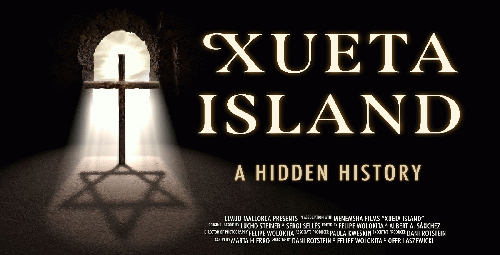
The film Xueta (pronounced cheweta) Island tells the story of the brutal persecution and murder of Jews over many centuries on the Spanish Island Of Majorca by the Spanish Inquisition. Ultimately the entire Jewish population of the Island was forced to convert. Judaism was then thought to have disappeared. But in recent years descendants of murdered Jews are returning to Judaism.
::::::::
I first heard the word Xueta (pronounced cheweta) in April 2022 at a brief Zoom presentation sponsored by Kulanu, an organization that supports isolated, emerging, and returning Jewish communities around the globe.
I wondered how it happened that 600 years after Judaism was crushed and vanished from Majorca, a Spanish Island in the Mediterranean, a Jewish boy originally from Englewood New Jersey discovered its tragic history of persecution and genocide and became committed to resurrecting Judaism.
I posed that question to Dani Rotstein after watching Xueta Island, the remarkable documentary film that he produced and co-directed.
Rotstein told me that his journey began in 2014, when he accepted a video production job in Majorca, Spain. He was looking forward to a career-building opportunity in an exotic setting. He had fallen in love with Spanish culture during a glorious year in Madrid in 2000-2001 on an exchange program when he was a student at Wesleyan University in Middletown Connecticut.
Judaism initially played no part in this new adventure in Majorca. In fact, he thought he would be the only Jew on the island. Little did he suspect that his experience would make Judaism the centerpiece of his life.
Soon after arriving, he wandered through the winding streets of the ancient quarters of Palma, the capital of Majorca. He was pleased and surprised to stumble on a synagogue, where he was able to join a prayer service with a scant number of Jews. Some present who called themselves Jews could not be counted for a minyan, the ten Jews required for some prayers. That's when he first heard the word "Xueta," which is the name given to descendants of Jews murdered during the notorious Spanish Inquisition. Eager to learn more, he began to research the tragic history of the brutal persecution of Majorcan Jews centuries earlier.
Rotstein learned that in 1435, after the earlier massacre of 300 Jews, the entire Jewish community on Majorca submitted to conversion to Catholicism rather than face public trials and execution. Many of these so-called conversos continued to practice Judaism secretly. The Inquisitors subjected any Jew suspected of being a pretend Christian (called crypto-Jews) to imprisonment, torture, and even execution. Spies, informants, and other anti-Semites often turned in these conversos, sometimes on the thinnest and often false "evidence."
In 1688 (CE), the Spanish Inquisition on Majorca conducted sweeping accusations and arrests of crypto-Jews. Forty attempted to escape on a British ship, but a raging storm prevented the vessel from leaving port. They returned to the walled ghetto where they were arrested. Along with other crypto-Jews they were imprisoned and tortured for three years. In 1691, eighty-eight were convicted and thirty-seven were sentenced to death. Three who refused to renounce Judaism, including prominent Rabbi Rafael Valls, were burned alive to the cheers of thirty thousand spectators.
In his book, La Fe Triunfante (The Triumphant Faith), written right after the executions, Jesuit priest Francisco Garau described with sadistic delight the blistering flesh and agony of the victims as flames consumed the "murderers of our Lord. "

As further punishment, the family names of those who were executed during the Inquisition, from 1645 onward, were posted in a major church in Palma (Santo Domingo Convent). Thus Xuetes, descendants with the same family names, would be demonized, shamed, and shunned for generations. Most were then only able to marry within the Xueta community. The names weren't removed from the church until 1834, the year that Spain officially ended the Inquisition.
After the forced conversions and executions, Judaism appeared to be gone from Majorca forever. But miraculously, as with other attempted genocides of Jews throughout history, the obituary of Judaism in Majorca proved to be premature.
Ironically, the very posting of the names of the families of the Jews who were murdered became the vehicle for the restoration of Judaism by modern-day descendants. A surprising number have acknowledged their connection to Judaism and some have converted (called returned) to fully embrace Judaism.
That resurrection is powerfully depicted in the documentary film Xueta Island. The returning Jews tell inspiring stories. Elderly chef Toni Pinya not only returned to Judaism but also sought Jewish identity in traditional Jewish cuisine, which he found described in the Torah. Pinya says: "The world's biggest cookbook is the Torah. All the recipes are in there." Xueta septuagenarian Miquel Segura describes how he traveled to New York, where he received instruction and certification as a returned Jew from a Sephardic (descendent of Spanish or Portuguese Jews) Rabbi, Marc Angel.
Narrator and guide Rotstein takes viewers on a ghostly tour through the medieval Jewish ghetto of Palma, the capital of Majorca, pointing to relics of Jewish sites, including street signs like CARRER DE MONTI-SION and CARRER DE CAN SALOM (shalom). He shows a wall of the monumental church of Montesion which was built on the site of the Sinagoga Major (Great Synagogue) that was confiscated in the 14th century to punish Jews. Rotstein told me: "Along that wall there is a rivet that legend says many Xueta families would run their hands alongside lovingly as a way of connecting to their Jewish past." In 2018, when he started giving educational tours, he invited visitors to leave notes in the cracks as a memory and tribute to the Converso and Xueta legacy. The site is now called Majorca's "wailing wall."

The film offers other evidence of the Jewish past. A baker displays a traditional Majorca gastronomic delight, empanada, which was a favorite Jewish Shabbat (Sabbath) dish, and a braided Majorca bread called ensaimada, which looks like a clone of Jewish challah.

Today Rotstein is the founder of a group committed to reestablishing a robust Jewish community in Majorca, with holiday celebrations sometimes held in outdoor venues in place of the formal synagogue in order to encourage nonobservant Jewish families on the island to attend.
In a further development, the community now has a part-time Rabbi. Rotstein informed me that Xueta Rabbi Nissan Ben-Avraham, who lives in Israel, was confirmed and hired as the official rabbi of Majorca in June 2021. He comes to Majorca to officiate at all of the major Jewish holidays, as well as ten days each month for Shabbat services and teaching a conversion class. In May 2022 he will be leading between five and ten new converts to their conversion in Israel. He is available full-time via WhatsApp and holds weekly classes via Zoom when he is not traveling to Majorca.
The responses of the non-Jews who have attended programs and services have been warm and encouraging. A Catholic Chorus learned Hebrew and sang Hatikvah (the Israeli National Anthem) and works by other Jewish composers in Hebrew at a High Holy Day service. Nevertheless, I wish the film had included interviews with the voices of non-Jews about their views of the history of persecution of Jews and the revival of a Jewish presence in Majorca. Rotstein assured me that he will report more about that when the film is released in theaters on the Island and later on the local TV channel. The pandemic has delayed wide distribution.
I asked Rotstein, who now lives permanently in Majorca with his wife and son, about his vision for the nascent Jewish community over the next decade. Although a practicing Jew, he nevertheless enthusiastically envisions a growing robust Jewish congregation that is inclusive of all levels of Jewish practices and commitment--and even open to non-Jews. He hopes to draw interest from young Xuetes as they learn more about the history of their ancestors. He believes that accepting diversity of practices is important since Majorca is a destination for Jews from around the world with different traditions, practices, and varying degrees of commitment.
As an antidote to the pain of the barbaric past, "tolerance" is the word that best expresses Dani Rotstein's vision.
Xueta Island has been screened at numerous film festivals and should be available soon on streaming services. You can find more information and the trailer at: https://xuetaislandthemovie.com
Don't miss this important and uplifting film.
(Article changed on May 10, 2022 at 8:00 PM EDT)
Authors Website: https://bernardstarr.substack.com/
Authors Bio:
Bernard Starr has written extensively on climate change since 2007, arguing that the crisis demands a coordinated, mission-driven response on the scale of the Manhattan Project. His work focuses on the structural failures of climate leadership and the need for centralized authority to accelerate the development and deployment of truly scalable solutions. A psychologist, Starr is Professor Emeritus at CUNY's Brooklyn College, where he taught developmental psychology to prospective teachers and research methods and statistics in a graduate program he directed. He is lead author of the lifespan textbook Human Development and Behavior: Psychology in Nursing. Starr is the founder and for twenty-five years was the managing editor of the Annual Review of Gerontology and Geriatrics, published by Springer. He also edited two Springer series, Adulthood and Aging and Lifestyle and Issues in Aging. For several years, he wrote for the Scripps Howard News Service on health care, the baby boom generation, and the challenges of an aging society, and for seven years he was writer, producer, and host of the award-winning radio commentary The Longevity Report on WEVD-AM in New York City. His books include The Starr-Weiner Report on Sex and Sexuality in the Mature Years (co-authored with Dr. Marcella Bakur Weiner), the first comprehensive study of sexual activity after age sixty; Escape Your Own Prison, exploring spirituality as a psychology of consciousness; and several works on antisemitism and Jewish identity, including The Crucifixion of Truth, Jesus, Jews, and Anti-Semitism in Art, and Jesus Uncensored. Starr is a past president of the Brooklyn Psychological Association and the Association for Spirituality and Psychotherapy. He serves as the principal United Nations representative for the Institute of Global Education, an NGO with ECOSOC status. His numerous op-ed and commentary articles for three years at the Scripps Howard News Service have appeared in newspapers throughout the United States. For several years he penned a blog at the Huffington Post. His articles have also appeared in Salon, the Daily News, OpEdNews and Barron's financial magazine.