| Back OpEdNews | |||||||
|
Original Content at https://www.opednews.com/articles/American-Painters-in-Franc-by-Meryl-Ann-Butler-American-Impressionists_Art-Exhibition_Art-Museum_Impressionism-220502-199.html (Note: You can view every article as one long page if you sign up as an Advocate Member, or higher). |
|||||||
May 2, 2022
American Painters in France: a Tour de Force Exhibition
By Meryl Ann Butler
WhyThe exhibit, "Whistler to Cassatt: American Painters in France" features 100 works by the first wave of expatriate artists to cross the Atlantic. Brilliant but relatively unsung female artists include Elizabeth Jane Gardner, Elizabeth Nourse, Lilla Cabot Perry and Cecilia Beaux. Also showcased is African-American artist Henry O. Tanner. It's a wonderful chance to see great artists left out of textbooks due to race or gender
::::::::
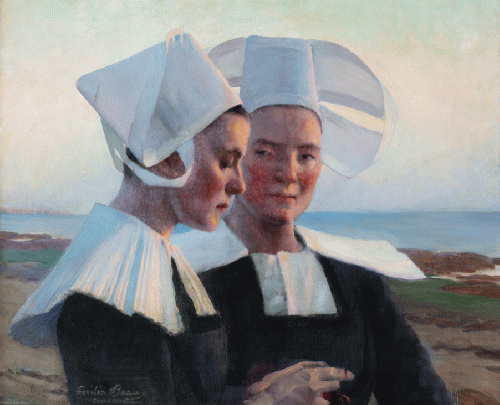
'Twilight Confidences,' 1888, by Cecilia Beaux. Georgia Museum of Art
(Image by Georgia Museum of Art) Details DMCA
In times like these, beautiful art is a welcome feast for the eyes and the soul. The exhibition, Whistler to Cassatt: American Painters in France features more than 100 inspiring works by the first wave of expatriate artists to cross the Atlantic. The young artists were seeking instruction, critical acclaim, and patronage in Paris, the center of the art world. Most returned home to become some of the greatest influencers on American art, although others, including Mary Cassatt, Elizabeth Jane Gardner and Henry Ossawa Tanner, chose to remain in France.
The exhibition debuted at the Denver Art Museum in the fall of 2021, curated by Timothy J. Standring, Curator Emeritus. It is now on display at Richmond's Virginia Museum of Fine Arts through July 31, 2022. It has been accurately labeled "a tour de force," and genuinely warrants a special trip from anywhere within driving distance.
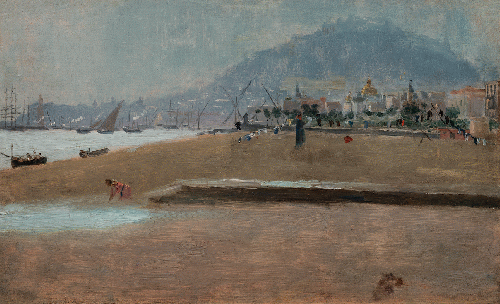
The Beach at Marseille, 1901. James McNeill Whistler (American, 1834-1903) oil on panel. Terra Foundation for American Art, Daniel J. Terra Collection, 1992.143. Photography © Terra Foundation for American Art, Chicago Terra Foundation for American Art
(Image by Terra Foundation for American Art) Details DMCA
If all you know of James Abbott McNeill Whistler is his iconic painting of his mother, you'll be delighted to discover his Impressionistic works.
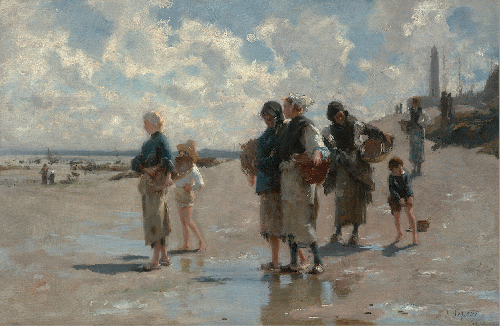
Fishing for Oysters at Cancale, 1878, John Singer Sargent (American, 1856-1925), oil on canvas. Museum of Fine Arts Boston, Gift of Miss Mary Appleton, 35.708. Photograph © Museum of Fine Arts Boston
(Image by Museum of Fine Arts Boston) Details DMCA
There are so many wonderful paintings by John Singer Sargent that at first it seems strange that his name isn't emblazoned in the exhibition title--but the title actually bookends the exhibition time frame with Whistler's entrance into France in 1855 and Cassatt's participation in the Armory Exhibition in 1913.
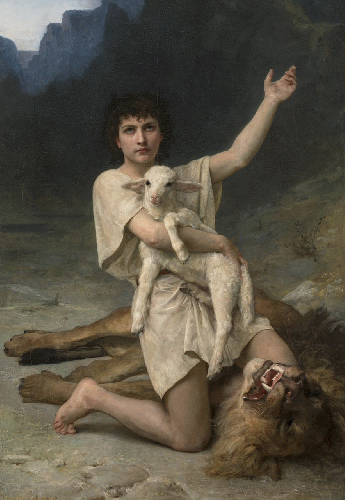
David the Shepherd by Elizabeth Jane Gardner c. 1895
(Image by National Museum of Women in the Arts) Details DMCA
But oh, the treasures in-between: Brilliant but relatively unsung female artists include Elizabeth Jane Gardner, Elizabeth Nourse, Lilla Cabot Perry and Cecilia Beaux. Few know that Beaux was a more sought-after portrait artist during her lifetime than her contemporary, John Singer Sargent.

Also showcased is the celebrated African-American artist Henry Ossawa Tanner. This exhibition is an extraordinary opportunity to see superlative works by artists who were unjustly left out of textbooks due to race or gender.
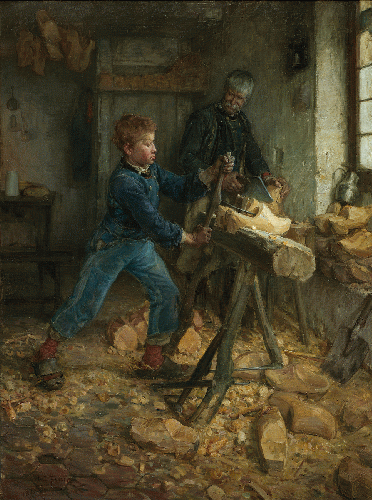
The Young Sabot Maker. 1895. Henry Ossawa Tanner (American, 1859-1937), oil on canvas. The Nelson-Atkins Museum of Art, Kansas City, Missouri, Purchase William Rockhill Nelson Trust
(Image by Nelson-Atkins Museum of Art, Kansas City, MO) Details DMCA
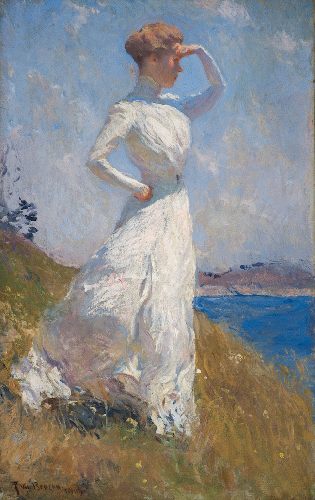
Sunlight, 1909. Frank Weston Benson. The Frank W. Benson Trust
(Image by Indianapolis Museum of Art at Newfields) Details DMCA
Other American Impressionists include Frank Weston Benson, William Merritt Chase, William J. Glackens, Childe Hassam, Robert Henri, Winslow Homer, Maurice Prendergast, Theodore Robinson and John Henry Twachtman.
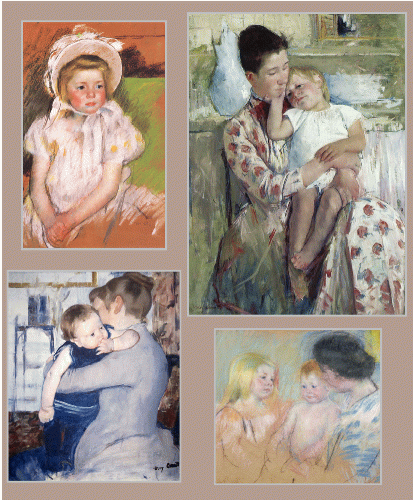
Mary Cassatt, clockwise from top left: Simone in a White Bonnet 1901, Pvt. col; Mother and Child, 1890. Wichita Art Museum, KS; Sara and Her Mother with the Baby (No. 1) pastel. 1901. Columbus Museum, GA; Mother and Child, ca. 1889, Cincinnati Art Museum,
(Image by various public domain) Details DMCA
There are two galleries filled with 18 breathtaking Cassatts, likely the largest number of her paintings assembled in one place in decades. Sitting on a museum bench surrounded by her stunning work was a magically transcendent experience.

Visitors view the exhibition, Whistler to Cassatt: American Painters in France' at VMFA.
(Image by Photo by Sandra Sellars © 2022 Virginia Museum of Fine Arts) Details DMCA
I visited with Dr. Susan J. Rawles, VMFA's Elizabeth Locke Associate Curator of American Decorative Arts.
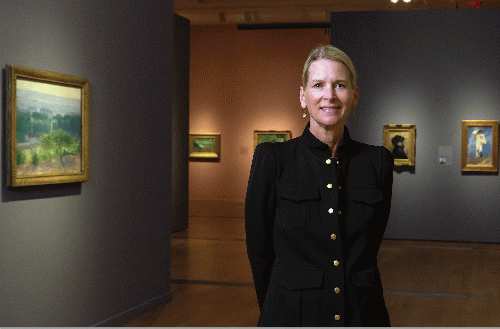
Dr. Susan J. Rawles, VMFA's Elizabeth Locke Associate Curator of American Decorative Arts.
(Image by Photo by Sandra Sellars, © 2022 Virginia Museum of Fine Arts) Details DMCA
Meryl Ann Butler: Thank you for visiting with us, Dr. Rawles. 'Whistler to Cassatt: American Painters in France' was an absolutely stunning exhibition. Virginia Museum of Fine Arts was very lucky to be one of the two venues - or, more likely it wasn't luck, but intentions. Can you share a little bit about how the VMFA came to host this exhibition?
Dr. Susan J. Rawles: VMFA is part of a French American Museum Exchange (FRAME) network that supports opportunities for dialogue and collaboration among its members. The Denver Art Museum approached VMFA's Exhibitions Department with a proposal for the show, the idea for which was initiated by Denver's curator, Timothy Standring.
That was three years ago. At that point, the Denver team was already pursuing loans from museums in the United States and Europe, and Timothy and I began exchanging ideas about the exhibition itself.
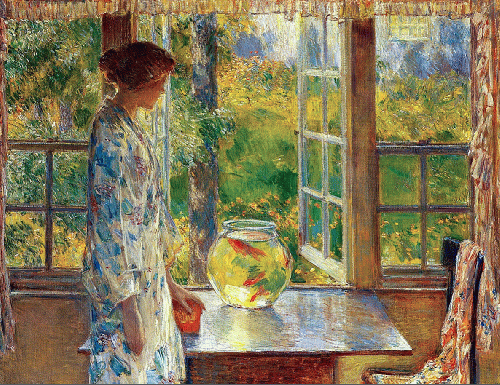
Bowl of Goldfish, 1912. Childe Hassam
(Image by David Owsley Museum of Art, Ball State Univ.) Details DMCA
MAB: What excites you most about this exhibition?
SJR: In addition to being beautiful, the paintings in this exhibition serve as visual evidence of the extraordinary revolution that occurred in the United States in the second half of the 19th century, from a country invested in the 18th-century idea of Manifest Destiny--an exceptionalism born of America's expansive landscape and natural resources--to the consequences attendant the sometimes-unsettling revolutions taking place in the post-Civil War era in science, technology, demographics, culture, politics, etc. That transformation is recorded in the shift in subject matter and technique of American artists.
Prior to the Civil War, artists and audiences celebrated the ideals of a new world Eden in academic pictures of land and nature characterized by the national Hudson River School.
When American artists returned home to the transformed United States, many selectively adapted their French training to produce a hybrid Franco-American Impressionist technique that celebrated the rise of a new middle class enjoying the leisure afforded by the country's burgeoning prosperity.
American painting continued to evolve beyond that, of course--a social realist or Ashcan school movement employed different techniques in the representation of marginalized people, for example--but the dominant body of work in the exhibition is American Impressionism.
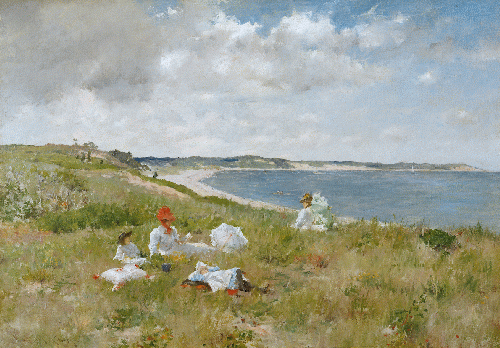
'Idle Hours,' ca. 1894. William Merritt Chase (American, 1849-1916), oil on canvas. Amon Carter Museum of Art, Fort Worth, Texas, 1982.1
(Image by Amon Carter Museum of Art) Details DMCA
MAB: Thank you, is there anything else you'd like to add before we conclude?
SJR: There are two primary thoughts that I hope that visitors will take away from Whistler to Cassatt: American Painters in France:
First, that Realism, Tonalism, and Impressionism reflected radical efforts to break away from conservative Academic ideas and conventions (that art should serve a moralizing purpose and, therefore, feature historical and biblical subject matter, for example) and express the lives, interests, and emotions of artists and everyday people. That rejection paved the way for modernism.
And secondly, that the subject matter of American Impressionism speaks to a new national identity born of the "Age of Invention" (as we call it), an era that, despite growing pains, propelled the United States into a global power and witnessed the elevation of a working class into a new and prosperous middle class.
Not only did everyday Americans experience a level of comfort and opportunity unprecedented in American history, but they also became the drivers of a national culture fueled by opportunity and optimism. Poised on the threshold of dramatic change, the president of the National Academy of Design, William Page, proposed in 1873, "Why shall not the Art of the World be done by America, as the other work of the World is destined to be done by her in the inevitable course of human events?"
MAB: I understand that William Merritt Chase, who is represented in this exhibition, said, 'Oh God, I would rather go to Europe than go to Heaven!" Thank you for visiting with OpEdNews!
SJR: Thank you for your interest in this exhibition.
The most remarkable painting for me to discover in the exhibition was Theodore Robinson's "Wedding March."
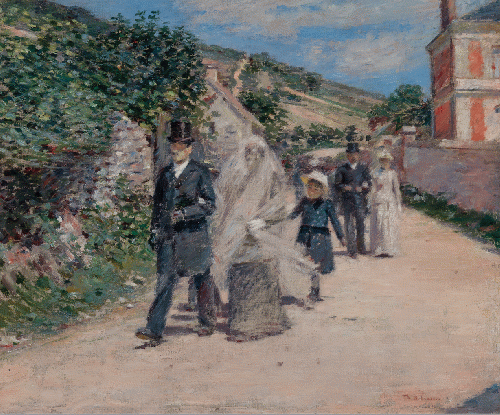
'Wedding March ' by Theodore Robinson. L-R: Claude Monet with bride, stepdaughter Suzanne Hoshede; unidentified child, groom, Theodore Earl Butler with Alice Hoshede, mother of the bride. Terra Foundation for American Art, Chicago: Daniel J. Terra Collec
(Image by Terra Foundation for American Art) Details DMCA
I have been wanting to see it ever since finding out that I am related to one of the people depicted. The beautiful painting is owned by a trust, and not displayed in a museum, so I feared my chances of ever seeing it were slim. So it was a delightful surprise to discover it in the exhibition! My kinsman is Theodore Earl Butler, an American Impressionist who became friendly with Monet. Butler was one of only two or three artists invited to paint in Monet's garden, and he married Monet's stepdaughter and favorite model, Suzanne Hoshede--an event that is celebrated in this painting.

Author Meryl Ann Butler is offering an online art appreciation workshop based on the exhibit which includes backstories and additional comparative works by the artists. OpEdNews readers can use this discount code for half off the sliding scale fees: HPARIS22 More info is here.
* * * * * * * * * * * * * * * *
About the Virginia Museum of Fine Arts

Virginia Museum of Fine Arts - entrance Fall2010.JPG
(Image by Wikipedia (commons.wikimedia.org), Author: Morgan Riley, Midlothian, Virginia) Details Source DMCA
The Virginia Museum of Fine Arts in Richmond, Virginia, is one of the largest comprehensive art museums in the United States. VMFA, which opened in 1936, is a state agency and privately endowed educational institution. Its purpose is to collect, preserve, exhibit, and interpret art, and to encourage the study of the arts. Through the Office of Statewide Partnerships program, the museum offers curated exhibitions, arts-related audiovisual programs, symposia, lectures, conferences, and workshops by visual and performing artists. In addition to presenting a wide array of special exhibitions, the museum provides visitors with the opportunity to experience a global collection of art that spans more than 6,000 years. VMFA's permanent holdings encompass nearly 50,000 artworks, including the largest public collection of Faberge' outside of Russia, the finest collection of Art Nouveau outside of Paris, and one of the nation's finest collections of American art. The Virginia Museum of Fine Arts is the only art museum in the United States open 365 days a year with free general admission. For additional information, telephone 804.340.1400 or visit www.VMFA.museum.
Authors Website: http://www.OceanViewArts.com
Authors Bio:
Meryl Ann Butler is an artist, author, educator and OpedNews Managing Editor who has been actively engaged in utilizing the arts as stepping-stones toward joy-filled wellbeing since she was a hippie. She began writing for OpEdNews in Feb, 2004. She became a Senior Editor in August 2012 and Managing Editor in January, 2013. In June, 2015, the combined views on her articles, diaries and quick link contributions topped one million. She was particularly happy that her article about Bree Newsome removing the Confederate flag was the one that put her past the million mark.
Her art in a wide variety of media can be seen on her YouTube video, "Visionary Artist Meryl Ann Butler on Creativity and Joy" at http://www.youtube.com/watch?v=UcGs2r_66QE
A NYC native, her response to 9-11 was to pen an invitation to healing through creativity, entitled, "90-Minute Quilts: 15+ Projects You Can Stitch in an Afternoon" (Krause 2006), which is a bestseller in the craft field. The sequel, MORE 90-Minute Quilts: 20+ Quick and Easy Projects With Triangles and Squares was released in April, 2011. Her popular video, How to Stitch a Quilt in 90 Minutes with Meryl Ann Butler can be seen at http://www.youtube.com/watch?v=PrShGOQaJQ8
She has been active in a number of international, arts-related projects as a citizen diplomat, and was arts advisor to Baltimore's CIUSSR (Center for Improving US-Soviet Relations), 1987-89. She made two trips to the former USSR in 1987 and 1988 to speak to artists, craftpeople and fashion designers on the topic of utilizing the arts as a tool for global wellbeing. She created the historical "First US-Soviet Children's Peace Quilt Exchange Project" in 1987-88, which was the first time a reciprocal quilt was given to the US from the former USSR.
Her artwork is in collections across the globe.
Meryl Ann is a founding member of The Labyrinth Society and has been building labyrinths since 1992. She publishes an annual article about the topic on OpEdNews on World Labyrinth Day, the first Saturday in May.
OpEdNews Senior Editor Joan Brunwasser interviewed Meryl Ann in "Beyond Surviving: How to Thrive in Challenging Times" at https://www.opednews.com/articles/Beyond-Surviving--How-to-by-Joan-Brunwasser-Anxiety_Appreciation_Coronavirus_Creativity-200318-988.html
Find out more about Meryl Ann's artistic life in "OEN Managing Ed, Meryl Ann Butler, Featured on the Other Side of the Byline" at https://www.opednews.com/Quicklink/OEN-Managing-Ed-Meryl-Ann-in-Life_Arts-Artistic_Artists_Quilt-170917-615.html
On Feb 11, 2017, Senior Editor Joan Brunwasser interviewed Meryl Ann in Pink Power: Sister March, Norfolk, VA at http://www.opednews.com/articles/Pink-Power-Sister-March--by-Joan-Brunwasser-Pussy-Hats-170212-681.html
"Creativity and Healing: The Work of Meryl Ann Butler" by Burl Hall is at
http://www.opednews.com/articles/Creativity-and-Healing--T-by-Burl-Hall-130414-18.html
Burl and Merry Hall interviewed Meryl Ann on their BlogTalk radio show, "Envision This," at http://www.blogtalkradio.com/envision-this/2013/04/11/meryl-ann-butler-art-as-a-medicine-for-the-soul
Archived articles www.opednews.com/author/author1820.html
Older archived articles, from before May 2005 are here.