| Back OpEdNews | |||||||
|
Original Content at https://www.opednews.com/articles/The-Plight-of-Iranian-Reli-by-abbas-sadeghian-P-Iran-Revolutionary-Guard-Corps_Iranian_Iranian-Jews_Religious-Persecution-211117-751.html (Note: You can view every article as one long page if you sign up as an Advocate Member, or higher). |
|||||||
November 17, 2021
The Plight of Religious Minorities in Iran
By Abbas Sadeghian, Ph.D.
This is an article ,collected from several people and places about the plight of minorities in Iran. It is heart wrenching and causes pain to know that this kind of horrific crimes still exists.
::::::::
The Plight of Religious Minorities in Iran
I guess at the age of 69, I have seen some of the ugly side of human beings and be able to be cover any story , but unfortunately the combination of human stupidity and savagery is so vast, that one cannot claim that one has seen it all.
For several years I intended to write an article about the plight of the religious minorities in Iran. Finally I found the gulls to do it a few days ago. Writing this article required to call a few old friends and reading about my countryman in depth. Although I knew a lot of it already, but I had managed to compartmentalize a lot of it. Unfortunately, repression works just so much. In order to prevent the readers of this article from feeling the way I feel .I deleted the most gruesome parts of it .besides being sad , I feel ashamed of what is happening in Iran. I feel guilty that I live in a secure part of the world and people like me have to endure the worst kind of human behavior in the same place that I was born at. I write the truth, you be the judge.
I start with the most oppressed:
The Baha'i
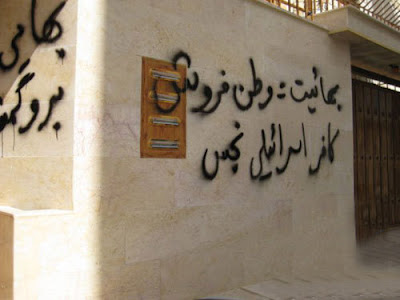
Anti Baha'i graffiti on a persons house in Tehran ,when translated to English , calls the owner "filthy infidel" , Israeli traitor.
The Baha'i faith is not recognized under the Iranian Constitution. Over 200 of its followers were executed after the 1979 Islamic revolution, while many Baha'i leaders were assassinated. Its followers are persecuted, arrested, frequently face judicial harassment and unfair prosecution, and are occasionally victims of extrajudicial killings, because of their faith.
Followers of the Baha'i faith are deprived of higher education, and persecuted in schools. They are prohibited from seeking employment in the public sector and their private businesses are subject to various types of unfair legal pressure and brutal administrative closures. In addition, private companies that employ Baha'is face great pressure from the authorities.
A campaign of raids on Baha'i homes and baseless arrests of Baha'is is currently unfolding across Iran. So far, dozens of Baha'i homes have been raided by authorities in Baharestan, Isfahan, and Shiraz, resulting in the detention of over 20 Baha'is and more who can be called to prison at any time. These raids and arrests are the latest in a long list of recent incidents of persecution, including the confiscation Baha'i-owned properties in the village of Ivel in Mazandaran Province, a confidential directive from the Commission on Ethnicities, Sects and Religions in the town of Sari in Mazandaran Province calls to monitor and suppress , the banning of the Baha'is of Tehran from burying their loved ones in land previously allocated to them in Tehran's Khavaran cemetery. Such incidents are nothing less than an extensive government campaign, the aim of which is the systematic eradication of the Baha'i community as a whole.
The Baha'i International Community is concerned that a recent intensification of the persecution of the Baha'is in Iran appears to be underway, signaling the implementation of a larger plan by the Iranian government to increase the persecution of the community, the largest non-Muslim Religious minority in the country.
Sunnis of Iran
The Sunnis are the largest minority in Iran. Twenty percent of Iranians are Sunny, they mostly live in the states of Kurdistan, Baluchistan and some in Khuzestan . The people of these states are systematically oppressed and deprived of governmental assistance. States like Baluchistan are deprived of water and are extremely poor. The most stupid recent event was when the governor of Baluchistan requested that people of Baluchistan should use less natural gas because of the shortages, the idiot did not know that his state does not have a natural gas system or its infrastructures.
The current sectarian and political differences between the Shiite and Sunnis are due in no small part to the Ayatollah Khomeini who instituted an Islamic government based on Shia religious principles. Although both Shiites and Sunnis are Moslem there is not even one Sunny mosque in Tehran.
Anti-Semitism
After the Iranian revolution in early 1979 members of the Jewish community feared for their lives, afraid that they would be murdered or expelled by the new Iranian regime. After the execution of prominent Jewish businessman Habib Elghanian on May 9, 1979, was publicized in local news outlets, the leaders of the Jewish community in Iran knew that they had to act fast in order to guarantee the safety of all Iranian Jews. The community leaders quickly assembled a group of two rabbis and four prominent young intellectuals and set off to meet with Ayatollah Khomeini in the Iranian city of Qom. After the group congratulated the Ayatollah on his victory over the Shah in the recent revolution, the Ayatollah gave a long monologue concluding by comparing Christianity, Islam and Judaism and saying that they are the only religions that are truly descended from heaven. The Ayatollah stated that in the Qur'an Moses's name is mentioned more times than the name of any other prophet. The discussion concluded with Ayatollah Khomeini claiming that "we recognize our Jews as separate from those godless, bloodsucking Zionists." This was the answer that the Jewish community leaders had been looking for At least 13 Jews have been executed in Iran since the Islamic revolution, most of them for either religious reasons or their connection to Israel Two synagogues in the Iranian city of Shiraz were vandalized during the last week of December 2017. The vandals ripped Torah scrolls, threw prayer books in toilets, soiled religious garments, and smashed various ritual objects. Shiraz has a Jewish population of approximately 2,000.
Reports vary as to the condition and treatment of the small, tight-knit community, and the population of Iranian Jews can only be estimated due to the community's isolation from world Jewry. Most are either too poor to leave or believe they would be less financially secure if they left the country.
The Islamization of the country brought about strict control over Jewish educational institutions. Before the revolution, there were some 20 Jewish schools functioning throughout the country. Most have been closed. Five remain in Tehran. Jewish principals have been replaced by Muslims. In Tehran there are still three schools in which Jewish pupils constitute a majority. The curriculum is Islamic, and Hebrew is forbidden as the language of instruction for Jewish studies. Special Hebrew lessons are conducted on Fridays by the Orthodox Otzar ha-Torah organization, which is responsible for Jewish religious education. Saturday is no longer officially recognized as the Jewish Sabbath, and Jewish pupils are compelled to attend school on that day. Jewish students who attend public school are required by the government to spend two to four hours a week on religious studies administered by the Jewish community.
Government officials continued to employ anti-Semitic rhetoric in official statements and to sanction it in media outlets, publications, and books. In an October 2 speech, IRGC Chief General Hussein Salami said Israel would be "wiped off the world's political geography." Government-sponsored rallies continued to include chants of "Death to Israel,"
Government officials continued to question the history of the Holocaust, and anti-Semitism remained a pervasive problem. In October 28 comments on his website and Twitter addressed to "young French people," Supreme Leader Khamenei questioned why it was a crime to raise doubts regarding the Holocaust. According to media reports, officials and media propagated conspiracy theories blaming Jews and Israel for the spread of COVID-19.
Christians
Christians from Armenian and Assyrian communities are recognized and protected by the state, but still treated as second-class citizens. They are not allowed to tell others about Jesus and have to speak in Persian during their church services. Persecutions has remained extreme in Iran, with an increase in the number of reported incidents of violence. COVID-19 has hit the country hard, and many Christians are in desperate need of food and aid. Measures to combat the virus have also made communication between Christians difficult, and they are increasingly exploring online fellowship and discipleship. Many Iranian prisoners, including some imprisoned for their faith, were released from prison in order to combat the spread of COVID-19 in packed jails. However, other Christians remained in jail and the sentencing of the Christians continued.
Christians from a Muslim background are most vulnerable to persecution from the government and from their communities. Government control is highest in urban areas, while rural areas are less monitored. However, the anonymity of urban areas gives Christians more freedom to organize meetings and activities than in rural areas.
Zoroastrians
When the Islamic revolution occurred in 1979, fundamentalist Shiites stormed the fire temple at Tehran. There, Zoroastrians worship in front of a blazing fire, as a symbol of God's grace, just like Christians face a cross and Muslims turn to a qibla pointing toward Mecca. The portrait of Zoroaster was tossed down, a photograph of Ayatollah Ruhollah Khomeini was put up in its place, and the congregation was warned not to remove the image of Iran's new leader. Only months later could the prophet's picture be mounted upon an adjacent wall.
Their schools and classrooms began to be covered with images of Supreme Leaders Ayatollah Khomeini and Ayatollah Ali Khamenei and with verses of the Quran that denounce non-Muslims. Those who do well academically nonetheless find no openings within state-controlled universities.
When the bloody war with Iraq raged from 1980 to 1988, young Zoroastrians were involuntarily drafted for suicide missions in the Iranian army. Rejecting the Shiite mullahs' claim that military martyrdom would lead them to a heaven full of virgins was futile. Failing to offer their lives on the battlefield could result in execution for treason.
Then in November 2005, Ayatollah Ahmed Jannati, chairman of the Council of Guardians of the Constitution, disparaged Zoroastrians and other religious minorities as "sinful animals who roam the earth and engage in corruption."
Their tottering political base has sharpened the Shiite clerics' ire. Like members of the Zoroastrian minority. Zoroastrian activists who protest the theocracy's excesses are sent to Tehran's notorious Evin prison on charges of sedition. At the ayatollahs' instigation, Iranian media characterizes the followers of Iran's ancient faith as polytheists and devil worshipers. Lesser mullahs rant against Zoroastrians not only in Iran, but even at mosques in Toronto.
The Zoroastrian cemetery outside Tehran now faces another challenge: The municipality seeks to lay a highway through it. Some schools and devotional centers in other Zoroastrian strongholds like Yazd and Kerman have also been notified of pending annexation. Communal gatherings are routinely monitored by fundamentalist Muslim authorities who allege that Zoroastrianism "threatens national security and subverts the Islamic revolution."
Protections offered by the Islamic Republic's constitution have been rendered meaningless in practice. Not surprisingly, the daily regimen of discrimination makes Zoroastrians feel wholly unwelcome in their Iranian homeland. Only between 35,000 and 90,000 now remain in a country of approximately 74 million citizens - and, fearing persecution, many do not readily identify themselves as Zoroastrians.
The Zoroastrian community has survived centuries of conquest, oppression and forced conversion to keep their 3,200-year-old monotheistic faith alive and guard ancient traditions in Shiite Muslim majority Iran. But having withstood the ravages of history, the community is now threatened by emigration, which is robbing the Zoroastrians of their precious youth day-by-day. Precise figures of the scale of the exodus are not available but sources in the community estimate that at the very least hundreds of young Zoroastrians are leaving Iran for the United States or Canada every year.
The Gonabadi Dervishes
The Irony about Dervishes is that they are all devout Moslems and follow the mystic version of Islam. The Gonabadi Dervishes believe that their faith in Islam is not based upon jurisprudence, but love, which is "an Attribute of God" and confirmed implicitly in numerous Qur'anic verses Accordingly, Dervishes share a common transcendent motif and seek the spiritual concept of unity. Their intended concept of unity indicates tolerance and friendship, not intellectual conflict. As a Gonabadi Dervish stated, "[Dervishes] have studied the book Ikhwân al-Safâ' (The Brethren of Purity).This book says that Zoroaster is the same as Mohammad and Jesus Christ. All of them were sent by God, so we have one God, and during the period of religious wars, suggested peace over the concept of God."
At the end I should emphasize that all of these minorities are extremely religious and politically they are of no threat to Islamic Republic of Iran.
.
(Article changed on Nov 18, 2021 at 2:53 AM EST)
Authors Bio:
I was born and raised in Tehran, Iran, and came to the United States in 1976 to study psychology. Over time, America became my home, and I later became a U.S. citizen. My professional career has centered on clinical neuropsychology, particularly the evaluation and rehabilitation of patients with neurological disorders and stroke. I also spent many years teaching and mentoring students in academic settings, including at Northeastern Ohio Medical University. In addition to my clinical work, I have been involved in research on neurological conditions, including hemianopsia, and have written articles and books on a variety of subjects. Growing up in the Middle East during a period of profound political and geopolitical change fostered an early interest in history, regional affairs, and international politics. As an undergraduate, I minored in Iranian history, and for decades I have maintained a strong personal interest in military affairs, strategic studies, and the psychology of political leadership. These interests have complemented my professional work and continue to inform my analysis of international conflicts. My interests have always extended beyond psychology. History, anthropology, politics, and culture have long fascinated me, and they continue to shape both my writing and my understanding of human behavior. Much of my work explores the intersection of psychology, leadership, history, military strategy, and international affairs. Today, I am semi-retired and devote much of my time to writing, reading, painting, producing educational podcasts, and playing the Tar, a traditional Persian instrument. Having lived under very different political and cultural systems, I have developed a deep appreciation for freedom of thought, critical inquiry, and open dialogue. While I do not follow a particular religion, I respect the important role that faith plays in the lives of many people. Above all, I remain curious about the human condition and committed to understanding the forces that shape individuals, societies, and history.