| Back OpEd News | |||||||
|
Original Content at https://www.opednews.com/articles/Black-Like-You-Life-As-A-by-John-Hawkins-Alienation_America_Black-Community_Black-Family-210204-667.html (Note: You can view every article as one long page if you sign up as an Advocate Member, or higher). |
|||||||
February 4, 2021
Black Like You: Life As A Horror Movie
By John Hawkins
TV Series Review: Lovecraft Country. The 10-part Season 1 has finished and Season 2 begins in August. It's a Jordan Peele-influenced series, so features what might be called political horror; monsters that prevent integration into the reality we all share to varying degrees. As if in agreement with the Black position, when traditional fantasy monsters do show up they seem to prefer white meat. Well-acted and great soundtrack.
::::::::
Black Like You: Life As A Horror Movie
by John Kendall Hawkins
" I'm Black, they'll never let me forget it. I'm Black alright; I'll never let them forget it."
-Miles Davis, Tribute to Jack Johnson
"Don't call me n-word, whitey / Don't call me whitey, n-word."
-Sly and the Family Stone, Stand!
I try hard but fail to imagine what it would be like to wake each morning self-consciously aware that my skin color - Black - will matter most today when I make my out into the Mighty Whitey's world.
What would I do if I couldn't process away that self-consciousness, work off its karmic influence through my dreams? Fantasize it away in my sleep? Fight it as a kind of panoptic monster? Resolve it in the acid tests of reason? What would it be like to wake up each day and set about in the world knowing I'm Black, knowing that whites see first my Black -- in their looks, in the subtleties of their body language, even, as with friends, in their seeming need to show they're cool with it. With my being Black. The Black elephant in the always well-lit white room.
I can't imagine being Black, to be Richard Pryor or Eddie Murphy, making people laugh at the horror of being alive, making the invisible risible, knowing that, as tough as my life has been, full of outrageous fortune, that when I look in the mirror and pull my skin, I see that it's white and know that I'll be able to blend in just fine, fade to white.
In the recent (and renewed) HBO horror series, Lovecraft Country, there's a scene in "Jig-a-Bobo," a late episode that sees Black blues singer, Hyppolyta, confront Christina, a white wraith-like witch who has been donning a Nordic-looking white male body to hump Hippolyta, consensually (it's complicated), about how she feels after the recent funeral of Emmett Till:
Hippolyta: A 14-year-old boy was beat and shot to death, then tied with barbed wire by the neck to a cotton gin fan and cast into the Tallahatchie River.
Christina: [matter of factly] I know.
Hippolyta: But do you care? At all?
Christina: You want me to say Yes.
Hippolyta: I don't want you to say anything. I want you to feel what I feel right now. Heartbroken. Scared. Furious. Tired. So f*cking tired of feeling this way over and over. And I want you to feel alone and shameful, 'cause I'm here, feeling this, and you will never understand it. I want you to feel guilty 'cause...For feeling safe next to you and your privilege".
Christina: No.
Hippolyta: What?
Christina: I don't care about Emmett Till....
Hyppolyta might be interrogating all whites about their souls and substance. Most of us would answer Yes, we care - each and every time there is another Black Man Down. Christina answers honestly, but does gets to work thinking more about it.
Lovecraft Country is based upon the same-named movie treatment-turned-novel (2016) by Mark Ruff. He's written a few novels of some modest acclaim, but this is probably Ruff's diamond, certainly it's his ka-ching. The story begins when Atticus Freeman (Jonathan Majors) returns home from Daegu, South Korea, where, aside from battling commies, he was married to a witch (Ji-ah, played by Jamie Chung) who is able to see his future when they f*ck and he has an orgasm, as if a portal in his psyche opens up before her. The two share a cultural legacy of racial vilification that binds them - him by slaver capitalists, her by the Japanese occupiers ultimately responsible for the division of her country, North and South.
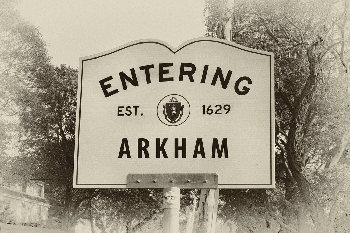
When he returns home, Atticus immediately hooks up with childhood friend Letitia (Jurnee Smollett) and his uncle Montrose (Michael Kenneth Williams) for a road trip adventure in search of his missing father. Narratively, we're told they are driving from the Chicago area to a place called Ardham in Western Massachusetts, but they could be driving through the South, given the crackers and fascist cops they come across, an adventure that includes a near-execution experience in Mass. when cops lead them into the woods only to see them saved by multi-eyed monsters straight out of Revelations, the scariest book of the Bible, who chew into and demolish the cops.
(You can imagine a movie theatre where such a scene would have led to a standing O. I'm not big on horror, but I was okay with a scene where the would-be, beset-upon desaparecidos were rescued from the cheesy Jim Crow crackers by the vengeful Jesus forces When He Returns.)
It turns out that Ruff's novel title is ironic, in that the whole country is a place of horror - Lovecraft country -- for Black people trying to make their way, this way and that, from one Green Book safe inn to another without getting themselves lynched. There is no friendly North and evil South - it's all nasty.
Lovecraft's horror is unique; it is widely known for its excursions into existential zones that are akin to Twilight Zone experiences, but with monsters and the fantasial. As Lovecraft writes, in his short craft piece "Notes on Writing Weird Fiction,"
I choose weird stories because they suit my inclination best -- one of my strongest and most persistent wishes being to achieve, momentarily, the illusion of some strange suspension or violation of the galling limitations of time, space, and natural law which forever imprison us and frustrate our curiosity about the infinite cosmic spaces beyond the radius of our sight and analysis.
On top of such ordinary imprisonment, Blacks are doing integumentary time; the worst kind, for which there is no escape. How do you lose your skin?
An exploration of such "strange suspensions" and "violations of limitations" is a major engine of Lovecraft Country, which is full of magic; voodoo-esque spells, intoned with what sounds like Haitian French; time travel portals; and monsters -- all intertwined with the illusions of normal reality, which, for Blacks in the 50s (the period of the narrative), included sudden lynching in a Jim Crow world, South and North. It's useful to keep in mind that Lovecraft was himself a racist, "a product of his time," as some apologists have noted, but a white trying to break on through to the other side of his ignorance. For Lovecraft, it is time that is unfathomable, but probe-able. He writes,
The reason why time plays a great part in so many of my tales is that this element looms up in my mind as the most profoundly dramatic and grimly terrible thing in the universe. Conflict with time seems to me the most potent and fruitful theme in all human expression.
Time is a constrict. And neither Lovecraft nor Ruff will let us forget it. History, memory are fragile and malleable constructs - another reason to worry about the hivemind ahead, speaking of horror.
Lovecraft suggests that the means to accessing the escape from time can be found in certain moods that remind us of our own alienation in the cosmos; we were barely the center of all things to begin with, relying on a bearded White Guy in the Sky to guide us (but mostly not help us), and we've discovered over time, especially in the postmodern period, that have never been more alone, given our prodigious planetary problems, with only each other to solve them. Lovecraft's mood seems to correspond roughly with what Freud referred to as the Uncanny experience. Freud writes in The Uncanny (1919), "The better orientated in his environment a person is, the less readily will he get the impression of something uncanny in regard to the objects and events in it." The Black experience is sometimes one of debilitating disorientation. The Father, Son and Holy Ghost (say, id) out of whack. There's a fissure of the unexplainable opened up amidst our ordinary existential alienation.
Zora Neale Hurston seems relevant here, too. She went exploring after certain Black-only phenomenon in Haiti, the Caribbean, and the Deep South, wanting to get to the core of certain mechanisms of coping, such as voodoo practices. While she performed anthropological analyses on her raw data in the field, in the end, when asked to explain voodoo, she said: "If you want to understand, believe." This simple approach could apply to White Man's capitalism, its introjections and zombie-like transformations of persons into rabid consumers - If you want to understand capitalism: believe. It will all have a patina of the wyrd and fetishistic, incomprehensible to those kept from its magic secrets by, say, the transformative power of equal opportunity.
Just as the Green Book is a thoughtful tool for Blacks to plot out their escape from the cell of their local circumstances, books, in general, are important in the series. We all read fiction, non-fiction and sci-fi to escape time and space, performing the page in our minds to the limits of our vocabulary and building (if we keep a dictionary handy) on it to enhance our future performances, and fantasies of reality. Atticus especially is fond of reading. He is most pleased in bookstores and, later, as a guest in a mansion, to discover Lovecraft and other favorite "escape" fiction in his room. (As a whimsical narrative inclusion, Atticus, toward the end of the first season of episodes, carries Ruff's book as another statement about time.) And ultimately, Tic, Leto, Montrose and Hyppolyta (Leti's sister) are in search of the missing pages from the Book of Names in which their family's entry is crucial to the plot. Think Ancestry.com with compelling evil events thrown in around every genetic corner.
On the cover of Ruff's novel is a little splash blurb that reads: America's Demons Exposed! We're not talking the monsters here, but the Mighty Whitey. And the actual multi-eyed monsters, when they do tunnel up from the earth, seem to prefer white meat. Again, it's all Lovecraft country -- "We're surrounded by monsters all around us," as Atticus puts it at one stage. And there's an edge, of the kind Hyppolyta describes above, a seething hatred in response not only to injustice but also its attendant sadism and depravity.
The seeming god complex of whites, what Hyppolyta describes as their sense of "privilege" for merely having been born into the world with the right skin color is unnerving. In episode 2, with scenes filled with deprecation, a soundtrack reminds of the often-unspoken resentment, Gil Scott-Heron sings,
A rat done bit my sister Nell
With Whitey on the moon
Her face and arms began to swell
And Whitey's on the moon....
And on it goes, the constant reminder of integumentary imperialism, with no relief.
The monsters gobbling up the cops, in the scene described above, is not the only moment of 'comic relief' in the series, though definitely infrequent. In episode 3, a subtle raspberry is blown at crackers unhappy that Leti has moved into a white neighborhood and opened a boarding house for Blacks. Now the neighborhood is teeming with people of color. To drive her out, local whites park their cars with bricks tied to the horn, creating a bonkers-inducing cacophony. Eventually, an enraged Leti smashes the windows of the cars and knocks the bricks off, and you can't help but think she's momentarily shutting up the honkies.
The series is executive-produced by Jordan Peele, and one notes his familiar touches in Lovecraft Country. The sense of a doubled self is present, as it is in Us (2019) with the doppelgänger experience that suggests the schistic life of being Black -- one for the horror show outside oneself in the white world -- a persona non gratis, as it were -- in existential conflict with the subject's ego, his r her real self, as if under the constant ordeal of parasitical introjection. And even taking succor in the company of other Blacks is manifested through an exclusive African American Vernacular English (i.e., ebonics); itself a rejection of the King's English.
In Lovecraft Country this phenomenon is most evident when Hyppolyta's daughter, Diana, is stalked by two terrifying girls, Topsy and Bopsy, who are vaguely reminiscent of the twin girls from The Shining., whose grins and acrobatics foreshadow evil events ahead. Echoes of Get Out! (2017) occur in the demonstrative need of whites to not only psychologically damage and dominate Blacks, but, in the case of Hyppolyta especially, to actually cover a Black body with a husk of their own white body; sex scenes are almost like molting exercises, one body irrupting from another.
In Get Out! introjection takes on more intensity when a cabal of whiteys regularly kidnap Blacks and arrange to have their white brains emplaced in the Black bodies. This is horror at its best, but also funny, suggesting that deep-down many whites are envious of the soul and poetry and rhythm of the pain-driven African American experience - and want to own that, too, as a commodity.
Jordan Peele got together with Keagan-Michael Key to produce a fantastically funny skit series, Key and Peele, where the two play out another layer of the color caste system that Blacks are forced to live with: Skin tones. In their introductory comments to the audience in season 1, episode 1, the two note that they are biracial, the product of Black and one white parent. The schism seems, they say, to require them to role-play back and forth between a white identity and Black. Or as Key puts it, "We lie." Peele nods and adds, "To scare white people." They are constantly aware that they make whites self-conscious with the audacity of their Blackness. Key and Peele is a comedy series, and Lovecraft Country is horror, but it all goes together in a way unique to the Black experience. (Who doesn't remember Richard Pryor, in his prime, describing how he accidentally lit his hair on fire while freebasing cocaine?)
Even Key and Peele seem to be referring back to Frantz Fanon and some of the things he said about skin color and race relations, in Black Skin, White Masks (1986):
The white man is sealed in his whiteness.
The black man in his blackness
This sealing off is so evident in Get Out! -- but perhaps equally so in the 'molting' scenes of Lovecraft. The desire to get out of our skin and its limitations. Thus far, it is a failed interpenetration of white and Black; a fact that the legacy of slavery, combined with simple color, cannot readily overcome. Fanon cites Hegel, and one thinks of his famous master-slave dialectic that is universal and the resolution of the thesis and antithesis in a new synthesis of co-understood need for each to progress in history.
Earlier, I pointed out a scene in which Hyppolyta questions Christina's ability to feel the suffering of others (or, at least, of Blacks), soon confirmed explicitly by the latter. But that's not the end of it. Later in the same episode, Christina pays some crackers to do to her what was done to Emmett Till, in one of the more bizarre scenes in the whole series. We watch as they beat the living sh*t out of her, choke her with a coil of barbed wire, tire her feet to a weight and dump her in the Tallahatchie River, where she sinks. The thugs leave, and a few moments later, Christina crawls back onto the pier sobbing, seeing, understanding. The problem is her motivation for gaining this empathy function. Like a drowned witch at Salem, she floats up where innocence fails. And she desperately wants to connect emotionally with Hyppolyta in order to procure missing pages from a book of magic spells that would make her perhaps unstoppably evil. White devil indeed.
Recently, I watched the film version of Horror Noire: Blacks in American Horror Films from the 1890s to Present (2011) by Robin R. Means Coleman. Given the unique experiences of many, if not most African Americans, the genre would seem to be a comfortable fit for Blacks -- and, indeed, has been, says Coleman, for quite some time. She says in her introduction:
The horror film is fascinating if for no other reason than that it prides itself on snuggling up next to the taboo, while also confounding our sense of good and evil, monstrous and divine, and sacred and profane. It is one of the most intrepid of entertainment forms in its scrutiny of our humanity and our social world.
It is an excellent venue for considerations of warped time, the Uncanny, and the search for true identity -- the latter an especially meet subject in late postmodern reflection. We can all relate -- Black and White -- to the constructs and deconstructions of time, and it is perhaps a place to find a common language for our common alienation, and a way for us all to finally get beyond it together.
Lovecraft Country Season Two begins in August. It's worth a viewing on HBO.
Authors Website: https://tantricdispositionmatrix.substack.com/
Authors Bio:
John Kendall Hawkins is an American ex-pat freelance journalist and poet currently residing in Oceania.