| Back OpEdNews | |||||||
|
Original Content at https://www.opednews.com/articles/Marta-Steele-Author-Acti-by-Joan-Brunwasser-Activist_Author_Books_E-books-190210-452.html (Note: You can view every article as one long page if you sign up as an Advocate Member, or higher). |
|||||||
February 10, 2019
Interview: Marta Steele, Author, Activist and Senior Editor at OpEdNews
By Joan Brunwasser
I was brought up by activist parents, ardent Democrats. Around the dinner table and even during the day, there'd be constant complaints about the status quo and how it must be changed and whose fault it was and "go fight city hall!" I did, vociferously, at college and, of course, joined the "Children's Crusade" and attended rallies and meetings, including the historical Yippie parade in front of the Justice Department in 1968.
::::::::
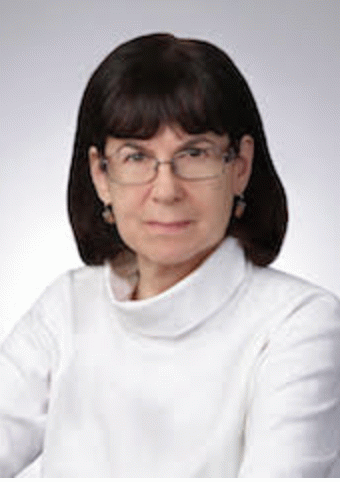
My guest today is Marta Steele, political activist, author, colleague and also a Senior Editor at OpEdNews.
Joan Brunwasser: Welcome, Marta. A few years back, you wrote the highly-regarded Grassroots, Geeks, Pros, and Pols: The Election Integrity Movement's Rise and Nonstop Battle to Win Back the People's Vote, 2000-2008, [Columbus Free Press, 2012]. You've been in the trenches for a long time. I know that you come from an academic interest in linguistics, can you tell us what led to your passion about politics and election integrity?
Marta Steele: Thanks, Joan. As a student of classical philology and Indo European linguistics in college and grad school, I developed deep and hugely detailed research skills and the sitzfleisch to explores various categories of information--all on paper in those days.
JB: Okay. I see that being able to look long and deeply helped your research in your new field of interest. But why was the study of recent elections compelling to you?
MS: I came upon it inadvertently--well, not exactly. I was furious about the hanging chads fiasco in Florida Election 2000. What I began to protest was media indifference to it. At the first relevant protest I attended, I heard about Greg Palast's discovery of tens of thousands of voters illegally struck from registration rolls there, accused of felonies they never committed (for the magisterial, pristine article, click here). Combatting election corruption became my predominant theme. This man's findings merited attention, lots of it. His remarkable accomplishments and brilliance can be appreciated, researched, and supported at his website.
JB: Yes, Greg Palast, and Brad Friedman (BradBlog), Bev Harris, Harvey Wasserman and Bob Fitrakis, Mark Crispin Miller, Jonathan Simon, Steven Rosenfeld, etc. have done a great job exposing the dark side of elections' dark side to their readers. Can you give us an idea of what themes you explored in your book, Marta? Many of our readers are not yet familiar with it.
MS: Sure, Joan, I do write about and quote all of these giants of the movement. Back in 2010, my goal was to write a history of how the people's choice finally prevailed in 2008 after having been squelched for eight years. Of course, history didn't stop there and more atrocities waited in the wings. I highlighted those incidents I found most outrageous and profiled the heroes who fought back. There was Election 2002 in Georgia, which was fixed by the president of Diebold to eliminate some prominent liberals from the congressional map, like Rep. Max Cleland, who was ahead in the pre-election polls but got trounced on Election Day. There was another fiasco in the Florida 2002 primaries--the Sunshine State had panicked because of the hanging chads and butterfly ballot tsunamis and purchased touchscreen machinery that malfunctioned massively. This type of fiasco would repeat itself again and again once the Help America Vote Act (HAVA) was passed late in 2002 and flocks of others rushed in to buy more of these awful, totally corruptible contraptions.
Other states, saner, went for optical scanners, which at least preserve a paper record of each vote cast--handwritten, that is, though getting recounts is often quite costly and otherwise like pulling teeth. Ohio 2004 was another historical fiasco whose crucial underpinnings weren't revealed until 2008--I describe the discovery of the man-in-the-middle device designed by the late GOP computer guru Mike Connell that subtracted 200,000 votes from Kerry and added them to GW Bush's total, winning him the Buckeye State by 120,000 votes.
Many other types of corruption became evident in this decider state to hand Bush II the victory, as detailed in Chapter 4 of my book. Ohio Secretary of State Kenneth Blackwell was complicit with Diebold in Ohio's pseudo-Republican victory as were Bush and Rove, who were seen in a Columbus meeting with Blackwell on Election Day-- summarizes the mechanics of the vote heist that Bob Fitrakis, Harvey Wasserman, and Cliff Arnebeck fought against so effectively. Mike Connell became a star witness to Rove's connivings in 2008 but was killed in a very suspicious crash of his private plane before he could "spill all," as he had planned to in a second hearing. The first deposition, held on November 6, 2004, revealed a connection with the corrupt vendor and service provider Triad; this revelation swayed the judge to rule in favor of the Election Integrity (EI) attorneys. "Our" attorneys managed to elicit that, even though Rove's lawyers objected to every question that they asked Connell. This event I detail in Chapter 8 of my book.
JB: I don't recall that meeting but I've probably blocked the memory because it was so disturbing. Very interesting.
MS: I discuss the man-in-the-middle device in Chapter 8, one of the high points of the book. Other hair-raising anecdotes abound, including the 18,000 votes lost in another congressional election, in Florida again, Sarasota County, in 2006. The votes were never recovered; the problem was attributed to errors at the level of the digital machinery. The Republican candidate, Vern Buchanan, was ahead among the votes that were counted by a minuscule 300-some votes. Because paperless DRE (direct recording electronic) machinery had been used, the election results couldn't be recounted. But he was seated in Congress while Christine Jennings, the Democratic contender, filed a lawsuit protesting that decision. Those are some of the main events of condoned skullduggery with lasting impact.
The stampede toward DREs began late in 2002, direct recording electronic, or touch-screen machinery that doesn't leave a paper trail, in violation of HAVA (the Help America Vote Act 301(a)2]; many state constitutions also required them). The stampede was encouraged, financially and politically benefiting several corrupt entities, including the infamous lobbyist Jack Abramoff, associated with HAVA's co-sponsor, Rep. Bob Ney--both of whom ended up serving time in prison. The voting machine vendors (ES&S, Diebold, etc.), generous contributors to the GOP, also had much to gain from migration to their infinitely corruptible systems. [My book is chock-full of similar anecdotes. I try to cover all levels from the precinct up to the feds.]
It turns out to be, from a nearly 20-year perspective, a good handbook for people wanting to join the EI movement and needing background on how and why we started and what happened once we did. I'm working on a sequel, covering the years 2008-2012, "Up against a Wall of Fire: Election Corruption and the Fight Back, 2008-2012," which is coming along slowly. The direction is so obvious but I want to cover all bases and do refer to subsequent events also, an awareness of where we were going and sort of an I-told-you-so when we got there in 2016.
JB: Yikes! Writing that first book must have been both exhausting and discouraging. Did you find anything to be optimistic about at that time? And, by the way, I love the title for your new book!
MS: Joan, good question. Optimistic? I celebrate the amazing brilliance, dedication, and pro bono hard work of the GGPP (grassroots, geeks, pros, and pols) some of whom I've mentioned above. I truly believe that nothing is beyond their abilities, even unscrupulous GOP skullduggery. How many lives have been lost because the wrong people were placed illegally in high places--the Iraq and Afghanistan wars, for example? It is mind-boggling. We must continue to fight against election fraud that so violates the people's will.
The good news is that even within the first decade of the two thousands, many states realized the vast shortcomings of the DREs and traded them in for optical scanners, which facilitate recounts. These machines should be required throughout the country; 25% among the states still voted on DREs in 2018 and among those planning to change over --Georgia, for instance there is a state-of-the-art option that for all intents and purposes is a DRE clone, ES&S's ExpressVote, which is also far more costly and less efficient than opscans and that is Georgia's targeted product even though the same company also manufactures optical scanners. Another example of what can happen when the people mobilize, putting aside their differences for the collective good, occurred when for Election 2008 the people rallied together--Democrats and Progressives--to put Obama in office. The Election Integrity movement is nonpartisan, though lately weighted toward Democrats, who have suffered most from corruption in every category. But benefits accrues when differences are overcome. There is so much that can be accomplished to "make things better."
JB: Thanks for the recap. And the reminder that everything is not grim. That brings us to the recent midterms. What's your take?
MS: As much as there was a blue sweep, and different people have different views on this, there is reason for optimism. That the country wasn't dyed blue doesn't speak well for the American public, given the red sweep that drowned us in 2016 and the violations of the US Constitution and its laws at every level that have occurred since then. The number of voters increased, especially women, and the number of women in office increased. What does this mean? I guess that's off our subject, elections. (Dare I say that people are expressing a desire for more feminist values--peace and absence of corruption?) The number of voters who showed up to vote in a midterm election is also the highest on record.
There were so many close elections, one of which amounted to a margin of two votes, which will be recounted. Do so many close elections indicate an even split between voter ideologies? I don't think so. Given the rampant roadblocks to a fairly counted election, one that genuinely reflects the people's will, a close election could be a glaring sign of corruption, vastly exacerbated by the photo ID requirement and perhaps the worst villain of them all, gerrymandering. Not that everyone voted Democratic, but with the Georgia gubernatorial election as the glowering epitome, with 334,000 struck from the voter rolls, the number of would-be Democratic voters was far greater than the number of Democratic votes counted.
And consider this: a recent poll indicated that a majority, more than 60 percent, of Americans favor progressive policies. No one wants a corrupt government except the perpetrators of corruption and those who profit from it and those convinced mistakenly that it is ideal--a minority. A handful. Now we have one arm of one of the branches of our federal government blue--the branch that most accurately reflects the will of the people, the House of Representatives. That in itself also speaks volumes.
JB: Indeed. The mainstream media have continued over the years to pooh-pooh concerns about election integrity, notwithstanding the hard work of Palast and the other Good Guys. And readers tend to follow the lead (or non-lead) of the mainstream press. How do you explain that?
MS: Ouch. Our heroes are pretty left of center. But some among us aren't. I guess one perspective is that all the channels, to my knowledge, are owned by fat cats (to revive a very dated term) and the fat cats live off money and greed, not concern to promote the general welfare. I asked Greg what to say when someone called me a conspiracy theorist. He said, "we're conspiracy experts." He's been interviewed on MSNBC a few times. All of the heroes you mentioned before are dynamite in front of cameras. Despite the "cats," we're getting more MSM attention than we used to, and the whole concept gained visibility with Trump's accusation of voter fraud committed by all voters in Hillary's lead of three million in 2016. Some MSM covered Trump's bogus commission dissolved in January, which was meant for no other purpose than to prove that ridiculous voter fraud theory. And the Georgia heist was pretty well publicized, though I wasn't watching Fox to get their take on it.
JB: However much exposure those intrepid election investigators - again, Greg Palast, and Brad Friedman (BradBlog), Bev Harris, Harvey Wasserman and Bob Fitrakis, Mark Crispin Miller, Jonathan Simon, Steven Rosenfeld - and their ilk are getting is in a word, or two - NOT ENOUGH. They're drowned out by the mainstream journalists who either don't understand what's going on or are forbidden to talk about it and who dominate the conversation.
MS: Good point about the media; I didn't mean to imply that we were receiving the coverage we need; only that the mercury has moved up the thermometer by one or two degrees--thanks for the clarification.
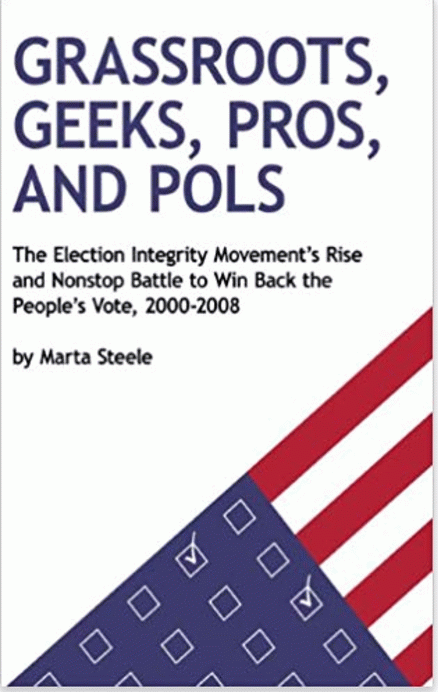
Cover art for Marta's Book: 'Grassroots, Geeks, Pros and Pols', [Columbus Free Press, 2012]
(Image by courtesy of Marta Steele) Details DMCA
JB: Speaking of journalists, you are one as well. You ended up writing a book and are at work on another. Can you share with us how you went from being a concerned citizen to becoming an activist? So many folks care a lot but haven't a clue about how to engage.
MS: Joan, I was brought up by activist parents, ardent Democrats. Around the dinner table and even during the day, there'd be constant complaints about the status quo and how it must be changed and who's fault it was and "go fight city hall!" And how can such horrible people (the Russians) write such beautiful music? Etc. My daughter told me I did the same thing when she was a little girl, pacing back and forth across the living room and expounding at her. I had learned from my parents that when things were wrong, we should speak out and that I did, vociferously, at college and, of course, joined the "Children's Crusade" and attended rallies and meetings, including the historical Yippie parade in front of the Justice Department in 1968.
What else could I do? Work with handicapped populations, which I did (as a volunteer and then professional), and underprivileged ones. I only got to writing as an activist while working as an academic editor. I was put in charge of the company's newsletter and began inveighing against the candidacy of George W. Bush and the abuse being heaped upon Bill Clinton. I'm surprised I lasted as long as I did as editor-in-chief, but my torch was lighted and once I left the press, I continued the newsletter under my own logo, Words, UnLtd., as a paper publication from 1999 to 2003. I sent it out to friends and colleagues, headlining political issues but expanding into many other terrains as well, each with a different pseudonym.
Politics became my main focus once Florida 2000 happened. I was a writer in search of a subject when I first learned of Greg Palast's discovery. I have written about him ever since, but after Florida 2000 came 9/11 and the Afghanistan invasion and Iraq War. They took over Words for a while; I haven't stopped since then. My book grew out of my involvement with EI once Election 2004 occurred and the grassroots caught on fire. The small group of six women from Bucks County, Pennsylvania, who responded to an ad for election integrity advocacy, turned into a force to be reckoned with, the Coalition for Voting Integrity, at the county level. Our leader, Mary Ann Gould, started a radio show, "Voice of the Voters," interviewing heroes of the movement. I'd blog about them and that's how I first joined OpEdNews, by offering my blogs to Rob as well as posting them at my own site, Wordsunltd.com. Rob lived in Bucks County and we met at an EI gathering; he had read my writing on other sites.
The blogs came together into knowledge and commitment that gelled into a long article I was commissioned to write. By the time I got done with it and the editor turned it down, I turned away but went back to it soon and said, "This is the germ of a book, dammit." Oh, there's so much more: Calling up Bob Fitrakis to thank him for saving our democracy when he and his colleagues saved Ohio for the Dems in 2008. (That's another amazing story I tell in my book) I told him, "Someone should write a book about you!" Guess who that turned out to be?
JB: Wow. About Bucks County and Mary Ann Gould and Rob Kall, that's how I got involved with OpEdNews! I was distributing a documentary about electronic voting machines called Invisible Ballots. I had seen it in the summer of 2005 and thought that, given our very short attention span, a movie could be a great vehicle for raising awareness on this critical issue. I ended up sending a copy to the Bucks County organization that you all belonged to and one thing led to another and Rob invited me to be Election Integrity Editor. Life is so serendipitous! So, tell us a few of your pseudonyms. I love that you customized identities for each of your issues.
MS: Joan, what a small world it is. I never heard your name until I became involved with OEN. Pseudonyms? Posthumus T. Peppercorn inveighed against generic injustices, a grouchy old crank--probably my parents reimagined. He was an early one. Severina Grammatica wrote about grammar and Severina Linguistica, about language and linguistics. AC wrote about classics and then became Philhellenica Antiquaria. And so on. Severinagrammatica became my first email handle.
JB: I love it! Particularly the Posthumus T. Peppercorn.
MS: Thank you! Wow, Bucks County, where I first became an activist, is considered a bellwether of the national vote. It is so moderate as a whole: blue collar in the south and upper echelon in the north. We attended one event where kids were playing polo! Amazing. Mary Ann? An experienced and savvy political strategizer. The late Mardi Harrison (RIP--she died very recently, a dedicate attorney and progressive activist) held a gathering at her horse farm where two Democratic candidates for Congress were speaking.
It was at Mardi's event that I first met Rob and then visited OpEdNews. I immediately got into it and am amazed at the breadth of its coverage and the insights it offers. Rob never runs out of topics himself and his knowledge of the issues is global and all-encompassing. A great mouthpiece for the progressive movement. Mary Ann never ran out of devices to add depth and dimension to our projects. And what a spectacle we -- the Coalition for Voting Integrity -- were at the bimonthly Bucks County commissioners' meetings. Public discussion, input, and Q and A followed business topics and we always lined the front row, us "loud-mouthed broads," with our questions and protests. It is so enlivening to speak truth to power.
JB: It sure is! What thought would you like to leave us with, Marta, before we wrap this up?
MS: My involvement with EI has been such a positive force in my life--providing important perspectives on so many different levels of life and, uh, truth. My author page at OEN proceeds from simple blogs all the way up to the complicated and ominous present--there are so many of them: it contains a few out of hundreds of issues. I hugely advocate activism to all, whatever you believe in--that's what democracy is all about, and keeping it alive: speaking truth to power, acquiring power and then using it in good ways!!!
What do you think, Joan? Is that possible without taking bullets and dropping dead? Get active, America, and take back our lives and everyone's, throughout the world. Get active.Join EI! Find my book at freepress.org/store.php, or here .There are ebook versions out there and at Amazon, you can get it for your Kindle.
JB:You raise a good question, Marta. I really don't know if it is possible to speak truth to power without paying a price. But what's the alternative? Thanks so much for chatting with me. It's been such a pleasure. I love hearing about how you got to where you are today. I hope your tale will inspire others to take the plunge!
MS: Thank you, Joan, for your insightful and inspiring questions and for listening to all of my sagas. Plenty more where they came from!
JB: That's good to know. I'm looking forward to future installments. You're quite the storyteller. Stay tuned, dear readers!
***
Coming soon, Marta's new book: Democracy Is a Verb: Election Corruption and the Fight Back, 2008-2012 (Columbus: CICJ Books)
Authors Website: http://www.opednews.com/author/author79.html
Authors Bio:
Joan Brunwasser is a co-founder of Citizens for Election Reform (CER) which since 2005 existed for the sole purpose of raising the public awareness of the critical need for election reform. Our goal: to restore fair, accurate, transparent, secure elections where votes are cast in private and counted in public. Because the problems with electronic (computerized) voting systems include a lack of transparency and the ability to accurately check and authenticate the vote cast, these systems can alter election results and therefore are simply antithetical to democratic principles and functioning.
Since the pivotal 2004 Presidential election, Joan has come to see the connection between a broken election system, a dysfunctional, corporate media and a total lack of campaign finance reform. This has led her to enlarge the parameters of her writing to include interviews with whistle-blowers and articulate others who give a view quite different from that presented by the mainstream media. She also turns the spotlight on activists and ordinary folks who are striving to make a difference, to clean up and improve their corner of the world. By focusing on these intrepid individuals, she gives hope and inspiration to those who might otherwise be turned off and alienated. She also interviews people in the arts in all their variations - authors, journalists, filmmakers, actors, playwrights, and artists. Why? The bottom line: without art and inspiration, we lose one of the best parts of ourselves. And we're all in this together. If Joan can keep even one of her fellow citizens going another day, she considers her job well done.
When Joan hit one million page views, OEN Managing Editor, Meryl Ann Butler interviewed her, turning interviewer briefly into interviewee. Read the interview here.
While the news is often quite depressing, Joan nevertheless strives to maintain her mantra: "Grab life now in an exuberant embrace!"
Joan has been Election Integrity Editor for OpEdNews since December, 2005. Her articles also appear at Huffington Post, RepublicMedia.TV and Scoop.co.nz.