| Back OpEdNews | |||||||
|
Original Content at https://www.opednews.com/articles/His-Majesty-Baby-Donald--by-Thomas-Farrell-Allies_Anxiety_Babies_Courage-181001-571.html (Note: You can view every article as one long page if you sign up as an Advocate Member, or higher). |
|||||||
September 30, 2018
His Majesty, Baby Donald! (REVIEW ESSAY)
By Thomas Farrell
Invoking Melanie Klein as his muse, the psychiatrist and psychoanalyst Justin A. Frank sings of the wrath of his majesty, baby Donald in his new book Trump on the Couch: Inside the Mind of the President. Dr. Frank has given us a profile of unresolved infantile wrath. Both our enemies and our allies should find Dr. Frank's profile informative as they try to figure out how to play President Trump's brashness.
::::::::
Duluth, Minnesota (OpEdNews) September 30, 2018: Over the years, I have devoted a certain amount of time and effort to reading the Iliad and teaching it. In the opening, the poet (known as Homer) invokes the Muse to help him sing, to musical accompaniment, about the wrath of King Achilles.
In all honesty, I find King Achilles more interesting to talk about than Trump -- whose wrath is often expressed in tweets (by contrast, King Achilles expresses his wrath at times in carefully articulated speeches). I do not know if the psychiatrist and Kleinian psychoanalyst Justin A. Frank, M.D., is familiar with the wrath of King Achilles. But Dr. Frank has studied the wrath of Trump to the best of his ability in his new book Trump on the Couch: Inside the Mind of the President (New York: Avery/ Penguin Random House, 2018).
Even though Dr. Frank's book is prose, his muse, figuratively speaking, is Melanie Klein. So we can think of Dr. Frank as the singer of tales singing about the wrath of Trump. However, Sigmund Freud has been quoted as referring to "His majesty, the baby." So we can think of his majesty King Donald -- and the wrath of Baby Donald.
Dr. Frank's new book should be extremely valuable not only to our international enemies but also to our international allies as they profile President Donald J. Trump and try to figure out how to play him to their own advantage. In the spirit of giving credit where credit is due, Trump profiles foreign leaders in his own way and uses an abundance of flattery as he tries to play them to his advantage.
Dr. Frank has previously published similar books about two previous presidents of the United States:
(1) Bush on the Couch: Inside the Mind of the President, 2nd ed. (New York: Harper, 2007; orig. ed., 2004);
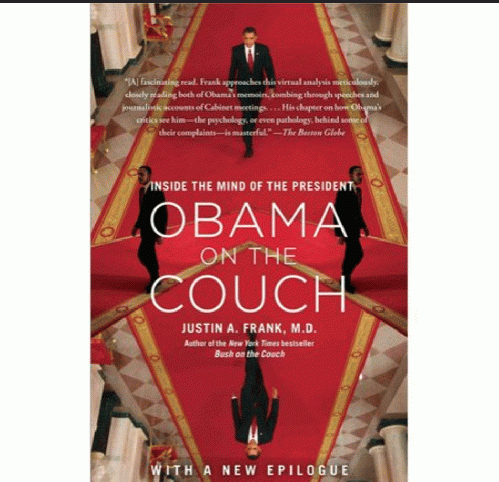
(2) Obama on the Couch: Inside the Mind of the President (New York: Free Press/ Simon & Schuster, 2011).
I have previously published three OEN pieces about Dr. Frank's books:
(1) https://www.opednews.com/articles/Justin-Frank-M-D--Puts-P-by-Thomas-Farrell-111019-84.html
(2) https://www.opednews.com/articles/President-Obama-Needs-to-M-by-Thomas-Farrell-120114-905.html
An overview of Dr. Frank's book Trump on the Couch is in order here. It includes the following parts:
(1) an introduction (pages xiii-xxiii);
(2) a chapter on President Trump's mother (pages 3-26);
(3) a chapter on his father (pages 27-54);
(4) a chapter on his older brother (pages 55-69);
(5) a chapter on his rivals (pages 71-88);
(6) a chapter on the psychology of his lying (pages 91-115);
(7) a chapter on the psychology of his narcissism (pages 117-137);
(8) a chapter on the psychology of his destructiveness (pages 139-165);
(9) a chapter on the psychology of his racism (pages 167-183);
(10) a chapter on the psychology of his sexism and misogyny (pages 185-202);
(11) a chapter on his dyslexia (pages 203-226);
(12) a concluding chapter titled "The End of the Beginning" (pages 227-237);
(13) a glossary of Trump-specific psychoanalytic terminology used in the book (pages 239-257);
(14) a bibliography (pages 259-263);
(15) acknowledgments (pages 265-270);
(16) an index (pages (271-279).
(Disclosure: in the acknowledgments [page 268], Dr. Frank thanks me for sending him links to articles in the New York Times.)
The glossary includes short Trump-specific entries about the following technical terminology in the book:
(1) containment (pages 239-241);
(2) displacement (page 241);
(3) dissociation (pages 241-242);
(4) dyslexia (pages 242-243);
(5) envy (pages 243-244);
(6) grandiosity (pages 244-245);
(7) hyperbole (page 245);
(8) idealization (pages 245-246);
(9) identification (pages 246);
(10) object (pages 246-247);
(11) persecution (pages 247-248);
(12) pre-conception (page 248);
(13) projection (page 249);
(14) regression (page 249);
(15) repetition compulsion (pages 250-251);
(16) sadism (page 251);
(17) splitting (pages 251-252);
(18) transference and counter-transference (pages 252-256);
(19) unconscious (pages 256-257).
Because the glossary entries contain key Trump-specific information, I would suggest that most readers should begin by reading the glossary.
However, I wish that Dr. Frank had also defined the term anxiety in the glossary. In the concluding chapter, he says that "anxiety, though unpleasant, is not something we have to run away from. Anxiety is a source of information, and in that respect is a responsibility as well" (page 236).
I suspect that I have experienced what he refers to as anxiety, but I probably thought I was experiencing fear and trepidation, but not so strong as to trigger all-out panic. So what exactly is the difference between the subjective experience of fear and trepidation, and the subjective experience of anxiety?
Regardless of whatever exactly anxiety means, the Canadian Jesuit philosopher and theologian Bernard Lonergan claims that feelings reveal values to us -- assuming that we reflect on our feelings perceptively to discern the values they are revealing to us.
Similarly, the American philosopher Martha C. Nussbaum refers to the "intelligence of emotions" -- in the subtitle of her book Upheavals of Thought: The Intelligence of Emotions (Cambridge University Press, 2001) -- assuming that we pause and reflect on the intelligence our emotions are communicating to us.
Now, recently I watched the nationally televised hearing of the U.S. Senate's Judiciary Committee in which Dr. Christine Blasey Ford testified under oath against Judge Brett Kavanaugh. At the beginning of her testimony, she stated that she was "terrified" (her word). I interpret her statement to mean that she was experiencing fear and trepidation, but not all-out panic. But I suspect that Dr. Frank would interpret her statement to mean that she was experiencing anxiety. However, by explicitly reporting that she was "terrified," she clearly moved herself out of what Dr. Frank refers to as "unprocessed, unacknowledged anxiety" -- because she explicitly acknowledged that she was "terrified."
Now, Plato, Aristotle, and certain other ancient Greeks thought of the virtue of courage as the mean between the extremes of brashness and cowardice. In my estimate, Dr. Christine Blasey Ford admirably exemplified the virtue of courage on national television for all Americans who were watching to see.
By contrast, Judge Brett Kavanaugh exemplified brashness for all who were watching to see. Of course, Trump's brashness appeals to his base, and so Kavanaugh's brashness may also appeal to Trump's base.
In any event, Dr. Frank says, "This book is a call to action for all Americans, because Trump reminds us what happens when anxiety is denied or ignored. He is consumed and misled by a lifetime of unprocessed, unacknowledged anxiety, which has no doubt been exacerbated by the power and responsibility of his office. Trump challenges us to avoid making the same mistakes. The work begun in this book must continue" (page 237).
I would urge readers to take Dr. Frank's book as a call to action in the sense of undertaking the action to reflect on their own lives as they read his chapters. After all, even though Freud used the masculine pronoun, he clearly did not mean to exclude female babies from his famous quip. We humans are all born as babies, and we start our lives in a relationship with our mothers (or mother-figures), just as baby Donald did. Usually, we also form a relationship with our fathers (or father figures). Oftentimes, we have brothers and sisters, and we form relationships with them as well. Consequently, as we read Dr. Frank's book about Trump, we should try to compare our life experiences with his -- our "inner" Trump, as it were -- as Dr. Frank himself suggests we should (page 231).
(Article changed on October 1, 2018 at 11:57)
(Article changed on October 1, 2018 at 16:38)
(Article changed on October 1, 2018 at 21:21)
(Article changed on October 1, 2018 at 23:06)
Authors Website: http://www.d.umn.edu/~tfarrell
Authors Bio:
Thomas James Farrell is professor emeritus of writing studies at the University of Minnesota Duluth (UMD). He started teaching at UMD in Fall 1987, and he retired from UMD at the end of May 2009. He was born in 1944. He holds three degrees from Saint Louis University (SLU): B.A. in English, 1966; M.A.(T) in English 1968; Ph.D.in higher education, 1974. On May 16, 1969, the editors of the SLU student newspaper named him Man of the Year, an honor customarily conferred on an administrator or a faculty member, not on a graduate student -- nor on a woman up to that time. He is the proud author of the book WALTER ONG'S CONTRIBUTIONS TO CULTURAL STUDIES: THE PHENOMENOLOGY OF THE WORD AND I-THOU COMMUNICATION (Cresskill, NJ: Hampton Press, 2000; 2nd ed. 2009, forthcoming). The first edition won the 2001 Marshall McLuhan Award for Outstanding Book in the Field of Media Ecology conferred by the Media Ecology Association. For further information about his education and his publications, see his UMD homepage: Click here to visit Dr. Farrell's homepage.
On September 10 and 22, 2009, he discussed Walter Ong's work on the blog radio talk show "Ethics Talk" that is hosted by Hope May in philosophy at Central Michigan University. Each hour-long show has been archived and is available for people who missed the live broadcast to listen to. Here are the website addresses for the two archived shows:
Click here to listen the Technologizing of the Word Interview
Click here to listen the Ramus, Method & The Decay of Dialogue Interview