| Back OpEdNews | |||||||
|
Original Content at https://www.opednews.com/articles/Inside-The-Wheels-on-the-by-Joan-Brunwasser-Author_Books-For-Children_Interviews_Publishing-180723-556.html (Note: You can view every article as one long page if you sign up as an Advocate Member, or higher). |
|||||||
July 22, 2018
Inside "The Wheels on the Bus": Interview with Caldecott Winner Paul Zelinsky
By Joan Brunwasser
"I did not grow up with the intention of becoming a children's book maker. I loved books, and pictures, and pictures in books, which basically means children's books, but I didn't quite understand that books were made by living people, and that becoming one of those people was a possible thing. So I thought I'd be an artist, or an architect, but I also liked to amuse myself and my friends by making books with stories in them."
::::::::
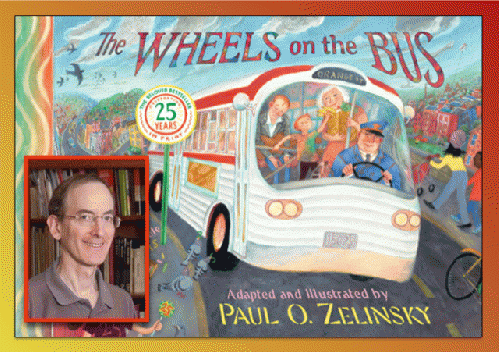
Cover art of 25th anniversary edition of 'The Wheels on the Bus'; headshot from Paul's website
(Image by courtesy of Paul O. Zelinsky) Details DMCA
My guest today is Caldecott winner and renowned children's author and illustrator, Paul O. Zelinsky.
Joan Brunwasser: Welcome to OpEdNews, Paul. You've had a long and illustrious career. In fact, one of your most beloved books, The Wheels on the Bus, celebrated its 25th anniversary in 2015 and is still going strong, with more than 3.5 million copies in print. Before we talk about that one, tell us where your interest in art and storytelling came from, please.
Paul Zelinsky: I could describe myself as a kid who at some point got interested in art and storytelling. But it feels more the case that an interest in art and storytelling decided to come into the world, and it needed a person to hang onto, so it created me.
I was born in Evanston, Illinois, a suburb of Chicago, and started drawing at an early age. When I was two, my family (my parents and older sister) moved to Japan for a year, where I was exposed to a deeply different culture, one with stronger aesthetic values than anything you'd see in the US. That influence remained after we returned to Illinois (after a year in Princeton, New Jersey, where a younger brother entered the picture).
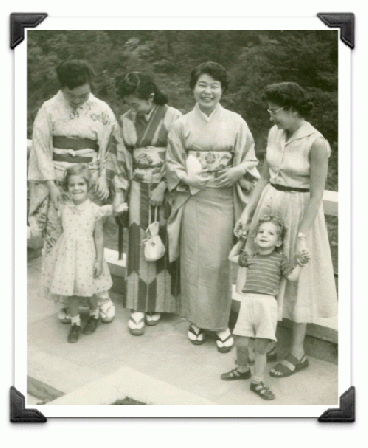
Our new home in Wilmette housed the Japanese furniture shipped back with us; my mother kept a lot of Japanese recipes in her cooking repertoire, and Japanese friends would stop in and visit as long as my parents lived. This is not to say that my art is very Japanese, but maybe it is!
And storytelling? The art I was interested in was always telling stories. It's still the case. There is no getting around it, really; everything you can hold in your mind has a story somewhere inside.
JB: You say that "art and storytelling needed a person to hang onto, so it created me." I'm intrigued by that statement. Can you flesh that out for us? When and how did you start to feel as if you were the medium for art and storytelling rather than the other way around? Or is it the same thing, in the end?
PZ: For the most part, I'm extremely literal-minded and don't go in for mystical or even metaphorical ideas, but I made a little exception here. I really meant that I was compulsive about making pictures that told stories from a very early age-- longer ago than I can remember (I wrote stories, too), and I have no sense of this tendency as having come from anywhere. I don't descend from a family of storytellers, though I had relatives who were good at it; but I can say for sure that I either inherited or picked up a lot of drawing facility from my mother, who trained as a medical illustrator and had a better eye for likenesses than I ever will. She was also very good at writing doggerel, and could rhyme better than 99.9% of people. My father was a mathematics professor (the year in Kyoto was for his Fulbright fellowship.) He used to say that math, as practiced by research mathematicians, is fundamentally an esthetic venture; that it is about shapes of abstract things fitting together, forming patterns that are real, and waiting to be discovered.
So much for my interests and abilities not coming from anywhere....
JB: Where did your desire to tell stories, or illustrate them, for kids come from?
PZ: I guess it's a combination of an inborn desire to make things, and a conviction that illustrated books are an irrefutably desirable thing in the world. At the time I conceived this conviction I think it was even more, let's say, apart from mainstream thinking than it has since become (in the 1960s celebrities were about as interested in writing children's books as they would have been in coming out of the closet [or some other comparison I can't think of]), although I believe that most adults today still don't hold the field of children's books in particularly high regard. And I think those adults (at least the imaginary ones I'm postulating) are nuts.
I did not grow up with the intention of becoming a children's book maker. I loved books, and pictures, and pictures in books, which basically means children's books, but I didn't quite understand that books were made by living people, and that becoming one of those people was a possible thing. So I thought I'd be an artist, or an architect, or something, but I also liked to please and amuse myself and my friends by making books with stories in them. It was just something I did.
JB: You imply that children's book authors get less respect than authors of other books. How sad! I say this because I have a young granddaughter and one of my biggest pleasures is sharing new books with her as well as the ones that I read to her mom and her siblings. The old ones left such a vivid impression and are tied to so many happy family memories; they are truly unforgettable. And how many books for adults can you say that about?
PZ: Well, I don't really know, but I doubt whether most adults in this country take children's book writing as seriously as I do! Before I got my first children's book to illustrate, I did a lot of editorial illustration for newspapers and magazines. But when the opportunity to do children's books presented itself, I pretty quickly stopped that other kind of work. Maybe I wasn't as good at it, but I was intensely aware of how much more my drawings in a children's book would mean to its readers than did, for instance, my drawings for Barron's Weekly, a financial newspaper. There used to be a saying about the long-term value of what's in a newspaper, something like "today's newspaper wraps tomorrow's fish."
JB: At what point did what you did go from simply amusing yourself and your friends to something bigger?
PZ: Well, in one sense, amusing myself and my friends (mostly myself) is still what I'm trying to do, though I suppose that if my published books amused nobody else, I'd be in a certain amount of trouble. But to answer your question, the possibility of becoming an actual children's book illustrator dawned on me in college, when I was casting around for courses to take or activities to sign up for that might provide some career path to a college graduate with an art major. I'd been lucky enough to get into Yale College, and when as a Sophomore I saw in the always-fascinating course catalog a seminar (a special offering, not part of any department) on the subject of children's literature, and noted that the teacher would be Maurice Sendak (along with an English faculty member), it looked like quite an opportunity.
The course was both academic and creative; all of the accepted students wanted to write or to write and draw, and by the end of a very inspiring term, led by a fascinating and committed teacher, it seemed the most natural thing to do to send off our efforts to publishers. (I wrote an essay about this seminar a couple of years ago in the book Maurice Sendak: a Celebration of the Artist). Later that year, my collaboration with another student in the class was accepted for publication by a small but distinguished house that had published Margaret Wise Brown, Clement Hurd, Gertrude Stein, Leonard Weisgard and others!

Unfortunately for everyone, before there was a contract, that publisher was bought by a large educational corporation, and dissolved. So I wasn't yet published, but the seed had been planted. Still, I followed the default path laid out for college art majors: to get a master's degree in painting, and teach college art. And at the end of that process, as a beginning college art teacher, I had the sense that this was not what I was meant to do. I also had the awful feeling that my students were reacting similarly. So I moved to New York to try my hand at book illustration.
JB: How did the move affect your career trajectory?
PZ: It only turned a none-too-promising career in art education into a turns-out-to-have-been-pretty-successful career in children's book illustrating! I think it was a good move.
That was in the late 1970s, before the advent of most of the instant communication that's so easy to take for granted today. If you lived far from the publishers, who were almost all in New York, being a working book illustrator would not be easy. I think it's quite possible that if I hadn't been showing up at publishers' offices with my portfolio, I might not have been the illustrator they thought of to pair with the manuscripts that were in fact offered to me. You can't ever really know something like that, of course.
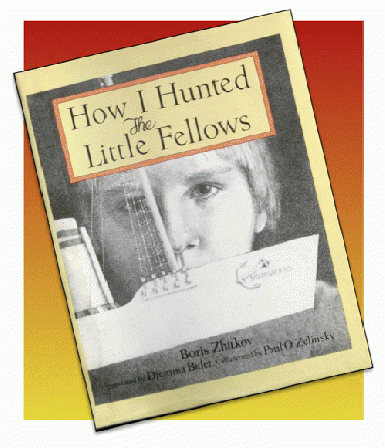
Cover art for the first published picture book Paul illustrated
(Image by courtesy of Paul O. Zelinsky) Details DMCA
JB: True. You've juggled illustrating books written by others with creating your own. How does that work? Did your illustrating open doors for you as a new children's author?
PZ: I suppose that after a couple of books, when I had established connections with an editor and could propose a book idea of my own, in person and in passing, it probably got more consideration than the same idea would have if it had arrived from a stranger in the mail. But I'm pretty idealistic about how book submissions work; that is, I think good ideas get recognized.
JB: Your classic, The Wheels on the Bus, celebrated an amazing 25 years in print back in 2015. How did you come up with the idea for a pop-up book? Was this your first attempt at it? Please share the backstory with us.
PZ: I tell this story, and it's always the same, but what can I do? It's true. I think I'm the only American I know who didn't learn the song "The Wheels on the Bus" in childhood. I learned it from my wife. Deborah was working on her doctoral thesis in Music Education, conducting a study on teaching spatial concepts, testing whether words like up and down and in and out, which aren't understood by the smallest children, are learned better and faster with the help of music. (They are.) So she was teaching some of her kindergarten classes--she was the music teacher in a Brooklyn public school--songs where those concepts come through, one of which was "The Wheels on the Bus."
I saw the sheet music on her desk. I read it. It sounded catchy. I thought that if children learn spatial concepts from the actions in this song, wouldn't it be an even stronger experience if there were a book where those actions took place in a real, physical way? Where while you sing "round and round" you can spin actual wheels with your fingers, seeing and feeling them go round and round? Or pop doors open and shut, or slide windows up and down? It would be kinesthetic, rhythmic, visual, aural, vocal, all at once.
This idea seemed pretty good, and I brought it to my editor at Dutton, Donna Brooks. From my bit of checking, it looked like the text of this song had never been made into a children's book, much less a moving-parts book. But neither of us knew how to go about making a book with wheels that spin and doors that open, so I put the idea off to the future. A couple of times over the next few years I noticed the title "The Wheels on the Bus" in children's book publishers' new book catalogues, and got nervous.
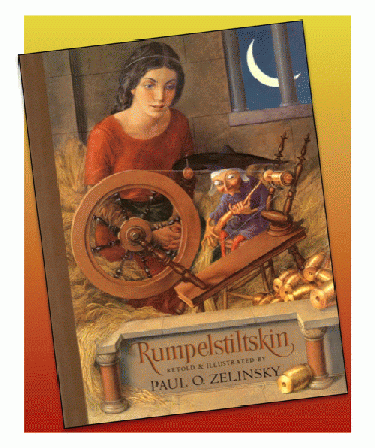
Cover art for 'Rumpelstiltskin', written and illustrated by Paul O. Zelinsky
(Image by courtesy of Paul O. Zelinsky) Details DMCA
But in both cases, the books were only what the pop-up community (I've since learned) calls "flat books." It wasn't until I finished my Rumpelstiltskin in 1986 that I felt I was ready to try my hand at this mechanical book. Dutton decided to create it through the company that at the time was producing most of the pop-up books in the country, as a packager subcontracting for other publishers. Intervisual Books (which had quite a story of its own), with paper engineers on staff in its Los Angeles office, would lead me through the process of turning my ideas into a physical book. It wouldn't exactly be a pop-up book, because almost nothing in it pops up, but "pop-up" is the term people use so much for movable books like this that by now even I go along and call The Wheels on the Bus a pop-up.
JB: That is a fun story. How many iterations did it take to get it exactly how you wanted it? What did you find particularly challenging to pull off? What worked and what didn't? And how did you make it sturdy enough that it didn't fall apart after engagement by one enthusiastic toddler?
THE MECHANICS BEHIND THE SCENES
PZ: I drew up my first draft as a page of thumbnail drawings, without much thinking about what would move and how. I assumed that I had 32 pages to work with, like a normal picture book. Then I learned that pop-up books are very expensive to produce, and that a lavish maximum length would be eight spreads. (A 32-page flat book has 15 double-page spreads, or 17, if you count the endpapers, which in pop-ups are full-fledged spreads).
So I went back to the drawing board and started boiling down, pushing some elements together into single spreads and leaving out a lot of others. I think I went through three versions, very roughly sketched in small sizes, to get to an eight-spread sketch that I liked.
As to the moving parts, I wanted to get an idea of possibilities, so I went to a good bookstore and bought all the books with mechanical parts that appealed to me (not popping up but moving sideways), took them back to my studio, and, feeling incredibly guilty for doing this, tore the pages out and cut them open to see how they worked. One of these books, by far the best, was a tribute to, and recreation of, the movable books of a renowned 19th century master of the art named Lothar Meggendorfer. That book has gone on to be a valuable rare book of its own, and I'm doubly conflicted about having torn it to pieces, but it was a necessary act!
JB: It took me years just to fold page corners or write notes, even in cookbooks. So I get it.
PZ: My book-slaughtering foray gave me lots of ideas for the movements in my Wheels book, but I wasn't responsible for devising the mechanics. Intervisual had paper engineers for that, though I wasn't in direct touch with them. Their sales rep, who was my contact, requested a full-sized dummy, where I would sketch the pictures and write indications of the movements I was asking for.
In a surprisingly short time after delivering that dummy, we got back a full-sized book from Intervisual's California office. It was a hardcover model of The Wheels on the Bus, eight spreads of stiff white paper, completely blank but with moving parts in place. Only if you knew my drawings could you make any sense out of it; here and there on the white pages would be some inscrutable cut-out shape that could move. Unfortunately, it wasn't remotely what I wanted; instead of ingenious hidden machinery inside the pages, these were all do-it yourself movements: to open the window, you lifted a flap. For the bus driver to move his arm back and forth in a "move on back" gesture, you would push the hand back and forth on its pivot. And so on.
JB: How disappointing! How did you handle that?
PZ: To let Intervisual know what I had in mind, I went into control-freak mode and did it all myself. Actually, I had tentatively made some moving pieces before this, but hadn't sent them in because maybe there were better ways to do them. But now I tried to channel the two most ingenious paper engineers I'd come across, Lothar Meggendorfer and Julian Wehr, and fully indulging my tendency to complicate things, produced an elaborate dummy which got sent to Intervisual. We waited to see what they would do next.
Before and After: mock up of bus doors and below, color dummy
(Image by courtesy of Paul O. Zelinsky) Details DMCAThey did a smart thing. They removed the first paper engineer and assigned another one who understood my intentions. If the first blank dummy hadn't been so awful, I don't know if I would have been as ecstatic over the second one, but it was pretty great right from the start. I asked for a few changes, but basically the mechanics of the book were set. And happily for me, most of them were based on my models, though paper engineer Rodger Smith had adapted them to be manufacturable, and as sturdy as possible, which was certainly important for a book like this. It is far from baby-proof, but it's much sturdier than it might have been, which I credit to a combination of Rodger's knowledge, and luck in my choices of movements.
Then I was asked to make a carefully drawn dummy in which the outline of anything that moved, and some things that didn't, would be final, unalterable. I played around a lot with art medium and technique trying to find the right style before starting this dummy, though the dummy itself was only pencil on (flat) paper. I hadn't yet managed even one mockup of a page in a finished style when I sent my dummy to California. I just hoped I could pull it off when the time came.
Not too long after they received this dummy, Intervisual sent me a set of diagrams on very large tracing paper. They were something like sewing patterns, with a lot of parts laid out across the pages, all of them constructed from messy-looking photocopies of my dummy, cut into pieces. The parts were clearly outlined with a band of "bleed" surrounding each one like a seam allowance. Some of the parts were full pages of the book but with blank sections where figures had been removed or would be covered up by some other part. Most of the parts were just parts: an arm, a head, the lady holding out a coin for the bus coin slot. Some of the parts were in there twice, as mirror images, for printing on the front and back of the same piece. These diagrams were my guides for making the art, and while I could paint whatever I wanted within their outlines, the outlines themselves had to be scrupulously observed, or the book's mechanics might not work.
So I was charged with creating eight double-page images by painting many dozens of separate parts and hoping they would coalesce into a visually pleasing whole when assembled in the book. Also, Intervisual pointed out that the bleed area around each piece would show a bit, because die blades would be cutting the parts out from large printed sheets with some inaccuracy. Leaving the bleed white would be a disaster. So, all around the edge on each piece the ideal bleed should match the color of whatever was in that spot behind the piece. I'd have to figure out and paint sort of halos around all the pieces, reproducing what surrounded them in the overall image, but in a very blurry form.
JB: Was this daunting?
PZ: I like challenges of this sort, and I have to say that the firm deadline that Intervisual demanded motivated me to work more efficiently than usual, which was satisfying in a way. So, it wasn't daunting. I worked up a fun, colorful technique using mostly thin, wet oil paint on gessoed paper, with some colored pencil drawn into the paint, and managed in nine months to finish what could easily have taken me a year and a half.
JB: Where did you get your ideas for the town/neighborhood that plays such a major role in the book? Was it based on any place you'd lived?
PZ: There wasn't a lot of reference research necessary to make these pictures. In a vague way, I let the cityscape resemble my local views in Brooklyn, but with nods to rural and suburban America as the bus goes out from the center of town. At the center (most visible in the panoramic view at the end which accompanies a full reprise of the song), buses travel around (and around) a domed governmental building that I think of as Brooklyn's Borough Hall, though it doesn't resemble it all that much.
The library nearby has features I associated with our local Brooklyn Public Library branch, (which was demolished recently, to the regret of many). Some people have observed that I put myself in the book as the guitar-toting passenger who turns out to be riding to the library to perform (you can guess what he'll be singing), but I had no intention of so doing and I don't think he looks like me. I did, though, deliberately put both of my daughters into the book: you can see the older one plugging her ears in frustration at the racket of the Waah-Waah-Waah-ing babies, the main one of which, a blonde infant, I based on her own little sister.


