| Back OpEdNews | |||||||
|
Original Content at https://www.opednews.com/articles/Why-President-Erdogan-Orde-by-Hamma-Mirwaisi-Iraq_Killing_Murder_Women-180112-827.html (Note: You can view every article as one long page if you sign up as an Advocate Member, or higher). |
|||||||
January 11, 2018
Why President Erdogan Ordered the Murder of Sakine Cansiz?
By Hamma Mirwaisi
PKK commando forces were able to arrest two high-ranking Turkish Intelligence Agency (MIT) members last year in the Kurdistan Regional Governments of Iraq (KRG) region. They were there to organize agent to kill PKK leaders based on KRG area. But PKK commando forces arrested them before killing anyone. They are disclosed important information about the murder of three Kurdish women in Paris-France under investigation.
::::::::
On January 3, 2013, three Kurdish women by the name of Sakine Cansiz (born 1958), Fidan Dogan (1982, France representative of the Brussels based Kurdish National Congress - KNK) and Leyla Saylemez (1989, young women activist) were found murdered in their place of work.
We wrote the book below without knowing who ordered the killing of these civilian Kurdish women activists for freedom and Peace in Kurdistan.
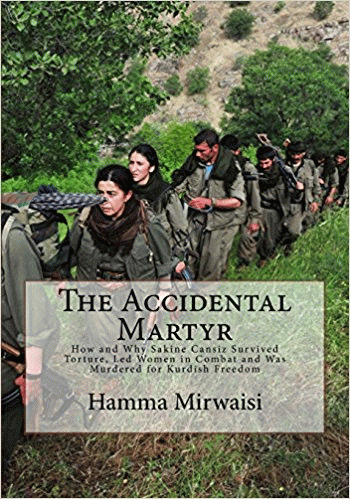
The Accidental Martyr: How and Why Sakine Cansiz Survived Torture, Led Women in Combat and Was Murdered for Kurdish Freedom.
PKK commando forces were able to arrest two high-ranking Turkish Intelligence Agency (MIT) members last year in the Kurdistan Regional Governments of Iraq (KRG) region. The intelligence agents were there to organize assassins to kill PKK leaders based in the KRG area. But PKK commando forces arrested them before they could kill anyone. They disclosed important information about the murder of three Kurdish women in Paris,France who were under investigation.
According to the two arrested high-ranking Turkish MIT members above, President Erdogan of Turkey directly ordered the head of the Turkish Intelligence Agency (MIT) to go ahead with the killings of those three Kurdish women while he was negotiating peace with the Kurdish leader Abdullah Ocalan in the Turkish prison since 1999.
KCK Executive Council Co-chair Bese Hozat answered questions about the Paris Massacre and the captured MdegreesT administrators in the program Ulkeden ("From the Country") on Medya News TV.
Hozat stated that the MdegreesT administrators captured by the HPG PKK forces made confessions about the massacre and said: "On the 5th anniversary of the Paris Massacre, I condemn the perpetrators of this massacre with hate. We will absolutely hold the perpetrators of this massacre, this vile murder to account. The blood of our friends won't be left unavenged.
Who are the Kurds? Why do they fight so valiantly, and for what? Why are we just now hearing about them? How do we understand all the chaos in Syria, in Iraq, and in Turkey? And why do the Kurds keep appearing in the picture? Who are those people? The Accidental Martyr helps to explain this complex part of the world and these little-known people through the life and times of Sakine Cansiz.
From the age of 20, Sakine Cansiz was ready to die a heroine's death for Kurdish freedom, if that was how things turned out, but she never planned to be a martyr, or sought out a heroine's death in order to make a point. She never wanted to die at all, except maybe during the worst part of ten years of unspeakable abuses by jailers who were so sadistic that even their own repressive regime eventually executed them. She didn't want to be a heroine either: she just showed her bravery when heroic circumstances were forced on her, which was far too often. Like the rest of the Kurdish people, she didn't set out to be heroic, just to survive; life among the Kurds and Turks would make that challenging enough.
After her years of torture, she became a famous guerrilla leader, actively fighting for the cause of Kurdish rights against enormous odds and expecting to die at any moment. Several times, she came all too close to having that opportunity. After a decade of battling with one of the most advanced military forces in the region, she survived that too, becoming a legend as a brave, powerful female fighter.
Eventually, she became too valuable for the Kurds to lose her in an insignificant firefight in the remote mountains. They sent her to the civilized, peaceful cities of Western Europe to become a diplomat and fund-raiser for the Kurdish cause. She had to give up combat patrols in order to print pamphlets and meet with heads of government. She excelled in that too, so much so that some government agencies got nervous. Eventually, one of them caught up with her.
In civilized, peaceful Paris, she hadn't sought death out, but there it found her, not on the battlefield but in a simple rented office. It was the very mundane nature of her death that turned her from the leader into the icon, not just to Kurds seeking liberation but to women across the Islamic world.
She didn't intend to become a martyr. It happened anyway. This is her story.
It's is also the story of the Kurds for whom she suffered, fought and died. The phases of her life and the questions surrounding her death can only be answered with an understanding of who the Kurds are, and who their neighbors in Iran, Iraq, Syria, and Turkey are. The Accidental Martyr follows the path of Cansiz' life to explore the trail of Kurdish history from the glory days of the Medean Empire, 3000 years ago, to their resurgence today. If you've ever heard a mention of the Kurds and wondered who they really are, this book's is for you.
References
Bese Hozat: The Paris Massacre will be called to account
THREE KURDISH WOMEN MURDERED IN PARIS: A CRYSTAL CLEAR MYSTERY
.byline.com/column/57/article/1303
The Accidental Martyr: How and Why Sakine Cansiz Survived Torture, Led Women in Combat and Was Murdered for Kurdish Freedom
Authors Bio:
Hamma Mirwaisi was exposed to the oppression of Kurds while still a youth, as his education was frequently interrupted by Iraqi government harassment. Forbidden from entering university in 1968, he had little choice but to join the peshmerga (freedom fighter) forces of Mustafa Barzani from 1968 to 1975 in their battles against the Iraqi Government forces.
Although the conflict was resolved by treaty in 1975, he foresaw reprisals by Saddam Hussein's secret service against his extended family. He took his wife and two children to Iran, and in 1976 they entered the US as legal refugees, settling in Valley City, North Dakota.
Mirwaisi completed BS and MS degrees in Electrical Engineering at the University of North Dakota. That led to a technical career, beginning in 1982 at the Sperry Corporation in Minneapolis. Sperry's merger with Unisys Corporation caused the end of his program, and he took up Ph.D. studies in Radio-Frequency (RF) Engineering at the University of Colorado at Colorado Springs. Eventually he returned to work at Honeywell, where he completed his career, becoming the Senior RF Engineer on the Air Force Satellite Communication program.
The tragedy of the Kurds intervened again in 1995. His sister and her two-year-old daughter were drowned while escaping Saddam Hussein's reprisals against the Kurds for their rebellion during the first Gulf War.
He returned to Kurdish affairs in 2004, when the US Army called on him to serve as an interpreter in the second Gulf War. At the end of that assignment, he began seeking American corporate sponsors for the rebuilding of Kurdistan. However, the Barzanis, who controlled the Kurdistan Regional Government, saw the initiative as a scheme to undermine their own influence and expelled Mirwaisi from Iraq. The doors to government and corporate sponsorship of works in Kurdistan (at least those that did not include a Barzani rake-off) slammed shut.
Since then, Mirwaisi has devoted his efforts to spreading the word about Kurdish history and culture through writing and speaking. After his first book, Return of the Medes, he was invited to serve for a year as an honorary member of the Kurdistan National Congress (KNK), a Kurdish parliament in exile that sits in Brussels. He is the author of many other books on Kurdish affairs
The History of the Caucasian People: The Civilizations without Hatred ...
https://www.amazon.com/History-Caucasian-People-Civilizations-without/dp/1543172784/ref=tmm_pap_swatch_0?_enc