| Back OpEdNews | |||||||
|
Original Content at https://www.opednews.com/articles/Alice-of-Alice-s-Restaura-by-Bernard-Starr-1960s_Activism_Arlo-Guthrie_Change-171203-682.html (Note: You can view every article as one long page if you sign up as an Advocate Member, or higher). |
|||||||
December 3, 2017
Alice of 'Alice's Restaurant' Is Back in Town
By Bernard Starr
The 50th anniversary celebration of Arlo GUthrie's song "Alice's Restaurant Massacree", which inspired the film "Alice's Restaurant, dramatizes the explosive era of the 1960's. In a 2017 interview with ALice Brock, she reminiscesd and drew comparaisons between "then" and "now"
::::::::
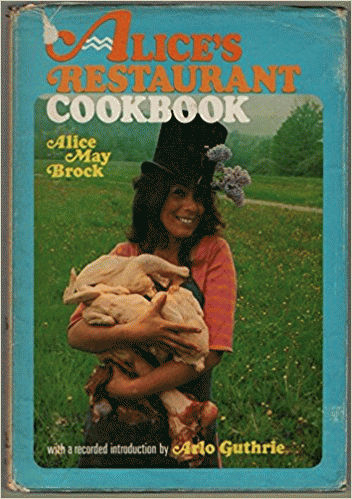
On this year's Thanksgiving Day (November 23rd) I was thrilled to view the PBS replay of the 50thh anniversary concert celebrating Arlo Guthrie's eighteen-minute hilarious musical monologue, "Alice's Restaurant Massacree," that recounts the quirky events which inspired the 1969 film Alice's Restaurant.
The anniversary concert was originally performed at the Colonial Theater in Pittsfield Massachusetts May 21, 2015, and aired on PBS on Thanksgiving Day, Nov. 26, 2015.
Guthrie's song dramatized the defining issues of the explosive era of the 1960's that forever changed the direction of American life.
The PBS program reminded me of an article I wrote ten years ago based on an interview with then artist and author Alice Brock, when she returned to the Berkshires for an exhibit of her artworks.
I decided to publish a revised and updated version of the article, since Alice's reminiscences casts light on the phenomenon of "Alice's Restaurant" and her life after the restaurant.
Note:The earlier article was published July, 2007 in UPI's Religion and Spirituality.com
Yes, Alice is back in town (July, 2007) -- and she's still cooking; not cooking food but cooking in her current life as an artist.
Alice Brock's story was featured in the 1969 film Alice's Restaurant, starring Arlo Guthrie. The film became a metaphor for an era. At that time young people were "dropping out," disaffected by the Vietnam war, the draft, hypocrisy, and an uptight American society bound by restricting conventions.
A group of counterculture teenage and "20-something" drifters searching for meaningful identities found their way to the home of Alice and her husband, Ray, in a deconsecrated church in Great Barrington, Massachusetts. They were called "the family."
Then Alice opened her famed restaurant in Stockbridge, MA, where, as the hit song written and sung by Arlo Guthrie said: "You can get anything you want at Alice's Restaurant."
The film filled me with nostalgia--for the era and for Guthrie's wry take on it. So you can imagine my delight when I heard an interview with Alice on Northeast Public Radio about her art show and reception scheduled for the coming weekend at "The Bookstore" in Lenox, MA, just a mile from my farmhouse. I rushed into my car and headed for town to get the details.
Just after I entered the store, a lively and energetic
On Saturday I arrived to a mob scene of Alice's admirers, many with memorabilia from the '60s that they wanted signed. Others were viewing and purchasing her artwork and recent book, How to Massage Your Cat; and still others were just seeking to recapture fond memories of their youth that Alice's presence evoked. An interview was impossible. The Bookstore owner told me to come back on Sunday at 3 p.m. to do the interview when things would be winding down. I did, but it was the same scene. I waited till 4 p.m., when the reception ended. But still, the hanging-on groupies crowded us. So we slipped across the street to the Olde Heritage Tavern for a quiet tête--tête.
As we crossed the street, we were greeted by two "60-something" bikers and a number of their friends. Alice commented that they were not ordinary fans, they were actually part of the church "family'" who were portrayed in the film -- Ralph Pinto, Jimmy Jacobs ("Dr. Vaseline" -- he was slippery) and Rick Robbins - who, along with Arlo Guthrie, dumped the garbage over the roadside (because the garbage dump was closed for thanksgiving) that was one of the main themes of the movie.
"But they're not hippies anymore," Alice said. She cited one member of the church family who became a high-end international art dealer.
How did
Her mother said to her: "You're feeding all those drop-ins at the church for nothing -- why don't you open a restaurant and get them to pay?" The real reason, though, for opening the restaurant, she said, was to get away from a troubled marriage and to do something on her own. They also needed money. Her husband Ray Brock, although an architect, was mainly working on construction projects and odd jobs. He also had three children from a previous marriage and gave most of his earnings for child support, said Alice.
Alice found an old diner in the alley behind the grocery store on Main Street in Stockbridge. It was a good location in town. Down the block was the famous Red Lion Inn. And not far from there in the other direction was Norman Rockwell's home. But the restaurant never made much money: "I charged too little, so it was popular -- it got a reputation for outstanding and unusual food. And of course, the "family" didn't pay -- but I did take a lot of food back to the church for the constant stream of dropouts."
Despite the popularity of the restaurant, townspeople were often hostile to
Alice left Ray in 1969 and went to Boston to get away from what she described as his continued pursuit of her. After two months in
Alice stayed on in the area and later bought an inn and restaurant - Avaloch -- on a hill in Lenox just across the road from Tanglewood where the Boston Symphony Orchestra is ensconced for the summer. Later, new owners named it the Apple Tree Inn. In 1979, she said, "I had it and just walked away and left it to the bank." She headed for Provincetown, Massachusetts., on Cape Cod, a place that she had fond childhood memories of from vacationing there with her parents.
When she split for Provincetown, she had little money, only $2,000 in quarters from Avaloch's vending machines: "But money was never a big issue in my life." She worked as a cook in a restaurant for a few months, and then later again as a cook, making her unusual dishes overnight and leaving in the morning when the customers started to arrive. Ironically, she eventually bought a house near the beach that was a chapel. Ironically, for a person who is not religious, she has lived much of her life in churches.
Today she says she's content and happy -- lives "in paradise," does her art, walks the beaches, breathes the air as a free spirit, and "dreams."
Her art that was on display at "The Bookstore" in Lenox is playful and upbeat -- it will bring a smile to your face. She also likes to paint stones -- with raunchy images -- that she leaves on the beach for others to find. Friends have joined in this mission and have dropped her stones on beaches and other exotic places around the world -- and some have even been dropped over the
Does she have any regrets, or wish she had done it differently? No, she said: "What happened, happened, and it was all part of the times." She never planned on having a commune -- "the family" also just happened -- it evolved by itself."
Is she still in touch with Arlo? Yes; in fact, a few years ago she illustrated a children's book that he wrote, Mooses Come Walking. And years after the church was sold, Arlo bought the Old Trinity Church in Great Barrington when it came back on the market in 1991. Now called The Guthrie Center, it's an interfaith center for meditation, local and international service programs, and social activism.
Since today's world situation has much in common with the '60s -- an unpopular war, loss of meaning, and rampant materialism -- I asked Alice for her view of then and now. "Kids have it much tougher today," she remarked. "At that time, we thought we could change the world, so we were hopeful. Today everyone feels powerless -- that the world is out of control and that life is all about making money, not about community or sharing." I followed with the obvious question: So what would you do today if you were 20-something? She had no easy answer. After a long hesitation, she said she would probably go into politics to try to make a difference -- but the absence of enthusiasm accompanying this answer from a person of great passion spoke tons about the difference between then and now: hope vs. despair.
In preparation for the interview, I revisited the film on video and was surprised at a feature that slipped past me when I saw it years ago. I always thought those counterculture years were steeped in spirituality. The '60s brings up images of Hari Krishnas chanting, Ram Das and his devotees, Allen Ginsberg reciting OM for 24 hours outside the volatile 1968 Democratic Convention in Chicago, the Beatles meditating with their guru in India, and other arcane spiritual activities. But in the film there is no mention or even hint of spirituality resembling any of those images.
Yes, the kids in the film are disaffected, turned off and dropping out, but they have no philosophic container to provide an anchor of meaning. Their counterculture took the form of sex, drugs, and protest -- often through the popular music of the time. Their posturing was defined by what they were against more than what they were for. "In your face" spirituality expressed by other groups was often more about challenging the sensibility of polite society -- the establishment, parents and squeamish relatives -- than a genuine quest for transcendent consciousness.
I expressed my thoughts to Alice and asked for her thoughts. Perhaps, I suggested, the film just left spirituality out -- films often take such liberties with the facts. Surely, I said to Alice, if the film were being made today, "the family" would be swimming in Buddhists, Jewbus, born-again Christians, and followers of assorted gurus. Alice acknowledged that "the family" was not about religion or spirituality; its focus, she said, was sharing, caring, and mutual support in what they perceived as a world that had lost meaning and human values.
Shifting to a more upbeat theme, I asked, "Will there ever be another Alice's Restaurant?" She said a few years ago she visited a friend in the area who wanted to finance her comeback by buying the original site of Alice's Restaurant and returning her with a big splash. She admitted there was a moment of nostalgia that gripped her, suggesting "maybe" -- but it passed quickly as she remembered the struggles of those years and her present joyful dance with life.
Who knows, though, what the future holds? Alice is likely to be around for quite a while. I met her father, Joe Pelkey, at the reception. He's 96 and her mother is 98.
The song says, "You can get anything you want at Alice's Restaurant." But many got more than they bargained for. Alice's spirit continues to touch and inspire.
2017 Update
What is Alice's current life like in Provincetown? To find out I telephoned her On November. 28, 2017.
Yes, she is still in touch with Arlo Guthrie. Just this past summer they reminisced over dinner when he came to
"Arlo has quite a following but apparently I do too," she remarked: "A day doesn't go by that I don't get an e-mail, a letter a phone call, or a card from somebody who was involved in my life back then."
Remarkably, Alice remains close to almost everyone connected to the film and the restaurant: "I get lots of visitors from the Berkshires and I hear from everyone from "the family" who lived or dropped into the church, and all my ex-employees at the restaurant. "
Ten from "the family" who lived in the church showed up in Provincetown during the summer of 2017: "We went out to dinner and were so happy to see each other--and it's been more than fifty years. Now that's really family. "
What does she think about protest then and now, a question that I asked ten years earlier? "Those protests made a difference; they did change things. Now we are up against something that I don't think anyone imagined. I don't think I'll live long enough to see where this is going to end. On the other hand, it looks like I have lived long enough already. Every time he [Trump] does something stupid we think ok this is it, this will finish him off--but it doesn't."
If you were "20-something" today (another repeat question)? "Oh. I would be out there--doing whatever I could," she fired back.
Her view on the explosion of sexual harassment charges? "It's been part of our lives for so long--they say women play into it--and in a way they do because it's the only way we could be recognized--the only way we could be heard. And harassment is absolutely everywhere--a woman can't walk down the street without getting hit on or commented on."
What's the answer? "Abuse is so widespread that it can't be dealt with solely on an individual basis, but as a cultural aberration--and men have a big learning curve ahead of them."
What about punishment? Here her interesting response is nuanced with some reservation: "It's so widespread that if you fired every man who ever abused a woman sexually at work or wherever, the world would come to a standstill. It should be made public and I would rub everyone's nose in it. It's a wonderful thing for women."
Looking back, would she have done anything differently? "If I had done anything differently then everything would be different now. And now I'm doing everything that I ever wanted to do, which is to live in
If "
To learn more about Alice Brock and her artwork visit her website: http://alicebrock.com/
Authors Website: https://bernardstarr.substack.com/
Authors Bio:
Bernard Starr has written extensively on climate change since 2007, arguing that the crisis demands a coordinated, mission-driven response on the scale of the Manhattan Project. His work focuses on the structural failures of climate leadership and the need for centralized authority to accelerate the development and deployment of truly scalable solutions. A psychologist, Starr is Professor Emeritus at CUNY's Brooklyn College, where he taught developmental psychology to prospective teachers and research methods and statistics in a graduate program he directed. He is lead author of the lifespan textbook Human Development and Behavior: Psychology in Nursing. Starr is the founder and for twenty-five years was the managing editor of the Annual Review of Gerontology and Geriatrics, published by Springer. He also edited two Springer series, Adulthood and Aging and Lifestyle and Issues in Aging. For several years, he wrote for the Scripps Howard News Service on health care, the baby boom generation, and the challenges of an aging society, and for seven years he was writer, producer, and host of the award-winning radio commentary The Longevity Report on WEVD-AM in New York City. His books include The Starr-Weiner Report on Sex and Sexuality in the Mature Years (co-authored with Dr. Marcella Bakur Weiner), the first comprehensive study of sexual activity after age sixty; Escape Your Own Prison, exploring spirituality as a psychology of consciousness; and several works on antisemitism and Jewish identity, including The Crucifixion of Truth, Jesus, Jews, and Anti-Semitism in Art, and Jesus Uncensored. Starr is a past president of the Brooklyn Psychological Association and the Association for Spirituality and Psychotherapy. He serves as the principal United Nations representative for the Institute of Global Education, an NGO with ECOSOC status. His numerous op-ed and commentary articles for three years at the Scripps Howard News Service have appeared in newspapers throughout the United States. For several years he penned a blog at the Huffington Post. His articles have also appeared in Salon, the Daily News, OpEdNews and Barron's financial magazine.