| Back OpEdNews | |||||||
|
Original Content at https://www.opednews.com/articles/The-Supporting-Role-of-Bre-by-Joan-Brunwasser-Audio_Babies_Books_Breastfeeding-170201-806.html (Note: You can view every article as one long page if you sign up as an Advocate Member, or higher). |
|||||||
January 31, 2017
The Supporting Role of Breasts
By Joan Brunwasser
I got the idea for writing the book when I found out there were toxic industrial pollutants rising exponentially in American breast milk, and I wrote an article about that for the NY Times Magazine. I never came at it as a breasts-are-titillating topic. It only became a little more engaged with that as the book came out, and all these morning radio shows wanted me on for some laughs (as well as a few moments of sobriety).
::::::::
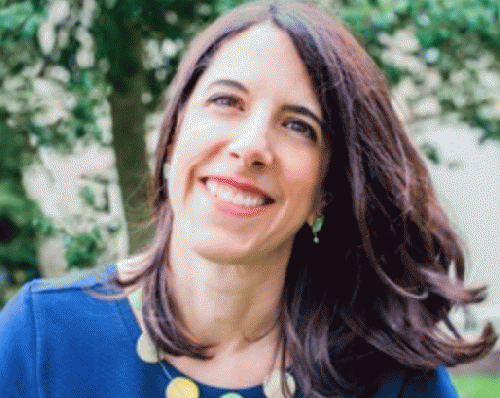
My guest today is science writer, Florence Williams, a contributing editor at Outside Magazine who also writes for National Geographic, The New York Review of Books, Slate, Mother Jones, O, The Oprah Magazine, and Bicycling.
Joan Brunwasser: Welcome to OpEdNews, Florence. The New York Times Book Review makes a list each year of the top 100 notable books for fiction, poetry and nonfiction. Your first book, Breasts, a natural and unnatural history [2012] made that list for nonfiction. While it's extremely well-written and shot through with humor, the topic is a serious one and often quite upsetting. Were you caught off guard by this high level of recognition, especially first time out?
Florence Williams: Well, as an environmental journalist, I'm pretty used to writing things and watching them go bump against the floor. This is science journalism after all, and as you mention, the topics can get depressing. But this topic is BREASTS! So I figured it would get more attention than the usual clean air act story. I tried hard to think in new, original ways, and the idea of looking at a body part through an environmental lens was pretty fresh. So it was really gratifying to see that get some attention and become part of a larger conversation about health, pollution, culture, feminism and the environment.
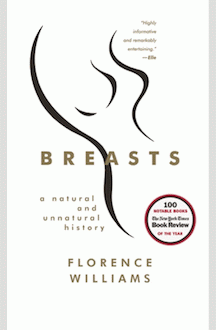
cover art for Breasts: a natural and unnatural history
(Image by courtesy of Florence Williams) Details DMCA
JB: Why breasts for your first book? When breasts are frequently seen as little more than sex objects, were you afraid you wouldn't be taken seriously?
FW: Maybe I went into it naively, but as someone who always took breasts seriously, I didn't think it would be weird. I got the idea for writing the book when I found out there were toxic industrial pollutants rising exponentially in American breast milk, and I wrote an article about that for the New York Times Magazine. I never came at it as a breasts-are-titillating topic. It only became a little more engaged with that as the book came out, and all these morning radio shows wanted me on for some laughs (as well as a few moments of sobriety). That was kind of a surprise to me, actually. I guess there are still a lot of adolescent brains doing talk radio...But I think I was still able to get some good points across, I hope.
Scientists now believe that the primary biological function of breasts is to make men stupid.
~Dave Barry
JB: I'm sure, for whatever the initial reason, the book has generated a good bit of interest. And there's a lot that is important to talk about. Why are breasts like the canary in the mineshaft?
FW: Breasts are uniquely sensitive to the world around us because they are built to converse with the body and the world. They are filled with estrogen and progesterone sensors that tell the breast tissue when to develop at puberty and when to start growing the dairy machinery during each cycle and then more so in pregnancy. Those receptors, unfortunately, also pick up compounds that mimic estrogen, like a whole bunch of plastic molecules and pesticides. As organs, they are also supremely fatty, and a lot of compounds, like flame retardants, are fat loving. Breasts kind of soak them up. Of course breasts are also uniquely vulnerable to breast cancer, which continues to kill 40,000 American women a year, so they are worth taking a close look at.

Florence Williams and Mary Beth Kirchner, co-creators of the Breasts Unbound audio series on Audible Channels
(Image by courtesy of Florence Williams) Details DMCA
JB: So, it's a mixed bag. Breast milk in many cases is seriously contaminated by elements in our environment. But there are also immense benefits within breast milk. Can you talk about that uneasy balance a bit?
FW: Sure. I believe breasts are these exquisitely, brilliantly evolved organs, because they create the perfect food for human infants - it's the only food on the planet designed just to benefit humans. It's so good at this that it also prepares the human gut to colonize the most beneficial mix of microbacteria, a mix that will set us up for optimal health over a lifetime. So breasts - and their milk - are more important to protect than ever. The milk has actually been very helpful to scientists in terms of identifying and understanding bio-burden pollutants, because you can test it easily and non-invasively. All these things are tied together. Breasts force us to look at them across disciplines, and that's what I was trying to do with the book: bring together medicine and culture and biology and evolution.
JB: There are so many people who suffer from mild to serious gut issues, you would think that breastfeeding would be a natural recommendation. As old a practice as it is, breastfeeding is not universally done in the US and in fact, you write that many women have a very hard time with it. Why is that?
FW: Breastfeeding is universally recommended at this point. Six months in the US and a year in Europe, so that's a big deal. The problem of course is that we don't support those recommendations through policy in this country. Zero maternity leave or very short maternity leave, lack of public comfort with the practice, lack of workplace facilities to pump, freely distributed and heavily marketed formula, all of these things make it challenging to meet the recommendations here. In the U.S. as well, many women have trouble making enough milk, and scientists are exploring what might be going on there, including pollution, which appears to alter the development of the gland early in life.
B is for Breasts Of which ladies have two; Once prized for the function, Now for the view.
~ Robert Paul Smith
JB: Speaking of which, in the course of writing this book, you did a detox with your daughter. Why did you do it and what did you find out?
FW: I was interested in exploring the issue of early puberty, which is an epidemic in the US, and it's something to be concerned about because, among other things, it's a risk factor for breast cancer. A number of hormone-altering chemicals are being examined for their possible influence on this, so I decided to test my 7-year-old daughter for some of the suspects. Then we tried to see if we could change her levels by doing some basic things, like not drinking canned soda or using perfumed personal care products or nail polish, etc., and we did see a difference. So it was pretty illuminating in terms of how easily our body responds to the environment around us.
JB: Based on what you discovered through this detox experiment, have you moved to the country and given up your car? Are there changes that you've introduced to your family life because of what you learned?
FW: Well, among the things I learned is that there's only so much you can do, and not many of us are willing to move into a tree house and sleep on a horse hair mattress. What we really need, as moms and families, is for our government to do its job: to test commercial chemicals for safety, and then to regulate the ones that pose risks. We can't all be expected to read every label and understand the chemistry of every additive. We have enough to do! I was happy to see that chemical regulations in the country have gotten a little tougher with updated legislation, so I hope that trend toward better oversight continues.
JB: How's the EPA been doing in that regard? I know that a few chemicals have been eventually banned. Are there fewer chemical floating around these days than in yesteryear? If not, why not? According to your book, there are many many chemicals out there that are totally unregulated.
FW: Yeah, our government has done a pretty lame job overall, especially compared to the EU, which generally operates under a guilty-until-proven-safe scenario. Here, we just dump the chemicals into the world and then do some studies in the private sector if someone gets concerned. But last year, the Toxic Substances Control Act was reformed, with better testing required. The chemical industry continues to push back, so stay tuned.
JB: With a brand-new, anti-regulation administration and Congress, it's hard to be too optimistic on that front at least for the next four years.
FW: What can I say? True. People who care about protecting human health and the environment are very concerned about the anti-science messages swirling around DC right now. But there is some bipartisan support because these are ultimately bipartisan issues. We all want healthy babies.
I think it's about time we voted for senators with breasts. After all, we've been voting for boobs long enough.
~Claire Sargent, 1992 Arizona senatorial candidate
JB: Agreed. According to your book, despite this being the 21st century, scientists still have not determined all the different components of breast milk. How is that possible? Why is a complete analysis so difficult to accomplish? And does not knowing the whole story prevent us from making conclusions regarding the potential benefits of breast milk?
FW: The analysis required for understanding all the complex long-chain molecules is really complicated and expensive. Formula companies would love to know how to replicate some of these specialized sugars, and they can't do it yet. But we've come an amazingly long way in the last five to ten years. It wasn't long ago that people thought breast milk was essentially sterile. Now they know it's more like yogurt, with live bacteria and amazing proteins and sugars. In fact, breast milk is helping provide an understanding about how specialized bacteria is important for every life stage, and i think the future of medicine will really benefit from these lessons. It's an exciting time in the research.
![Florence standing in front of Lady of Northumberlandia: aerial view of this 'huge land sculpture in the shape of a reclining female figure' [Wikipedia] Northern England](https://www.opednews.com/populum/visuals/2017/02/2017-02-79-460-ImagesAttr-populum_uploadnic_flo-williams-breast-uk-resized-png_79_20170201-648.png "Florence standing in front of Lady of Northumberlandia: aerial view of this 'huge land sculpture in the shape of a reclining female figure' [Wikipedia] Northern England")
Florence standing in front of Lady of Northumberlandia: aerial view of this 'huge land sculpture in the shape of a reclining female figure' [Wikipedia] Northern England
(Image by courtesy of Florence Williams) Details DMCA
JB: You consulted with experts all over the world in researching this book. Along the way, you gathered such a collection of interesting facts about breasts, human and otherwise. I'm thinking specifically about the research into (is it rhesus monkeys?) monkeys whose breasts differentiate the gender of the unborn baby and alter the composition of the milk accordingly. Can you talk about that for a moment?
FW: Sure, that research came out of UC Davis, so not too far away. I believe that was Katie Hinde and her colleagues who found that milk is generally richer that's given to males than females. Is it biological sexism? Not exactly. One theory is that in these monkeys, young males need to be encouraged to go off and explore, while young females may benefit more by sticking close to mom and learning from her. So the fatter milk enables the males to feed less frequently. Breasts also know when to put extra antibodies in the milk if the baby is sick. Pretty amazing that the breasts know so much about who is actually doing the feeding.

alongside the Lady of Northumberlandia, the largest man-made human breast, UK
(Image by courtesy of Florence Williams) Details DMCA
JB: It is amazing. Even though you finished this book four years or more ago, you haven't yet given up on the subject. Tell us about your latest project, please.
FW: It's true, I can't seem to give up Breasts. It's just an infinitely fun and interesting topic to me. My latest project is an 8-part original series for Audible. It's an audio documentary, basically a podcast, but it's highly produced. We go out in the field and interview experts and provocateurs, like Oxford zoologist Desmond Morris, who has some influential (and amusing) theories about breast evolution. I climb the tallest breasts in the world (in the North of England), and we interview the woman in Texas who got the first-ever silicone implants in 1962. And then we interview her surgeon. Pretty fun stuff. You can check it out through the Audible Original Channels app or through Amazon.
JB: That sounds great! Can't wait to listen to it. What haven't we talked about yet that you'd like to before we wrap this up?
FW: I'd just like to mention that I'm still writing about environmental health. The Breasts book looked at how the environment is harming our health, but my new book, just out, looks at how nature can help us. It's called The Nature Fix: Why Nature Makes us Happier, Healthier and More Creative (W.W. Norton 2017).

cover art for 'The Nature Fix: Why Nature Makes Us Happier, Healthier, and More Creative
(Image by courtesy of Florence Williams) Details DMCA
JB: A very interesting premise. Is there anything else about your new book you want to tell us or is this enough to entice us to look for it in our local bookstores or online?
FW: I think this is fine as long as you get in the full subtitle...Many many thanks!
JB: Thanks so much for talking with me, Florence. Your book is spectacularly interesting and engaging. I enjoyed it immensely and look forward to following up with your audio documentary series.
FW: Thanks so much, Joan.
***
"Breasts" Awards: Winner, Los Angeles Times Book Prize, 2013; Winner, Audie Award for Nonfiction (from Audible.com), 2013; Notable Book of 2012, New York Times Review of Books
***
Check out Florence Williams at these sites:
http://www.audible.com/channels (this is a general one)
Twitter: @Flowill
Instagram Florence999
Facebook: www.facebook.com/florencewilliamsauthor/
Breasts Unbound, documentary 8-part series, Audible
Authors Website: http://www.opednews.com/author/author79.html
Authors Bio:
Joan Brunwasser is a co-founder of Citizens for Election Reform (CER) which since 2005 existed for the sole purpose of raising the public awareness of the critical need for election reform. Our goal: to restore fair, accurate, transparent, secure elections where votes are cast in private and counted in public. Because the problems with electronic (computerized) voting systems include a lack of transparency and the ability to accurately check and authenticate the vote cast, these systems can alter election results and therefore are simply antithetical to democratic principles and functioning.
Since the pivotal 2004 Presidential election, Joan has come to see the connection between a broken election system, a dysfunctional, corporate media and a total lack of campaign finance reform. This has led her to enlarge the parameters of her writing to include interviews with whistle-blowers and articulate others who give a view quite different from that presented by the mainstream media. She also turns the spotlight on activists and ordinary folks who are striving to make a difference, to clean up and improve their corner of the world. By focusing on these intrepid individuals, she gives hope and inspiration to those who might otherwise be turned off and alienated. She also interviews people in the arts in all their variations - authors, journalists, filmmakers, actors, playwrights, and artists. Why? The bottom line: without art and inspiration, we lose one of the best parts of ourselves. And we're all in this together. If Joan can keep even one of her fellow citizens going another day, she considers her job well done.
When Joan hit one million page views, OEN Managing Editor, Meryl Ann Butler interviewed her, turning interviewer briefly into interviewee. Read the interview here.
While the news is often quite depressing, Joan nevertheless strives to maintain her mantra: "Grab life now in an exuberant embrace!"
Joan has been Election Integrity Editor for OpEdNews since December, 2005. Her articles also appear at Huffington Post, RepublicMedia.TV and Scoop.co.nz.