| Back OpEd News | |||||||
|
Original Content at https://www.opednews.com/articles/Fate-of-Dakota-Access-Pipe-by-Georgianne-Nienabe-Dakota-Access-Pipeline_North-Dakota_North-Dakota-Lawsuits-Standing-Rock_South-Dakota-161208-991.html (Note: You can view every article as one long page if you sign up as an Advocate Member, or higher). |
|||||||
December 8, 2016
Fate of Dakota Access Pipeline Remains in Limbo Over Missing Documents
By Georgianne Nienaber
The fight over the Dakota Access Pipeline is not over yet. Lawyers for Energy Transfer Partners requested that U.S. District Judge James Boasberg issue a ruling at a hearing scheduled Friday morning that would allow the company to complete the project
::::::::
The fight over the Dakota Access Pipeline is not over yet. Lawyers for Energy Transfer Partners requested that U.S. District Judge James Boasberg issue a ruling at a hearing scheduled Friday morning that would allow the company to complete the project. On Monday, December 5, papers filed in U.S. District Court in Washington, DC. stated delays have cost the company $450 million.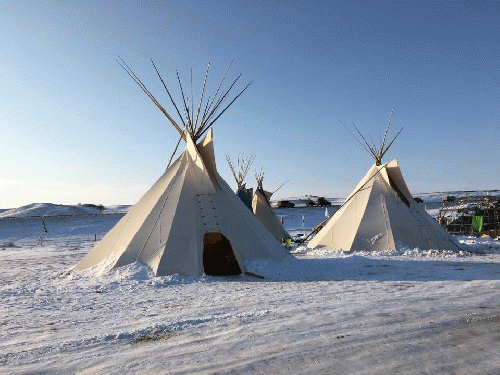
In a separate filing December 7, the Cheyenne River Sioux Tribe (CRST) requested a summary be added to the Friday status conference. "The administrative record remains incomplete, as there are approximately 30 documents that still have not been produced. The Tribes stand ready to work with the other parties to resolve any outstanding disputes over confidentiality."
CRST has a legal leg to stand on. The December 4 ruling by Assistant Secretary of the Army (Civil Works) Jo-Ellen Darcy, withholding the easement for Energy Transfer Partners to drill under Lake Oahe, makes it clear that documents have been withheld from the public record.
"Because of Security concerns and sensitivities, several documents supporting the environmental assessment were marked confidential and withheld from the public or representatives and experts of the Standing Rock Sioux Tribe. These documents include a North Dakota Lake Oahe Spill Model Discussion prepared by the Wood Group Mustang, the Lake Oahe Risk HDD Risk Analysis Report, and the DAPL-Route Comparison and Environmental Justice Considerations Memorandum."
Common sense suggests that documents are withheld only if they damage the argument of the Defendant, in this case the Army Corps of Engineers, and by proxy, DAPL interests.
A review of the timeline of the lawsuit is helpful in this complicated case.
July 27- Standing Rock Sioux Tribe (SRST) files a compliant for Declaratory and Injunctive Relief against the Corps regarding halting the Dakota Access Pipeline.
August 19-The Court orders that The Cheyenne River Sioux Tribe's Motion to Intervene (join the lawsuit) is granted.
September 9. Judge James E. Boasberg denies the motion for a preliminary injunction against DAPL by CRST and SRST and submits a 58-page memorandum in support of his decision.
September 9. click here. Within 30 minutes, a "Joint Statement from the Department of Justice, the Department of the Army and the Department of the Interior regarding Standing Rock Sioux Tribe v. U.S. Army Corps of Engineers" overrules Judge Boasberg and demands that construction of the DAPL must cease on public lands, pending review, and requests a voluntary halt on private land.
September 16. Status conference with Judge James E. Boasberg. Transcript here. See 31-page discussion (begin on page 147) between the Judge and the Corps where a composed, but clearly miffed judge, pointedly asks the Corps why it put him through the arduous process of issuing a ruling under a time constraint when they knew it would be overturned.
November 14. Corps press release click here
December 4. See final denial of easement by Corps.
Here, some of the missing documents, noted by the Cheyenne Sioux Reservation, are identified by Assistant Secretary Darcy.
"Because of Security concerns and sensitivities, several documents supporting the environmental assessment were marked confidential and withheld from the public or representatives and experts of the Standing Rock Sioux Tribe. These documents include a North Dakota Lake Oahe Spill Model Discussion prepared by the Wood Group Mustang, the Lake Oahe Risk HDD Risk Analysis Report, and the DAPL-Route Comparison and Environmental Justice Considerations Memorandum."
December 5. DAPL files a request for a summary judgment "that the U.S. Army Corps of Engineers has issued a right of way under 30 U.S.C. 185(a) allowing Dakota Access LLC and its successors and affiliates to construct, operate, and maintain an oil pipeline beneath federal land at Lake Oahe, North Dakota, and that the right-of-way is subject to the "Conditions of Easement (Lake Oahe)" set forth in the July 25, 2016 Mitigated Findings of No Significant Impact."
December 7. The Cheyenne River Sioux Tribe files a Summary Request. "The administrative record remains incomplete, as there are approximately 30 documents that still have not been produced. The Tribes stand ready to work with the other parties to resolve any outstanding disputes over confidentiality."
A Status Conference is set for Friday, December 9.
The uncertainty in the case of Standing Rock Sioux Tribe vs. the Army Corps of Engineers has been mind-boggling in its confusion. A closer look at the transcripts from the status conference of September 16 offers some insight into the political maneuvering demonstrated by the Corps, and how even the Judge is forced to confront the language of "permits vs. easements."
A story of obfuscation begins on page 147 of the Monday December 5 filing by DAPL. In an email, Jan Hasselman, lead attorney for the Standing Rock Sioux Tribe, clarified that Dakota Access included the 32-page transcript in its 228-page exhibit with their motion. "We posted everything they filed," Hasselman explained in answer to a question as to how the exhibit ended up on the Internet. Usually a transcript will appear in the Case Docket first.
Judge Boasberg takes USACE to task for blindsiding him about the September 9 stop order from the Obama administration, which he suggest was planned in advance, since the press releases came out within a half hour of his 50-plus-page ruling that the project (DAPL) should go forward. The Judge makes it clear he has no stake in whether it goes forward or not, but that he spent a week working on his ruling to expedite things. He wants to know if they had already planned to overrule him, why did they not just tell him the Feds would go over his head in any case. Courtesy to the court would suggest a heads-up.
On page 147, click here an obviously frustrated Judge Boasberg, confronts the USACE attorneys.
"So my first question is: How did this happen? And how is this complying with your duty of candor to the tribunal when you knew, and apparently had known for some time, since the press release talks about coordination among several departments, that you would reverse your opinion, but waited until after my opinion issued? How can this happen?"
USACE stumbles all over itself, but does not offer a clear explanation, except to say that there is a difference between granting a permit, which it did, and granting an easement, which it has not. Note that the ruling that came out this past Sunday (December 4) is in regard to the easement not being granted pending an EIS (Environmental Impact Statement).
In another exchange, the Judge elaborates on his frustration.
"What I do have an opinion on is the way it has been handled and the way that I believe I have -- I won't say been misled -- but that I don't believe the filings have been fully truthful. I think there have been omissions, material omissions, that would have, had I been informed of them, caused different timetables or this to proceed on a different track. That's my concern."
I asked Sandy Rosenthal, founder of Levees.org, who fought the USACE for almost ten years in the case of the massive levee failures in the aftermath of Hurricane Katrina, to offer an opinion on the transcript.
Sandy, you know how the Corps operates. What is going on here?
"In reviewing the transcript, I note two common tactics that the USACE employs when its goal is self-preservation.
"First, I note that attorney Gette defends the Corps' actions out of concern for citizen safety. After the corps' levees broke during Hurricane Katrina, the Corps barred independent expert investigators from accessing the major breach sites, also in the name of "concern for safety." Later, it was found that the Corps was attempting to hide data by controlling the flow information.
"Second, I observe that attorney Thorp cites "ongoing litigation" to defend its position. When my group, Levees.org attempted to list the Katrina levee breach sites to the National Register of Historic Places, the corps also cited "ongoing litigation" to stall our listing. The litigation was irrelevant. Facts are facts, regardless of who may or may not be found guilty of wrongdoing. (Eventually the corps was found responsible, but not liable for the levee failures, due to sovereign immunity.)"
Obscuring the Issue
Anyone reviewing the transcript between the Corps' attorneys and the judge would find the conversation convoluted at best.. The Corps' attorneys say the same thing over and over, yet say nothing of substance.
On page 153, Attorney Michael Thorp who is defending the corps states: "Your honor, the litigation was an evolving situation throughout this entire process." This reads like an excuse to stall on taking a action, whether reasonable or not.
Concern for "Safety"
On page 154, Attorney James Gette states, "As you know from the taxing week that I'm sure you had, it was a very challenging and fluid situation, both on the ground and legally, as well, as we presented our arguments to you. During that process, our client agencies were grappling with some very heady and important issues, including issues of public safety and public concern."
Thorp on page 153 also uses this tactic when he said this: "Your honor, the litigation was an evolving situation throughout this entire process." Was this another delay tactic, using mounting demonstrations at Oceti Sakowin after security personal from DAPL used attack dogs against protestors on September 3 as "issues of public safety and concern?"
However one wishes to read the tea leaves in this ongoing litigation, what will be most interesting will be the revelation of the missing documents, IF they are made available to the public.
Someone is manipulating the truth in this case, but truth has a way of revealing herself.
Meanwhile, even though the Dakota Pipeline Project is halted as the Obama administration holds back the easement, the fate of the pipeline is uncertain. President-elect Donald Trump has indicated support of the pipeline while also saying he wants to review the process after he takes office.
(Article changed on December 8, 2016 at 20:36)
Authors Website: http://www.georgianne-nienaber.com
Authors Bio:
Georgianne Nienaber is an investigative environmental and political writer. She lives in rural northern Minnesota and South Florida. Her articles have appeared in The Society of Professional Journalists' Online Quill Magazine, the Huffington Post, The Ugandan Independent, Rwanda's New Times, India's TerraGreen, COA News, ZNET, OpEdNews, Glide Magazine, The Journal of the International Primate Protection League, Africa Front, The United Nations Publication, A Civil Society Observer, Bitch Magazine, and Zimbabwe's The Daily Mirror. Her fiction expose of insurance fraud in the horse industry, Horse Sense, was re-released in early 2006. Gorilla Dreams: The Legacy of Dian Fossey was also released in 2006. Nienaber spent much of 2007 doing research in South Africa, Rwanda and the Democratic Republic of Congo. She was in DRC as a MONUC-accredited journalist, and was living in Southern Louisiana investigating hurricane reconstruction and getting to know the people there in 2007. Nienaber is continuing "to explore the magic of the Deep South." She was a member of the Memphis Chapter of the National Academy of Recording Arts and Sciences and is a current member of Investigative Rorters and Editors.