| Back OpEdNews | |||||||
|
Original Content at https://www.opednews.com/articles/Elections-that-Went-to-Pot-by-Meryl-Ann-Butler-Cannabis_Elections-And-Campaigns_Marijuana_Medical-161206-776.html (Note: You can view every article as one long page if you sign up as an Advocate Member, or higher). |
|||||||
December 6, 2016
Elections that Went to Pot: It's a Good Thing!
By Meryl Ann Butler
The good news from the November 2016 elections is that more Americans will have access to medical and recreational marijuana. We've invited Norma Eckroate, the author of the groundbreaking book, "The Medical Marijuana Handbook: A Patient's Guide to Holistic Healing with Cannabis" to weigh in on why so many people are, for the first time, flocking to this natural herb as a healing solution.
::::::::
The good news from the November 2016 election results is that Florida, North Dakota, and Arkansas legalized medical marijuana, and Montana voted to expand medical marijuana rights. (According to Boston 7 News WHDH, "A recount of a public referendum that legalized recreational marijuana use in Maine is getting underway in the state's capital city.")
Twenty-seven states now have some form of legalized marijuana. (More details in sidebar below.)
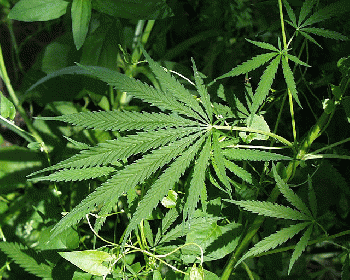
Marijuana
(Image by (From Wikimedia) United States Fish and Wildlife Service, Author: United States Fish and Wildlife Service) Details Source DMCA
Many more Americans now have a legal path to this medicinal herb. Both medical users and recreational users can benefit from the many healing qualities of cannabis. More and more medical and scientific experts are saying that medical marijuana may provide relief in situations where pharmaceutical drugs fall short. It's more natural and therefore easier for the body to interact with and it has fewer side effects -- and it's almost always much less expensive.
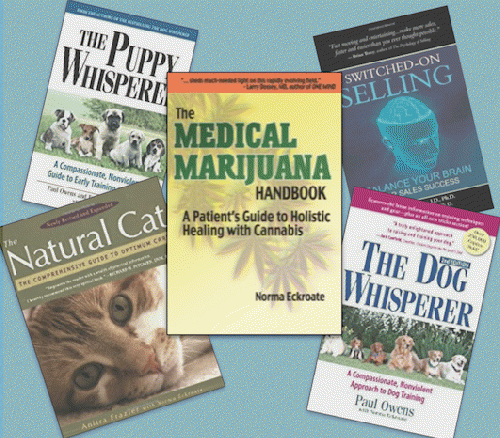
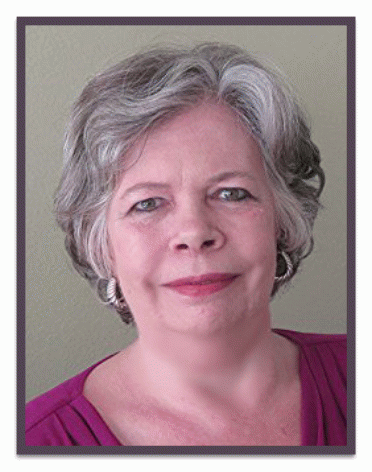
Norma Eckroate is the author of the groundbreaking book, The Medical Marijuana Handbook: A Patient's Guide to Holistic Healing with Cannabis. She has co-authored a dozen books, including the holistic bestsellers The Natural Cat, The Dog Whisperer: A Compassionate, Nonviolent Approach to Dog Training, and The Puppy Whisperer. Lately she's been exploring holistic health for humans, and she joined us for an interview today.
Meryl Ann Butler: Thank you for visiting with us, Norma. I've been reading your comprehensive book and I see that it really fills a need. What makes your book unique in the field of medical marijuana?
Norma Eckroate: Well, in addition to lots of nitty-gritty facts about medical marijuana, I draw on my background as a licensed spiritual counselor to explain the importance of integrating body-mind-spirit perspectives in optimizing healing and well-being.
My book also includes a look at some of the ways that natural remedies, like medicinal herbs, are different from pharmaceuticals -- and why they can be more conducive to healing.
MAB: So tell us, how did a little Ohio farm girl end up writing a handbook about pot?
NE: I'm probably more surprised that I'm using marijuana than anyone else. Even though I live in California and could have legally used it since 1996, it was frankly too scary to pursue. During most of those years, the federal government was still jailing people for possession, even though medical marijuana was legal on a state level.
But, over many years, a lifelong health challenge -- a mild form of cerebral palsy -- became much more difficult to deal with. Muscle spasms and pain, along with other symptoms, made sleep more and more elusive.
Because I was concerned about the addictive aspects of pharmaceutical painkillers -- as well as other side effects -- I opted for over-the-counter painkillers instead, always taking the minimum amount that would quell the pain enough for me to sleep. For decades, I took over-the-counter painkillers, avoiding the prescription drugs that doctors wanted to prescribe for me.
Then, a new doctor, who was concerned about my condition and a lack of restorative sleep, convinced me to try a new type of opioid painkiller, explaining that it didn't have as many side effects as others. But that didn't work out so well as, over time, I needed more and more of it to get to sleep, and I still woke during the night, needing to take more. I felt like I had become addicted to it. And I still felt lousy. I was desperate.
Finally, to her great credit, it was that same doctor who encouraged me to try medical marijuana -- and discontinue the pharmaceutical painkiller.

MAB: What are the benefits of medical marijuana? Why is it better than allopathic alternatives?
NE: Science has an awesome answer to this question! In the 1990s, scientists made an amazing discovery that made it clear why marijuana is one of the most effective super-herbs on the planet. They found that marijuana -- which I also refer to by its scientific name, cannabis -- is a "match" to receptors in the cells of our own bodies.
When we ingest cannabis, the receptors in our cells greet the herb in a synergistic way, assisting the entire system in handling biological functions -- and defending the body from any challenges to those functions.
The scientists honored the plant by naming the body's own newly-discovered, internal counterpart after it. They added the prefix "endo," which means "in, within, inside," to the word "cannabinoid" (one of the types of chemicals in cannabis) to create the word endocannabinoid.
Your body's endocannabinoid system is considered to be the largest neurotransmitter system in your body.

MAB: Wow, that's amazing!
NE: Yes, it's awesome the way Nature has provided us with so many healing botanicals -- and marijuana is certainly one of the most highly effective. The fact that the plant's chemistry is a match to the body's endocannabinoid system makes it unique among botanicals that have medicinal qualities -- and that is believed to be the reason why it is so very healing for so many health symptoms and concerns.
When I first started using medical marijuana about four years ago, I met a couple of medical marijuana experts who were proclaiming their excitement about the endocannabinoid system in the human body. But I didn't really understand what they were saying until I found an article in Scientific American that summarized it this way:
"Research into natural chemicals that mimic marijuana's effects in the brain could help to explain -- and suggest treatments for -- pain, anxiety, eating disorders, phobias and other conditions."
In fact, the title of the article this is excerpted from, "The Brain's Own Marijuana," almost says it all.
Imagine that -- the cells in our own brains contain chemicals that mimic marijuana!
MAB: It's rewarding to see the scientific research on these things -- which many former hippies certainly suspected!
NE: Well, it's not just hippies who knew there was something inherently special in cannabis. Until the early 1900s, cannabis was in almost every doctor's medical bag. Back then, every doctor was a botanist because medicines came from Nature -- and cannabis was known to help with many health concerns, from minor issues such as anxiety and sleeplessness to serious health challenges. When a body is imbalanced, cannabis helps it achieve homeostasis. (See the book excerpt below for more info on "The Role of Cannabis in Promoting Homeostasis.")
MAB: Do you have any anecdotal stories of healing to share with us?
NE: Actually, the most amazing stories are those of people who experience quick and dramatic benefits. I was delighted to see an example of that in this 2-minute video clip from the award-winning feature documentary, "Ride with Larry." It shows a retired police captain with advanced Parkinson's disease trying medical marijuana for the first time. You can actually watch Larry's debilitating symptoms quickly and dramatically improve in just a few minutes after he takes one drop of cannabis oil.
NE: While not all patients experience such rapid and dramatic improvement, there are many different strains of marijuana available today, each with its own unique chemical profile. Finding the right one for you may require research and experimentation. And taking the time to do so is imperative to obtaining the best possible results.
MAB: That video is amazing to watch, as well as heartbreaking. It's sad to see his wife's distress at the fact that such an easy and effective treatment is not available to him due to their state's laws. I'm glad this election has made the benefits of medical marijuana available to so many more people. Norma, what is most important thing for these "newbies" who are thinking of trying medical marijuana to know?
NE: When people hear the term "medical marijuana," many of them think of two things -- smoking a joint and the psychoactive "high" or "stoned" effect. But, these days, "smoking" is optional and, in many cases, so is the "high."
Smoking a joint is fine for those who want to ingest marijuana that way. But there are numerous other ways, including my preferred methods: tinctures, capsules, lozenges, and chocolates.
MAB: Chocolate! That sounds like a great way!
NE: Yes, there are lots of edible products that are easy to take.
In terms of the "high," not all marijuana products cause psychoactivity. It all depends on the ratio of THC (tetrahydrocannabinol) in the specific plant. Over many years, starting in the 1930s and 40s, the illegal back-alley trade created strains that were higher and higher in THC, making it much more psychoactive than the strains prescribed by doctors in prior generations.
Today, medical marijuana experts are trying to recreate those more medicinal strains with a focus on the most healing ratios of the hundreds of chemicals in each plant. But it's a time-consuming process because it can take five or even ten years to create a new strain. As one expert explained to me, "It's like starting from scratch since we don't even know the chemical profiles of the most healing strains from yesteryear."
Throughout my book, I continually clarify that each strain of marijuana is like a different medicine. Not all strains and forms of marijuana are efficacious for all conditions -- so patients need to research their options. But it gets confusing because, in some states, a doctor who recommends that you use medical marijuana is NOT legally allowed to tell you where to go to buy it or what strain, potency, or dosage to choose. So, instead of being given solid advice on a specific marijuana product to purchase by a trusted medical expert, patients are on their own in making those decisions.
While it's hard to imagine a similar scenario in the world of medicine, here is an analogy: Let's say your doctor wrote you a prescription for an antibiotic. But, instead of writing down which of the 100-plus antibiotics in the pharmacy that she wanted you to take, and the dosage, she simply wrote "antibiotic" on the prescription and signed it. The pharmacist would be flummoxed and, of course, unable to fill the prescription.
While some medical marijuana patients like the experience of the "high," others, like me, find it challenging. Too much THC makes me wobbly -- and since I'm already a bit wobbly, I have to be careful that I don't take too much. However, I can't sleep if I take too little THC either.
That's why it's helpful to experiment with different products until you find a strain with the best chemical profile for you -- and then you also need to determine the best dosage for yourself, as well.
There are two types of cannabis products that typically do not cause a psychoactive high and are extremely efficacious for many people:
1. HIGH-CBD means "No High":
Patients who don't want the cannabis "high" may find efficacy in products that are very high in the chemical compound, CBD (cannabidiol), and contain less than 0.3% of THC (tetrahydrocannabinol which causes psychoactivity.)
There are many high-CBD products currently being sold across the U.S. without restrictions because of the negligible amount of THC they contain.
Several years ago, Charlotte Figi, a five-year-old with Dravet Syndrome, a type of epilepsy that causes debilitating and life-threatening seizures, was helped in a dramatic way by a high-CBD product that was eventually named Charlotte's Web after her. And now many more patients are being helped by similar strains.
However, as long as cannabis is still considered illegal on a federal basis, it is possible that the government could ban high-CBD products or decide to treat them like their high-THC cousins. (Please note: in addition to high-CBD products that contain less than 0.3% THC, many strains that contain a fair amount of THC may cause little to no psychoactivity because they have been bred to contain more CBD than THC, such as 4 to 1 or, let's say, 40 mg. CBD to 10 mg. THC. In some of those cases, the large amount of CBD may minimize the psychoactive qualities of the THC.)
2. RAW cannabis products:
As long as cannabis is consumed in a raw form, any THC in it is basically inactive. That's because, in its raw state, the THC is actually THCa.
The "a" at the end of THCa stands for "acid" and it only converts to actual THC when it is exposed to heat. If there's no heat involved, there is no psychoactivity present in cannabis. Raw cannabis juice and cannabis oil capsules that are produced with a cold-processing method are among the raw products being used by today's patients.
(Note: Exposure to a small amount of heat may cause a bit of the THCa to convert to THC. For example, even the heat from a juicer can cause this; however, as long as caution is taken, it is generally a tiny amount.)

MAB: Thanks so much for visiting with us, Norma, this has been enlightening. Any last thoughts?
NE: There is lots more information on my website, and visitors can download 3 FREE chapters from the book!
Thanks so much for the opportunity to visit with OpEdNews! I am so delighted that so many people are waking up to the potential for healing and greater well-being through the many natural and alternative methods that are available today. And, because of the many ways it has helped me personally, I find cannabis to be one of the most important!
The Medical Marijuana Handbook: A Patient's Guide to Holistic Healing with Cannabis is available at retailers everywhere and online at Amazon.com and Barnes and Noble.com.
Norma Eckroate's website is www.NormaEckroate.com, where you can download three free chapters from her book.

Excerpt from "The Medical Marijuana Handbook: A Patient's Guide to Holistic Healing with Cannabis," by Norma Eckroate, pg 13-15:
The Role of Cannabis in Promoting Homeostasis
There's a lot going on in your body simultaneously; it is set up for balance and harmony, with a goal of promoting maximum wellness. The body's constant effort to maintain equilibrium among all of its internal processes and systems is called homeostasis, which the Merriam Webster Dictionary defines as "the maintenance of relatively stable internal physiological conditions (as body temperature or the pH of blood) in higher animals under fluctuating environmental conditions." [i] Early on in my research, I learned that cannabis has healing properties that promote this important function in the body.
As the body pursues optimal harmony and balance through homeostasis, it is constantly in the process of compensating. When one process or system is out of balance, another process or system compensates for the system that is not fully functioning. One example is the body's ability to regulate temperature. As the body gets too hot or too cold, it will compensate to deal with the change in temperature. That's why you sweat on a hot day; it's the body's way of cooling down.
The "repair and replace" mechanism within all of the cells in your body is also part of homeostasis. In fact, in the second that it took you to read the previous sentence, thousands of your cells were automatically repaired or replaced with new cells. The body's intelligence is mind-blowing and its ability to prioritize is what homeostasis is all about.
Imbalances in any of your body's systems throw it off balance and out of whack and require compensating systems to restore balance. For most of us, these compensating mechanisms kick in automatically and keep us healthy, especially when we're young. If we get a cold or flu, our immune system goes to work and we are soon well again. If there's a toxin in the air, the body compensates, handles it, and we don't even know about it because the body is programmed for wellness. It automatically compensates over and over to ensure survival with the very best outcome. That is, unless it's overwhelmed and unable to handle the challenges that come its way, including infections, parasites, and environmental toxins. And, in addition to the tangible challenges that we deal with in the physical world, emotional traumas and negative thinking can also impact the body chemistry in negative ways and impact our health.
So how does homeostasis fit into the scheme of things when the subject is cannabis? Well, anything that helps the body deal with its imbalances will help it get back into homeostasis. While the ratios of the chemical compounds in cannabis vary from strain to strain, scientists have discovered a wide range of positive effects from these healing chemicals, including effects that are anti-inflammatory, anti-epileptic, anti-ischemic, anti-diabetic, anti-psychotic, anti-nausea, anti-spasmodic, antibiotic, anti-anxiety, anti-depressant, anti-proliferative, and anti-neoplastic (inhibiting development of malignant cells).
Even knowing all of this, it took a while for me to understand why cannabis is so significant and powerful, and why its healing properties are utilized by our bodies to such an amazing extent. As you will learn in these chapters, cannabis truly has a special and unique place in the world of botanicals, which is why many doctors and other health professionals are now recommending it to patients.
Most medicinal herbs give us results over a period of time; their action is usually not very fast and we might not feel the beneficial effects for days, weeks, or even months. That's why it's important to give medicinal herbs time to do their work and not give up on them too soon. It's okay that it takes time, because we understand that medicinal herbs heal on a causal basis. One of my mentors recently used the term "softer" to describe the healing we receive from herbs and many other holistic modalities. I like that terminology because experts in herbal medicine tell us that herbs heal on a deeper level than pharmaceuticals, and that does feel softer to me. When we take a medicinal herb that benefits our body, it does so by getting to the root of problems and restoring balance.
While it can take time for a major health issue to be helped, or in some cases, even resolved with cannabis medicine, most patients experience some of its beneficial effects almost immediately, especially if they are astute in noticing their body's responses. For example, you might immediately notice deeper, more relaxed breathing, and more relaxation in the muscles and skeletal system, which can result in better sleep, fewer bathroom visits during the night, improved lung function, and/or greater endurance and stamina. Cannabis can also quickly boost a patient's mental attitude and it's known for giving quick relief to those suffering from nausea or lack of appetite.

Marijuana Plant 03
(Image by (From Wikimedia) User:Jennifer Martin, Author: User:Jennifer Martin) Details Source DMCA
States with some form of legalized medical marijuana (at the time of this writing):
1. Alaska
2. Arizona
3. Arkansas
4. California
5. Colorado
6. Connecticut
7. Delaware
8. Florida
9. Hawaii
10. Illinois
11. Maine
12. Maryland
13. Massachusetts
14. Michigan
15. Minnesota
16. Montana
17. Nevada
18. New Hampshire
19. New Jersey
20. New Mexico
21. New York
22. North Dakota
23. Oregon
24. Pennsylvania
25. Rhode Island
26. Vermont
27. Washington
States which have legalized recreational marijuana:
1. Alaska
2. California
3. Colorado
4. Oregon
5. Massachusetts
6. Nevada
7. Washington
Note: Maine is currently in a recount.
Info from "Where Is Marijuana Legal in the United States? List of Recreational and Medicinal States."
The video clip in this article shows the effects of cannabis on Parkinson's tremor dyskinesia. It is from the award-winning feature documentary, "Ride with Larry" and shows retired police captain Larry trying medical marijuana for the first time. The full film is now available to stream and to own on Amazon: www.ridewithlarrymovie.com
Authors Website: http://www.OceanViewArts.com
Authors Bio:
Meryl Ann Butler is an award-winning artist, author, educator, and Managing Editor of OpEdNews, where her articles and other contributions have received more than 4.5 million views. She has written for OpEdNews since 2004 and has been Managing Editor since 2013. In 2015, her work on OpEdNews passed one million views with her article about Bree Newsome's removal of a Confederate flag; she was delighted that this particular story carried her across her first million-view milestone. Her article topics range from art, creativity, spirituality, women's issues, and feminine empowerment to politics, social justice, and the occasional irresistible absurdity. Her popular Art & Creativity series includes nearly 200 articles and has received more than half a million views. Butler has been creating and teaching art for many decades. Her artwork, in a wide variety of media, is in collections around the world. She is the author of two quilting books, including a niche-market bestseller. Her adventures have included two trips to the former USSR as a citizen diplomat, where she spoke in Moscow and Odessa and met with artists, craftspeople, and fashion designers about using the arts as a tool for global wellbeing. In 1987-88, she created the historic First US-Soviet Children's Peace Quilt Exchange Project with a school in Odessa, an exchange that brought the first reciprocal quilt from the former USSR to the United States. Butler's assorted roles have included journalist, international workshop facilitator and speaker, labyrinth designer and builder, founding member of The Labyrinth Society, entrepreneur, Renaissance woman, proud gramma and, on one memorable occasion, unexpected babycatcher, when the midwife was stuck in traffic. Interviews & Features Media appearances include an interview about her Near Death Experience and how it influenced her art on the JeffMara Podcast, with over 17,000 views. Her YouTube channel, @Merylannb, features "Visionary Artist Meryl Ann Butler on Creativity and Joy," "The Art of Creating Wellbeing Amidst Chaos (Art vs. Tyranny)," and "How to Stitch a Quilt in 90 Minutes with Meryl Ann Butler," which has over 79,000 views.