| Back OpEdNews | |||||||
|
Original Content at https://www.opednews.com/articles/Job-Guru-Kerry-Hannon-on-C-by-Joan-Brunwasser-AARP_Advice_Ageism_Author-161130-517.html (Note: You can view every article as one long page if you sign up as an Advocate Member, or higher). |
|||||||
November 30, 2016
Job Guru Kerry Hannon on Combatting Workplace Ageism
By Joan Brunwasser
There's no denying it, ageism is alive and well in the workplace. At the same time, I know first hand that experienced workers are landing jobs and are moving up the rungs, they're still engaged, getting noticed and feeling valued, and honestly loving their current positions. The key is to believe in yourself. Have some swagger. Keep your skills and energy sharp. Network like crazy. And always be open to trying new things.
::::::::
My guest today is Kerry Hannon, New York times columnist and nationally acclaimed expert on job satisfaction, career transition, personal finance and retirement. She is also the author of ten books.
Joan Brunwasser: Welcome to OpEdNews, Kerry. Your recent piece 5 Employers That Welcome Older Workers [11.27.16] caught my eye. I had assumed that age discrimination is rampant and that the more mature worker is essentially extraneous in today's struggling economy. You disagree? Get us started, please.
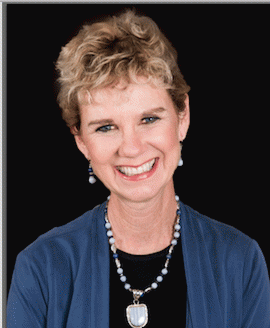
Kerry Hannon: I disagree. Yes, there's no denying it, ageism is alive and well in the workplace. It's subtle, but the old, 'your expiration date is nearing' undercurrent is ever present in many companies.
You're passed over for promotions, not offered plum stretch assignments, raises disappear, and drip-by-drip you become invisible.
At the same time, I know first hand that experienced workers are landing jobs and are moving up the rungs, they're still engaged, getting noticed and feeling valued, and honestly loving their current positions. I find it's often is a matter of attitude and taking control of your destiny. It's the Me Inc. philosophy of work.
I agree there are the broad stereotypes that may be true on an individual basis, but can't be applied to all workers over 50. Yes, employers do worry that you don't have the energy and stamina for the job. They're concerned that you aren't up to speed with technology, won't play nicely with a younger boss, are too expensive and overqualified. But there are ways to prove them wrong, and many workers are doing just that. I can get into that a little later.
Just look at the facts: The percentage of workers over age 50 is growing. In fact, the hottest demographic in the labor market: men and women working into their 70s, 80s. Over the coming decade, they'll be the fastest-growing segment of the workforce, according to the Bureau of Labor Statistics. Among 65- to 74-year-olds, labor force participation is predicted to hit 32 percent by 2022, up from 20 percent in 2002. At age 75 and up, the rate will jump from 5 percent in 2002 to 11 percent in 2022. Meantime, participation rates among younger age groups will be flat or will even fall.
Moreover, as the U.S. economy shifts from physically-demanding manufacturing jobs to service positions, there are more jobs in which cognitive skills and tapping your knowledge and experience are the key. That translates to more opportunities for older workers.
It's true, though, that for a worker 55 and older, it does often take longer to land a new job when you lose one, than it does someone younger. And it's imperative that you keep your resume alive by skill-based volunteering or doing part-time consulting projects, while you job hunt! Keeping your skills up to date and sharp is non-negotiable.
JB: This is quite heartening. Let's talk brass tacks. In order to get a foot in the door, you need to send a resume, with or without cover letter. If it contains a picture or other "evidence," the potential employer will know that you are not a newly minted college grad. Can a resume/cover letter overcome that initial age prejudice?
KH: Yikes. No photos on resumes, please. You are not looking for a date. The key to a great resume is short, no more than two pages, and tell your story.
Think advertisement not obituary. Cull to last 10 or 15 years of jobs listed. Package your earlier experiences into one paragraph at the end of your resumes 'experience' section and omit dates. And only use the work history that's relevant to the job you're applying for now.
Don't just list a title and job description, but explain how you raised 15 percent more than the fundraising goal, brought a project in two months ahead of schedule, ramped up sales by 20 percent in six months. Something that shows what you can do and how you can hit the ground running. Employers are looking for people who can solve their problem right now.
Experienced workers have that in their quiver. That said, be sure you have attained the credentials required for the job, and use keywords from the job posting in your resume whenever possible, in case there's an automated screening system. Don't put dates of graduation and so forth. They will figure that out. And truthfully, that's not a bad thing. Years of experience won't cost you the job. Not having an up-to-date skill set will.
You might need a new email address. Using an AOL, Hotmail or Yahoo email address on a resume can hold people back from landing an interview. It says you are not up with the times, and you're not tech savvy.
If possible, use an email address that includes your full name, such as johnsmith@gmail.com, or one that includes your own domain name, such as kerry@kerryhannon.com. You can get a free Gmail address by going to Google's site.

JB: Great suggestions. That's so interesting about the email address. Who would think that a detail like that can indicate a mindset? Although, now that I think of it, I think I read about a study that showed that you can measure people's creativity by which web browser they use. Same principle. Can you share some resources to make older workers more attractive and more confident about our value to the workplace?
KH: Absolutely. I advise everyone to spend some time on the AARP site. Lots of great material and advice, resources, and not only my Great Jobs column. Also PBS NextAvenue.org, the Work & Purpose section, is fabulous and, again, I have a column that runs there, but Richard Eisenberg, Chris Farrell and Nancy Collamer provide smart expert advice. Here is the link.
In addition, there's in-depth information on the site Job-Hunt.orgSusan Joyce is a job expert that runs this site and there's lots of great guidance for workers over 50.
And of course, my books, Getting the Job You Want After 50, Great Jobs for Everyone 50+, What's Next?And Love Your Jobare packed full of resources, can-do advice on everything from resumes to interviews to starting your own business, and inspirational stories.
I pull together my columns from The New York Times, Money, PBS Next Avenue, AARP and others, plus videos and more on my website, www.KerryHannon.com.
JB: A veritable treasure trove of resources! What haven't we touched on that you'd like to mention before we wrap this up?
KH: If you're looking for work, the key is to believe in yourself. Have some swagger. Keep your skills and energy sharp. Network like crazy. And always be open to trying new things.
JB: You've given us a lot to digest and integrate. Thanks so much for talking with me, Kerry. It's been a pleasure!
***
Website: KerryHannon.com
@KerryHannon
Linkedin.com/in/kerryhannon
Kerry Hannon has spent more than two decades covering all aspects of careers, business and personal finance as a columnist, editor, and writer for the nation's leading media companies, including The New York Times, Forbes, Money, U.S. News & World Report, and USA Today. Kerry's work has also regularly appeared in BusinessWeek, Kiplinger's Personal Finance,The Wall Street Journal, and Reader's Digest, among other national publications. She has appeared as a financial expert on ABC News, CBS, CNBC, NBC Nightly News, NPR, and PBS.
Authors Website: http://www.opednews.com/author/author79.html
Authors Bio:
Joan Brunwasser is a co-founder of Citizens for Election Reform (CER) which since 2005 existed for the sole purpose of raising the public awareness of the critical need for election reform. Our goal: to restore fair, accurate, transparent, secure elections where votes are cast in private and counted in public. Because the problems with electronic (computerized) voting systems include a lack of transparency and the ability to accurately check and authenticate the vote cast, these systems can alter election results and therefore are simply antithetical to democratic principles and functioning.
Since the pivotal 2004 Presidential election, Joan has come to see the connection between a broken election system, a dysfunctional, corporate media and a total lack of campaign finance reform. This has led her to enlarge the parameters of her writing to include interviews with whistle-blowers and articulate others who give a view quite different from that presented by the mainstream media. She also turns the spotlight on activists and ordinary folks who are striving to make a difference, to clean up and improve their corner of the world. By focusing on these intrepid individuals, she gives hope and inspiration to those who might otherwise be turned off and alienated. She also interviews people in the arts in all their variations - authors, journalists, filmmakers, actors, playwrights, and artists. Why? The bottom line: without art and inspiration, we lose one of the best parts of ourselves. And we're all in this together. If Joan can keep even one of her fellow citizens going another day, she considers her job well done.
When Joan hit one million page views, OEN Managing Editor, Meryl Ann Butler interviewed her, turning interviewer briefly into interviewee. Read the interview here.
While the news is often quite depressing, Joan nevertheless strives to maintain her mantra: "Grab life now in an exuberant embrace!"
Joan has been Election Integrity Editor for OpEdNews since December, 2005. Her articles also appear at Huffington Post, RepublicMedia.TV and Scoop.co.nz.