| Back OpEdNews | |||||||
|
Original Content at https://www.opednews.com/articles/What-s-Wrong-with-Paul-Kru-by-Thomas-Farrell-Abortion_Anger_Democratic_Electoral-College-161125-794.html (Note: You can view every article as one long page if you sign up as an Advocate Member, or higher). |
|||||||
November 25, 2016
What's Wrong with Paul Krugman's Analysis of Trump's Decisive Electoral Victory?
By Thomas Farrell
The liberal economist Paul Krugman supported former Secretary of State Hillary Rodham Clinton, the Democratic Party's 2016 presidential candidate. As a result, perhaps Krugman was blindsided when the Republican Party's 2016 candidate, Donald J. Trump emerged with a decisive electoral victory. Krugman's analysis of Trump's victory is not cogent or compelling.
::::::::
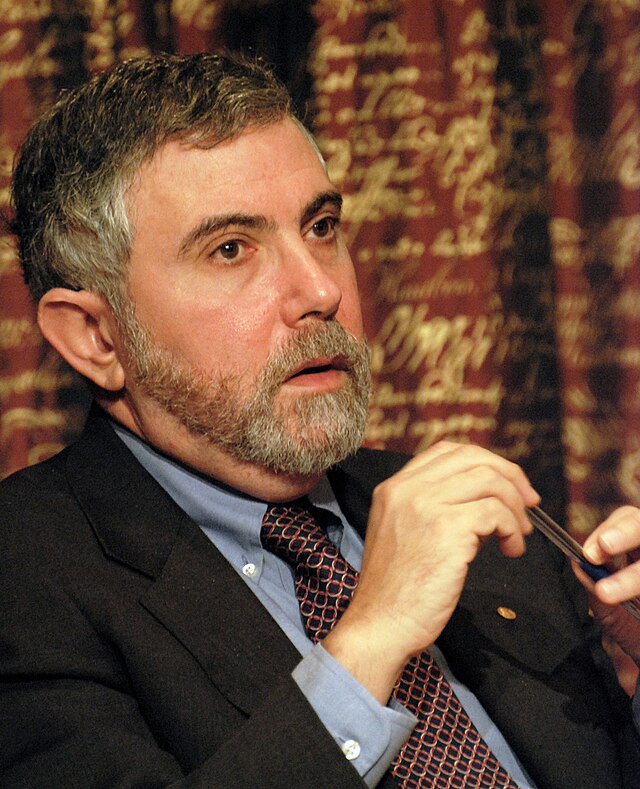
Duluth, Minnesota (OpEdNews) November 25, 2016: The Nobel-prize winning economist Paul Krugman specializes in macro-economics. At times, he writes about macro-economics in connection with social justice -- a theme that ancient Hebrew prophets such as Amos pioneered centuries ago. However, in his column titled "The Populism Perplex" in the New York Times (dated November 25, 2016), Krugman appears to be unaware that certain other moral themes can motivate American voters to vote for or against a certain presidential candidate.
For example, in the 2016 presidential election, the Republican Party's candidate, Donald J. Trump, made big-sounding statements against legalized abortion and big-sounding statements about the kind of conservative justices he would nominate for the U.S. Supreme Court. But Krugman mentions neither abortion nor the Supreme Court in "The Populism Perplex," his post-mortem autopsy of the 2016 presidential election results and Trump's decisive electoral victory. Krugman did not predict Trump's decisive electoral victory, and Krugman may have been blindsided by it.
Not surprisingly, the Democratic Party's candidate, former Secretary of State Hillary Rodham Clinton, strongly supported legalized abortion.
No doubt Hillary understood that she needed 270 electoral votes to win the presidency. She won the popular vote by a substantial margin, but lost the electoral vote decisively.
Krugman claims that "what put Donald Trump in striking distance was overwhelming support from whites without college degrees."
Krugman also says, "Maybe a Trump administration can keep its supporters on board, not by improving their lives [economically], but by feeding their sense of resentment."
QUESTIONS: Aren't certain Hillary supporters also motivated by a sense of resentment? Isn't resentment the drive force of "identity politics"? But what kinds of things have contributed in the past to building up the alleged sense of resentment of Trump's supporters?
Krugman delineates one specific example involving the vote in eastern Kentucky, and then says, "The only way to make sense of what happened is to see the vote as an expression of, well, identity politics -- some combination of white resentment at what voters see as favoritism toward non-whites (even though it isn't) and anger on the part of the less educated at liberal elites whom they imagine look down on them."
I have discussed "identity politics" in my OEN piece "What is 'Identity Politics' -- and What's Wrong with It?"
Please note here that Krugman's claim that this is "The only way to make sense of what happened" appears to exclude any other possible way to make sense of what happened such as religious values and the abortion debate.
In the spirit of giving credit where credit is due, I want to give Krugman credit for also saying, "To be honest, I don't fully understand this resentment." I would say that this is an under-statement.
Nevertheless, our Nobel-prize-winning economist ends by saying that "the white working class just voted overwhelmingly against its own economic interests."
Ah, homo economicus.
But what about homo religious?
Isn't it a wee bit patronizing for Krugman to write about white working class voters without even considering that they may be motivated at least in part by non-economic interests involving religious values and the abortion debate?
Authors Website: http://www.d.umn.edu/~tfarrell
Authors Bio:
Thomas James Farrell is professor emeritus of writing studies at the University of Minnesota Duluth (UMD). He started teaching at UMD in Fall 1987, and he retired from UMD at the end of May 2009. He was born in 1944. He holds three degrees from Saint Louis University (SLU): B.A. in English, 1966; M.A.(T) in English 1968; Ph.D.in higher education, 1974. On May 16, 1969, the editors of the SLU student newspaper named him Man of the Year, an honor customarily conferred on an administrator or a faculty member, not on a graduate student -- nor on a woman up to that time. He is the proud author of the book WALTER ONG'S CONTRIBUTIONS TO CULTURAL STUDIES: THE PHENOMENOLOGY OF THE WORD AND I-THOU COMMUNICATION (Cresskill, NJ: Hampton Press, 2000; 2nd ed. 2009, forthcoming). The first edition won the 2001 Marshall McLuhan Award for Outstanding Book in the Field of Media Ecology conferred by the Media Ecology Association. For further information about his education and his publications, see his UMD homepage: Click here to visit Dr. Farrell's homepage.
On September 10 and 22, 2009, he discussed Walter Ong's work on the blog radio talk show "Ethics Talk" that is hosted by Hope May in philosophy at Central Michigan University. Each hour-long show has been archived and is available for people who missed the live broadcast to listen to. Here are the website addresses for the two archived shows:
Click here to listen the Technologizing of the Word Interview
Click here to listen the Ramus, Method & The Decay of Dialogue Interview