| Back OpEdNews | |||||||
|
Original Content at https://www.opednews.com/articles/Why-Capitalism-Is-Failing-by-Timothy-Gatto-Capitalism_Capitalism-Failures_Corporations_Deficit-160902-259.html (Note: You can view every article as one long page if you sign up as an Advocate Member, or higher). |
|||||||
September 2, 2016
Why Capitalism Is Failing
By Timothy Gatto
Today, there are leading intellectuals, such as Chris Hedges among others, who are saying that capitalism is in its death throes. Having never been a fan of unfettered capitalism, I find this verdict a source of hope for constructive change, but also of fear for what could be very dangerous consequences.
::::::::
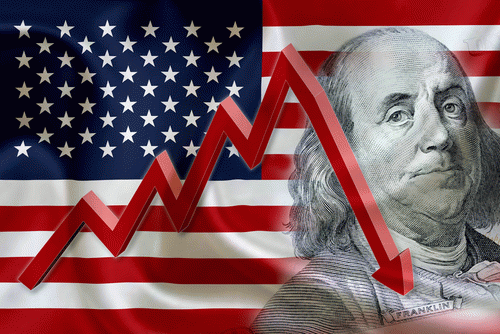
Why Capitalism Is Failing
(I am writing a series of articles on the failures of our capitalistic economy because I want people to start asking the question: Why is all this happening?)
When I started to write about politics, my biggest concern was the role money played in it. Consequently, my earliest articles were about campaign finance reform and stopping billionaires and multinational corporations from buying the election of politicians who would do their bidding. I saw that flouting of the democratic process as the greatest evil in our political system.
I still believe that money in politics is one of our most important problems and should remain a great concern. No doubt many supporters of Senator Sanders will agree with me. Bernie not only emphasized the corrupting effect of money in politics over the course of his presidential primary campaign; he has raised the issue again in his new spin-off movement, called "Our Revolution," which is designed to support and elect genuine progressives to office at every level of government from the bottom up. I should note that I agree with Bernie not only on this issue but on most of what he says. At the same time, however, I feel he is missing the boat on something that is even more sinister and more dangerous to our republic than anything that has come before.
As background to this point, I should mention the following: I don't have a PhD in economics or an MBA in business. I've never held political office, and I attended college for only two years. Still, that doesn't mean I haven't learned many things in the 65 years I've been on this earth. One important thing I've learned is that history is written by the victors. I watch many documentaries that portray leaders as people who are gifted with some kind of vision that allows them to do exceptional things; they are made to appear bigger than life and often presented as virtual demigods compared to other men. I've also seen how the narratives about such men differ, depending on when a documentary was made or an article was written, and how they change through the decades in parallel with evolving social values. A good example is Franklin Delano Roosevelt. I was brought up to believe that FDR was a giant among men. That seemed evident in the fact that he worked in behalf of the common man despite having roots in a wealthy family that came as close to aristocracy as you can get in America. Now, however, I read that FDR was not just trying to lift the common man; he was also trying to save capitalism.
Today, there are leading intellectuals, such as Chris Hedges among others, who are saying that capitalism is in its death throes. Having never been a fan of unfettered capitalism, I find this verdict a source of hope for constructive change, but also of fear for what could be very dangerous consequences. The outcome hinges precisely on the point on which I think Bernie Sanders--who wants to reform the capitalism we now have without changing its underlying structure--misses the boat. I strongly believe that, without fundamental structural change that extends to the political economy as a whole, the capitalist system will surely collapse. But I also believe that its fall carries with it the great danger of social chaos. In any developed nation, its economic system serves as the glue that holds society together. America's economic system is capitalism, whether we like it or not. Its fall would cause destructive repercussions throughout the society, and, considering the global reach of the American economy, throughout the world as well. The combined result could be catastrophic.
Today, almost every major economy in the world is based on capitalism. That fact is no accident. Capitalism in fact works well when economies are expanding incrementally. At this point in history, however, many economic experts both inside and outside of government recognize that the system can no longer function as it did throughout the industrial age. The problem is that there are more things to buy and fewer people willing to buy them. The system is imploding. Markets for the goods being produced are shrinking, because they no longer offer what most people really need. This is especially true with respect to products being pushed in America.
In spite of diminishing markets, however, multinational corporations are making out like bandits. Dylan Rattigan, an insightful analyst who had a show on MSNBC, was pulled off the air after he went into a rant about how the multinationals are extracting wealth from the people, especially in the United States. But it's not only Americans who are hurting; it's also people in the European Union, in Asia, in Africa, and in most other places around the world.
It was a different story directly following World War II, when American productivity and wealth for the middle class were tied together. In those days, as productivity rose, so did wages. Regrettably, that's no longer the case. Today, wages remain stagnant as productivity rises. This is because America's financial leaders themselves recognize that capitalism in its present form is in its death throes. In consequence, they are trying to squeeze as much money as possible out of the economy before it finally collapses.
In the early 20th century, the U.S. had the menace of communism hanging over its head. When the Great Depression came around, many politicians knew that, given the very bleak economic conditions, they had to do something to keep the American people from embracing Soviet-style socialism. In order to appease the masses, Roosevelt embarked on a giant jobs program designed to rebuild the country's physical infrastructure and produce manufacturing jobs. He didn't do this because he was a great visionary; he did it because he knew the government's back and the American state were against the wall. At the time, communism was a real threat to the existing American power structure. Sad to say, it does not remain a threat today. What makes our own future bleak, and is so dangerous to both our country and the world, is that we no longer have a viable alternative to our unraveling capitalist system.
What We Can Do
Because America and the world now effectively operate under only a single economic system, capitalism, we have no choice but to restructure the system in a way that restores the balance between increased productivity and higher middle-class income, and also meets the real needs of people. In order for capitalism to function, the state must have the necessary capital to ensure that people have enough to eat, have access to health care, and are properly clothed and housed. When those essentials are unmet, it is pretty hard to achieve any kind of consensus as to what additional investments should come next. So, to my mind, the first thing we Americans must do to restructure our crumbling version of capitalism is to reduce wasteful spending. What follows are several ideas for achieving that goal.
Lower military expenditures. Here's an area ripe for real structural change that goes beyond the reforms Bernie has proposed (though, as you'll see below, I also agree strongly with those reforms). We currently spend 54% of our discretionary budget--over $800 billion annually--on the military, not counting the money we spend on spy agencies and so-called "black" operations. That is ten times more than is spent by our nearest competitor, Russia. We in fact, spending almost as much on our military as the rest of the world combined, including the maintenance of hundreds of military bases around the world. Even adjusting for inflation, last year's military budget was larger than it was during 1945, the last year of World War II. And we have never seen the so-called peace dividend that was promised to us after the fall of the Soviet Union.
Adopt a single-payer health care system and eliminate the insurance companies and other middlemen that eat up our tax dollars. The U.S. spends more for health care per capita than any nation on earth, yet outcomes produced by our healthcare system rank among the lowest in the industrialized world. We could save billions of dollars a year if we allowed the government to negotiate drug prices with the pharmaceutical industry. Eventually, we should nationalize our healthcare system.
We need to overturn Citizens United and stop corporations from buying our politicians. As long as politicians rely on multinational corporations and political action committees and big-money donors to fund their campaigns, we will never have a fair and equitable political system that works for the benefit of all Americans. As long, too, as politicians rely on corporate contributions for their political funding, the American economy will never be equitable and those with deep pockets will continue to profit off the American taxpayer.
Revise the tax code and stop the loopholes that allow large corporations to evade paying their fair share of taxes. There are many multinational corporations in this country that pay no income tax at all. There are millionaires and billionaires that pay less in taxes than people in the middle class. This is unacceptable and must be stopped.
Renegotiate trade deals. NAFTA, CAFTA, and all other trade deals that benefit corporations and not the people of the United States must either be scrapped or renegotiated. The TPP should never be allowed to pass. These trade deals favor corporations, not the American taxpayer!
Eliminate unemployment by upgrading our basic infrastructure. Water systems, highway systems, and bridges should be repaired, and rail systems and alternative energy resources should be developed. Such projects could employ many millions of currently unemployed Americans, giving them money to spend and reducing government outlays for economic and social support.
Break the monopoly on American politics currently held by our two major parties. This proposal represents another structural change that I think is imperative and again goes deeper than Bernie's proposed reforms. Both the Democratic and Republican parties are controlled by corporate interests. They will never allow control of the federal government to come into the hands of a president or a majority of senators and representatives who are committed to serve the broad common interest rather than the narrow special interests that keep the two parties in power.
Recognize that the automobile is probably the least efficient form of mass transit that can be imagined. We need to break our century-long attachment to the automobile as a fixture of American life. Doing so can lead to another critical structural change that is not only important in itself but can help conserve resources needed to meet real human needs. Besides harming the environment and keeping the fossil fuel industry in business, automobiles make it necessary to maintain an extensive highway system and the extensive infrastructure that entails, imposing a constant drain on tax dollars. High-speed rail, bus systems, and even conveyor belts that move humans represent better options for transportation than does the automobile. Already, there are cities in the United States where people don't even need to own an automobile. This should also be true in suburban and rural areas. There is no practical reason why someone who lives outside of city limits can't be served by public transportation. The only thing missing is the availability of public transportation outside of large cities, which can be readily supplied.
If mass transit were to be implemented in suburban and rural areas, it would eliminate one of the largest household expenses, saving taxpayers a significant amount of their own money and greatly reducing government outlays for repairing highway systems and infrastructure. This is not to say that we should get rid of automobiles, but only that we could greatly stimulate the economy by replacing much of their use with public transportation.
These are just seven proposals for reforming and restructuring our political economy based on the capitalist system we have, and they are by no means complete. The proposals can all be expanded with additional points to justify their implementation, and other proposals could surely be added.
In summary, I want to emphasize the point that the United States is not only the wealthiest country in the world; it probably wastes more money than any other nation in history. One striking example is the massive amounts of money wasted by the Department of Defense on no-bid contracts, through overpayment on bid contracts, and by simply losing track of the expenditures it makes. It seems odd to me that a country supposedly in immense debt, and with a Congress that worries annually over deficits, never asks questions when it comes to paying for the arms, weapons and contracts of its military. If corporations, who are responsible to shareholders, were to waste billions or trillions of dollars in similar ways, there would be hell to pay. That simply doesn't happen, however, with the United States government. Just recently, for instance, the Department of Defense was unable to account for almost $3 trillion that had somehow been lost. The loss was reported in muted tones, but where was the public outcry?!
I know I've written a lot at this point and there is much to take in. I'm therefore going to stop here and continue my critique of capitalism in the next of what I plan to be a continuing series of articles. As you read the articles, be aware that everything I write is not merely my opinion, but can be documented. My hope is that the information I provide will give OEN readers a better understanding of the real crises both our own nation and many other nations are facing. The next installment in the series will deal with ways in which I think ordinary people can help solve the problems I've raised in this first article. Later, I'll also discuss other matters, such as the national security state, the military-industrial complex, voter fraud, and what can be done about what is happening in the African-American community. Most importantly, I want to go beyond merely citing what is happening in our country and world to my own understanding of why it is happening. I hope that by the end of this series of articles I will have convinced you that what is happening is happening because there are people in power that want it to happen.
(Article changed on September 2, 2016 at 15:29)
(Article changed on September 2, 2016 at 19:24)
(Article changed on September 3, 2016 at 07:17)
Authors Website: https://wordpress.com/view/timothyvgattoonline.wordpress.com
Authors Bio:
Tim Gatto is Ret. US Army and has been writing against the Duopoly for the last decade. He has two books on Amazon, Kimchee Days or Stoned Colds Warriors and Complicity to Contempt.