| Back OpEdNews | |||||||
|
Original Content at https://www.opednews.com/articles/FCC-Commissioners-voted-un-by-Katie-Singer-Activism-Environmental_Cell-Phone_Health_Health-Cancer-160803-165.html (Note: You can view every article as one long page if you sign up as an Advocate Member, or higher). |
|||||||
August 3, 2016
FCC Commissioners voted unanimously in favor of the Spectrum Frontiers Proceeding on July 14, 2016
By Katie Singer
Twenty years ago, during Bill Clinton's presidency and Reid Hunt's chairmanship of the FCC, the U.S. Congress passed the Telecommunications Act of 1996 (the TCA). Section 704 prohibits environmental and health concerns from interfering with the placement of telecom equipment. Regardless the public's awareness of this federal law, we all live downwind of it. Here are some recent e-developments. --Katie Singer
::::::::
Posted by Katie Singer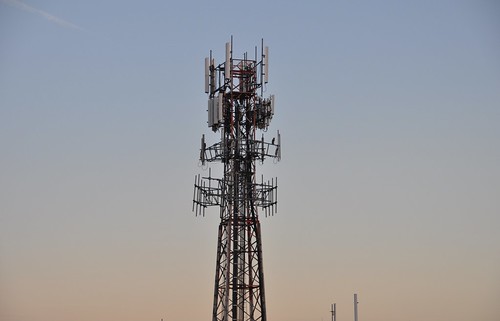
www.electronicsilentspring.com
Twenty years ago, during Bill Clinton's presidency and Reid Hunt's chairmanship of the FCC, the U.S. Congress passed the Telecommunications Act of 1996 (the TCA). Section 704 prohibits environmental and health concerns from interfering with the placement of telecom equipment.
Regardless the public's awareness of this federal law, we all live downwind of it. Here are some recent e-developments. --Katie Singer
FCC Commissioners voted unanimously in favor of the Spectrum Frontiers Proceeding on July 14, 2016. This vote gives the FCC authority to allocate (rent) 5G (5th generation) bandwidth.
What is 5G? Some mobile devices are now labeled "5G." In this case, the "G" refers to gigahertz (GHz). These devices' Wi-Fi and Bluetooth may operate at 5GHz, or five billion vibrations per second.
Spectrum Frontiers allows the FCC to allocate (rent) 5th generation of mobile operations, With 1G, mobile devices could transmit voice. 2G allowed talk and text. 3G let mobile devices connect to the Internet. 4G enabled higher speeds and video downloads.
Currently, with 4G, Verizon does not have enough bandwidth for its customers to download more than one DVD per day. With 4G, downloading a feature-length movie can take eight minutes. With 5G, you could download the same movie in less than five seconds.
According to FCC Chair Tom Wheeler, 5G will provide speeds 10 to 100 times faster than 4G speeds. With 5G, "autonomous vehicles will be controlled in the cloud. Smart-city energy grids, transportation networks and water systems will be controlled in the cloud. Immersive education and entertainment will come from the cloud." 5G could allow surgeons to perform surgery remotely. It will "unleash new waves of innovation and discovery that we are yet to imagine."
How will 5G be deployed? 5G will operate by millimeter waves (mmW). These are very short microwaves. According to Wheeler, mmW signals "tend to travel best in narrow and straight lines, and do not go through physical obstacles very well. This means that...5G buildout is going to be very infrastructure intensive, requiring a massive deployment of small cells."
Dr. Gary Olhoeft, professor emeritus of geophysics at the Colorado School of Mines, explained mmW and 5G infrastructure another way: "Say you put a frozen chicken into a microwave oven, which operates at 2.45 GHz. You'll cook the whole chicken. If you put a frozen chicken into an oven operating in the millimeter range, you'll boil off its skin. The meat under the skin will not cook, because millimeter waves will not penetrate past the surface. Likewise, 5G bands will not penetrate buildings made of concrete and rebar or adobe and chicken wire. They could penetrate wood and windows. To access 5G effectively, we'll need transmitters on every utility pole, possibly every building, possibly more than one transmitter per building."
Some airport full body scanners operate with mmW imaging technology. The scanner highlights a person's "generic outline" onto a monitor. While the TSA claims negligible risk from these scanners, mmW technology is also used to treat some skin cancers.
What is the basic motivation behind deploying 5G? At a recent technical meeting of the IEEE Communications society, at the Univ. of Colorado/Boulder, Dr. H. Anthony Chan of Huawei Technologies was asked this question after a lecture about 5G. He replied, "If technology does not change, the company will die.... People must buy a new phone."
5G will likely increase cell phone bills--and provide new revenue sources for mobile carriers.
How does mmW technology affect living creatures? For the most part, we don't know, since 5G is largely untested. In the Air Force's Radio Frequency Radiation Dosimetry Handbook, 5th Ed., 2009, the chapter "Responses to RF Overexposures" reported that a study of the millimeter frequency 94GHz found effects on the surface of the eye. These effects are "highly dependent on energy density and, because the effective stimulus is joule heating, exposure duration is very important" (emphasis added). With ubiquitous, dense deployment of 5G transmitters, living creatures may not be able to shorten the duration of their exposure.
Since insects, including bees, are tiny, might they be especially impacted by 5G's millimeter waves? How will 5G affect sleep, sperm, pregnant women, infants, children, people with implants, rooftop workers? Will 5G antennas and devices affect rates of autism, ADHD, Alzheimer's, depression, skin cancer, vision problems including cataracts, tech-addiction? For now, these are unanswered questions. Further, the Spectrum Frontiers does not designate any agency to test or regulate 5G for biological safety. It will allow industry to define 5G's intensity, amplitude and duration, as well as its specific absorption rate. While the FCC is responsible for overseeing the safety of radiofrequency emissions, Chair Tom Wheeler has clarified that "we" will "stay out of the way of technological development, since "turning innovators loose is far preferable to expecting committees and regulators to define the future."
It's worth noting that the FCC has typically not enforced its emission standards on existing cellular antennas. See "Americans Beware," a 2013 study conducted by the Electromagnetic Radiation Policy Institute of 600 cell tower sites around the U.S.
Did the FCC conduct a NEPA (National Environmental Protection Act) assessment before it voted to permit the Spectrum Frontiers? No.
Isn't this grounds for a lawsuit? Yes. However, in the event that a court required the FCC to conduct a NEPA review, it (FCC) would conduct the review. We can predict that they'd find no environmental reasons to prevent 5G deployments. Further, scientists cannot study what does not exist.
How much electricity will 5G require, and how will this usage impact climate change? Isn't reducing our energy use and climate change impacts a greater "national priority" than 5G? In 2015, the single largest category on YouTube was cat videos. Perhaps, if the public learned this and committed to a moratorium on cat videos, we could begin to reduce our energy use...and open so much 4G bandwidth that we wouldn't need 5G?
For more information about 5G, please see
* applied physicist Dr. Ronald M. Powell's Comments on Proceedings 14-177, 15-256, 10-112 and 97-95.
Also on July 14, 2016, FCC Commissioners voted to support the transition toward "sunset" of landlines and replace these with cell phones and voice over Internet protocols such as Magic Jack or Skype. Commissioners seem oblivious to the fact that during a power outage, only landlines work and that some people (pregnant women, children, people with medical implant) may use corded landlines, not cell phones or VoIPs, to protect their health.
Health issues downwind of cell phones
* Consider Dr. Ron Melnick's correction of the NY Times article about the National Toxicology Program's finding that cell phone radiation significantly increases brain cancer risk.
* In Sweden and other Nordic countries, the incidence of thyroid cancer has increased. Scientists postulate that increased exposure to cellphone and cordless phone radiation over time may contribute to this trend.
* China now has a visual health crisis. According to a recent Nomura research report, issued by Peking University's China Center for Health Development, 47% of Chinese children ages 6 to 15 and 55% of 16 to 25-year-olds suffer from myopia (nearsightedness). An academic study from the Australian National University estimated that the prevalence of myopia in 20-year-olds has reached 80% in developed Asia. In the U.S. and Europe, the rate is closer to 50%, twice the rate of 50 years ago. According to Nomura, urbanization, sedentary lifestyles, the prevalence of smartphones, "the intensity of near-range work and the decreasing intensity of outdoor activities" contribute to this crisis.
Posted by Katie Singer
www.electronicsilentspring.com
Authors Website: http://www.ourweb.tech
Authors Bio:
Katie Singer writes about nature and technology in Letters to Greta. She spoke about the Internet's footprint in 2018, at the United Nations' Forum on Science, Technology & Innovation, and, in 2019, on a panel with the climatologist Dr. James Hansen. Her most recent book is An Electronic Silent Spring. www.DearGreta.com and www.ElectronicSilentSpring.com.