| Back OpEdNews | |||||||
|
Original Content at https://www.opednews.com/articles/Division-in-the-Nation-s-P-by-Walter-Brasch-Bernie-Sanders_Bernie-Sanders_Bernie-Sanders-2016-Presidential-Candidate_Bernie-Sanders-Presidential-Campaign-160729-79.html (Note: You can view every article as one long page if you sign up as an Advocate Member, or higher). |
|||||||
July 29, 2016
Division in the Nation's Political Parties
By Walter Brasch
Hillary Clinton, facing division and distrust, will be the first woman to be the nation's president. Here's why.
::::::::
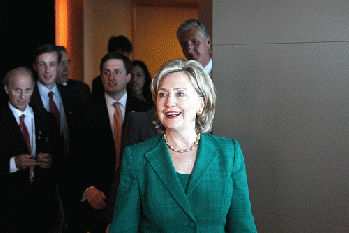
by Walter Brasch
Hillary Rodham Clinton limped into the Democratic National Convention with enough pledged delegates to claim the Democrats' nomination for the presidency and enough hubris that forced her and her senior advisors to spend time and resources dealing with her own party rather than targeting Donald Trump.
She had emerged from numerous Congressional hearings about Benghazi and the e-mail scandals with minimal or no culpability, but was sprayed by maximum venom by Trump, other Republican nominees for the presidency, and almost every conservative in the country who regularly watches Fox News and listens to partisan talk radio.
Numerous polls had revealed about 58 percent of voters disliked both Clinton and Trump, with the numbers of voters favoring each of them trending downward.
The Republican convention had been marked by a sharp division among Trump, Tea Party favorite Sen. Ted Cruz (R-Texas), and moderates who didn't like either of the last two remaining Republicans for their party's nomination. Many of Cruz's both ardent supporters were thinking about voting for Gary Johnson of the Libertarian party.
The Democratic convention, which closed this past Thursday, was also marred by a major split. Clinton--a child and social justice advocate, First Lady, U.S. senator, and secretary of state--is seen as more conservative and less trustworthy than Sen. Bernie Sanders (I-Vt.), a Democratic Socialist who has led a major revolt against establishment politics and policies. During the primaries, he accumulated about 12 million votes and 1,894 delegates to Clinton's 16 million votes and 2,807 delegates. For much of the campaign, while Sanders was drawing as many as 20,000 to his rallies, and was broadening his appeal to those who wanted to follow his leadership on liberal issues, the national media gave him significantly less coverage than they gave to the Tweeting Trump.
Three days before the convention, Clinton, who would become the nation's first female candidate from a major political party, announced that Sen. Tim Kaine (D-Va.), who had been chair of the Democratic National Committee, 2009--2011, was her choice as vice-president, angering the Sanders' supporters who saw Kaine as representing the established Democratic leadership.
On the Sunday afternoon before the convention, a protest and a resignation furthered the division. The protest was carried out by more than 10,000 anti-fracking activists who marched a mile from City Hall to Independence Hall; the march was barely covered by the major national media. Clinton favors fracking as one part of an "all of the above" approach to energy exploration and delivery. Sanders is adamant there should be a ban on fracking and a greater push for renewable energy.
The DNC platform committee closed some of the division between Sanders and Clinton's supporters by accepting or modifying some of what Sanders and his 12 million voters were fighting for, including a federal minimum living wage of $15 an hour, plans to break up large Wall Street banks, free tuition for most students attending public colleges, and several policies that would protect the environment and enhance medical coverage for citizens.
The resignation was from Rep. Debbie Wasserman Schultz (D-Fla.), the DNC chair who was caught in an e-mail scandal of her own. Among thousands of internal e-mails among Democratic politicians and senior staffers that were hacked, and then posted on Wikileaks, were those that had revealed a partisan campaign by DNC officials to discredit Sanders and to support Clinton. The release of the e-mails occurred three days earlier. The FBI said that cyber-tech experts hired by the DNC believed the hacking was done by Russians who preferred to deal with a Trump presidency.
Trump, on the third night of the Democrats' convention, grabbed the media spotlight by suggesting Russia could hack into DNC and Clinton e-mails and make them available to the American citizens. A senior campaign aide hours later said Trump was being sarcastic.
Trump's campaign staff had choreographed much of the Republican convention. Seeking to unify the party, they gave Cruz a speaking slot on the third night. Cruz, who was expected to endorse Trump, listened to his followers, spoke about Republican issues, did not endorse Trump, and told the 2,472 delegates they, and the nation's Republican voters, should "vote your conscience." There was only one day to counter the stinging rebuke by a large segment of the party that was divided before and during the convention, and is likely to remain divided for at least the next three months.
The Democrats had learned a lesson. The liberal wing of a liberal party got prime-time speaking slots the first day of the convention. If there was any problem, it could be addressed the next three days and, hopefully, forgotten by Friday.
Addressing the delegates during the prime-time first night, which carried the theme of "Unite Together," were Michelle Obama, Sens. Cory Booker (D-N.J.), Elizabeth Warren (D-Mass.), and Al Franken (D-Minn.), all of whom enthusiastically praised Clinton, all of whom attacked Donald Trump, but didn't mention his name. Sanders, who had previously endorsed Clinton and spoke on her behalf the first night of the convention, had angered many of his followers who wanted him to defect to an independent race or, at the least, support Jill Stein, the Green Party's nominee.
Nevertheless, the delegates pledged to Sanders were still largely loyal to the 74-year-old fiery politician who spoke of social justice and could be anyone's nice Jewish crotchety grandfather. The delegates were still upset by party rules that favored Clinton, who Sanders' supporters believed was too close to corporate interests and corporate money to earn their trust; many believed that Sanders, who enthusiastically endorsed Clinton and said he'd work for her, as a sell-out. When speakers mentioned her name, they booed. More important, they correctly perceived Sanders' campaign as one of a bottoms-up political revolution, swelling from and empowering the grassroots masses, similar to the one carved out by Sen. Gene McCarthy against President Johnson in 1968; Clinton, they also knew, was a "top-down" politician. Their rebuke, and possible defection to the Green Party or staying at home for the general election, came not from the politicians, but from a comedian. Sarah Silverman, a strong supporter of Sanders, in one sentence on stage silenced many of them--"Can I just say to the Bernie or Bust people: You're being ridiculous."
The Republicans paraded a couple of actors, Scott Baio and Antonio Sabato Jr., to praise Trump. The Democrats countered with Meryl Steep, Debbie Massing, Lena Dunham, America Ferrara, and the support of most of Hollywood's "A-list."
Bill Clinton spent the first 25 minutes of his speech on the convention's second day rambling about how he and Hillary Clinton met and were intertwined as a team, perhaps hoping to humanize the woman who constantly faced claims, by persons across a wide political spectrum, that she was cold, calculating, untrustworthy, and someone who was well-shielded by layers of gatekeepers who kept the public away from her except for photos.
The stars on the third night of the Democratic convention were people the Republicans wished they had--the president and vice-president of the United States. The president told the delegates that "homegrown demagogues will always fail," a blunt reference to Trump. He brought even more cheers when he talked about Teddy Roosevelt's idea of a great leader being one who "strives valiantly, who errs, but who in the end knows the triumph of high achievement," and said he knows Clinton is such a leader. But, even having Barack Obama and Joe Biden didn't mend the Democrats' division; the DNC revoked credentials of several dozen delegates who were pledged to Sanders, and walked out of the convention hall after the votes were recorded the day before.
For three days, the TV cameras recorded a sea of delegates who reflected America--Christians, Jews, and Muslims; straight delegates and those who were part of the LGBTQ community; working class Americans who were supported by labor unions, and business executives who drew six-figure salaries; Whites, Blacks, Hispanics, and persons whose parents came from Asia. No one had to say it, but the cameras showed a difference between Democratic and Republican issues and values.
On the final day of the Democratic convention, senior retired military officers, law enforcement officers, and the mothers of children killed by gun fire on America's streets told the delegates why they supported a Clinton presidency. But, it was Hillary Clinton who brought the delegates to the feet, shouting and clapping and laughing in all the right places, and closing the last night of the last convention. Donald Trump, who egotistically proclaimed, "I, alone, can fix it," was diminished by Clinton's "It takes a village" approach to solving problems.
And that's one of the major reasons the next president will be the first woman elected to the office--division or no division.
[Dr. Brasch has covered politics and government for more than four decades. His current book, his 20th, is Fracking America: Sacrificing Health and the Environment for Short-Term Economic Benefit.]
Authors Website: http://www.walterbrasch.com
Authors Bio:
Walter Brasch is an award-winning journalist and professor of journalism emeritus. His current books are Before the First Snow: Stories from the Revolution , America's Unpatriotic Acts: The Federal Government's Violation of Constitutional and Civil Rights, and 'Unacceptable': The Federal response to Hurricane Katrina, available at amazon.com, borders.com and most major on-line bookstores. BEFORE THE FIRST SNOW is also available at www.greeleyandstone.com (20 discount)
Walter Brasch, a deeply valued Senior Editor at OpEdNews passed from this world on February 9, 2017, age 71, his obituary follows:
Walter M. Brasch, Ph.D., age 71, of 2460 Second Street, Bloomsburg (Espy), died Thursday, Feb. 9, 2017, at Geisinger Medical Center, Danville surrounded by his family.
He was an award-winning former newspaper reporter and editor in California, Iowa, Indiana, and Ohio; professor emeritus of mass communications and journalism at Bloomsburg University; and an award-winning social issues journalist and book author.
Walter was born March 2, 1945, in San Diego, the son of Milton Brasch and Helen (Haskin) Brasch and was a 34 year resident of Espy.
In his early years he was a writer-producer for multimedia and film companies in California, and a copywriter and political analyst for advertising and public relations companies. For five years during the late 1990s, he was the media and social issues commentator for United Broadcasting Network. He was also the author of a syndicated newspaper column since 1992 and the creative vice-president of Scripts Destitute of Phoenix.
Dr. Brasch was a member of the Local Emergency Planning Committee and was active in the Columbia County Emergency Management Agency. He was vice-president of the Central Susquehanna chapter of the ACLU, vice-president and co-founder of the Northeast Pennsylvania Homeless Alliance, a member of the board of the Keystone Beacon Community for healthcare coordination, and was active in numerous social causes. He was co-founder with his wife Rosemary Brasch of The Oasis, a biweekly newsletter for families and friends of personnel stationed in the Persian Gulf. Later, during Operation Iraqi Freedom, they published The Oasis 2, for families of persons in combat zones. They were supported by the Bloomsburg Chapter, America Red Cross and Geisinger Medical Center, Danville.
He was the author of 20 books, most which fuse historical and contemporary social issues. Among his books are Black English and the Mass Media (1981); Forerunners of Revolution: Muckrakers and the American Social Conscience (1991); With Just Cause: The Unionization of the American Journalist (1991); Sex and the Single Beer Can: Probing the Media and American Culture (1997); Brer Rabbit, Uncle Remus, and the 'Cornfield Journalist': The Tale of Joel Chandler Harris (2000); The Joy of Sax: America During the Bill Clinton Era (2001); Unacceptable: The federal Response to Hurricane Katrina (2005); America's Unpatriotic Acts: The Federal Government's Violation of Constitutional and Civil Rights (2006); Sinking the Ship of State: The Presidency of George W. Bush (2007); and Before the First Snow (2011). He was co-author of The Press and the State (1986), awarded Outstanding Academic Book distinction by Choice magazine, published by the American Library Association.
His last book is Fracking America: Sacrificing Health and the Environment for Short-Term Economic Benefit (2015), a critically-acclaimed novel that looks at what happens when government and energy companies form a symbiotic relationship, using "cheaper, cleaner" fuel and the lure of jobs in a depressed economy but at the expense of significant health and environmental impact.
During the past two decades, he won more than 150 regional and national media awards from the National Society of Newspaper Columnists, Society of Professional Journalists, National Federation of Press Women, USA Book News, Independent Book Publishing Professionals Group, Pennsylvania Press Club, Pennsylvania Women's Press Association, Pennsylvania Associated Press Broadcasters Association, Penn-writers, International Association of Business Communicators, Pacific Coast Press Club, and Press Club of Southern California. He was recognized in 2012 by the Pennsylvania Press Club with the Communicator of Achievement award for lifetime achievement in journalism and public service.
He was an Eagle Scout; co-recipient of the Civil Liberties Award of the American Civil Liberties Union, 1996; and was honored by San Diego State University as a Points of Excellence winner in 1997. In 2000, he received the Herb Caen Memorial Award of the National Society of Newspaper Columnists. For the Pennsylvania Humanities Council he was twice named a Commonwealth speaker. He also received the meritorious achievement medal of the U.S. Coast Guard.
At Bloomsburg University, he earned the Creative Arts Award, the Creative Teaching Award, and was named an Outstanding Student Advisor. He received the first annual Dean's Salute to Excellence in 2002, a second award in 2007, and the Maroon and Gold Quill Award for nonfiction. He was the 2004 recipient of the Martin Luther King Jr. Humanitarian Service Award. For 22 years, he was Editor-In-Chief of the awarding-winning Spectrum Magazine, part of the journalism program of the Department of Mass Communications, Bloomsburg University until his retirement in 2010. The community magazine was published twice a year by students for residents of Columbia and Montour counties in northeastern Pennsylvania and one of the few to be inducted into the national Associated Collegiate Press hall of fame. The magazine was also a consistent award winner in competition sponsored by the Society of Professional Journalists, Columbia Scholastic Press Association, and the American Scholastic Press Association. He primarily taught magazine editing and production, public affairs reporting, feature writing, newspaper editing; every Fall, he taught a 250-student section on mass communications and the popular arts.
Dr. Brasch was co founder of the qualitative studies division of the Association for Education in Journalism, president of the Keystone State professional chapter and for three years deputy regional director of the Society of Professional Journalists, from which he received the Director's Award and the National Freedom of Information Award. He was president of the Pennsylvania Press Club, vice-president of the Pennsylvania Women's Press Association, and founding coordinator of Pennsylvania Journalism Educators. He was a featured columnist for Liberal Opinion Week, senior correspondent for the American Reporter, senior editor for OpEdNews, and an editorial board member of Journalism History and the Journal of Media Law and Ethics.
He was a member of the National Society of Newspaper Columnists, Author's Guild, National Writers Union (UAW/AFL-CIO), The Newspaper Guild (CWA/AFL-CIO), and the Society of Environmental Journalists. He was a life member of the service fraternity Alpha Phi Omega, and was indicted into the national scholarship honor societies Phi Kappa Phi (general scholarship), Kappa Tau Alpha (journalism), Pi Gamma Mu (social sciences), and Kappa Tau Alpha (sociology.) He is listed in Who's Who in America, Who's Who in the East, Contemporary Authors, Who's Who in the Media and Who's Who in Education. Dr. Brasch earned an A.B. in sociology from San Diego State College, an M.A. in journalism from Ball State University, and a Ph.D. in mass communication/journalism, with a cognate area in both American government/public policy and language and culture studies, from The Ohio State University.
He is survived by his wife of 34 years, the former Rosemary Renn the most wonderful thing that happened in his life and whom he loved very much; two sons, Jeffery Gerber, Phoenix AZ and Matthew Gerber and his wife, Laurel (Neyhard) of Bloomsburg, a sister, Corey Brasch of Sacramento, Calif; a niece, Terri Pearson-Fuchs, Calif, numerous cousins; and his beloved dogs Cabot and Remy.
Funeral services will be held on Wednesday, at 2:00 p.m. at the Dean W. Kriner Inc. Funeral Home & Cremation Service, 325 Market St., Bloomsburg with family friend, Nathaniel Mitchell officiating. Interment in Elan Memorial Park, Lime Ridge.
Friends may call at the funeral home on Tuesday from 6 - 8 p.m. or Wednesday from 1-2 p.m.
In lieu of flowers, donations may be sent to the Walter M. Brasch Scholarship Fund,
c/o First Keystone Community Bank, 2301 Columbia Blvd, Bloomsburg, PA 17815 or to
Mostly Mutts, 284 Little Mountain Rd., Sunbury, PA 17801