| Back OpEdNews | |||||||
|
Original Content at https://www.opednews.com/articles/Dance-First-Think-Later--by-Rena-Grasso-Democracy-Spring_Political-Values_Revolution_Technology-160617-154.html (Note: You can view every article as one long page if you sign up as an Advocate Member, or higher). |
|||||||
June 17, 2016
Dance First, Think Later: Reflections on Democracy Spring and Political Revolution
By Rena Grasso
A reflection and critique/analysis of Democracy Spring and the much invoked political revolution and including recommendations for strengthening the social movement our times demand.
::::::::
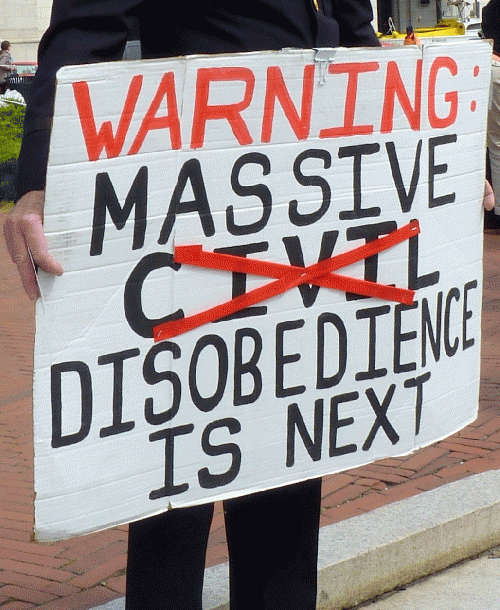
Ray Lewis, retired Philly police officer, promises a future to believe in
(Image by Rena Grasso) Details DMCA
On the eve of The Peoples' Summit in Chicago (June 17-19) and as Democracy Spring plans next steps, I want, in the spirit if constructive criticism, to express concerns about the "political revolution."
I was one of the 450 arrested on day one, April 11, of Democracy Spring. "Was it worth it?" I was asked, - three travel days, arrest, the fine, the risks (my last arrest at the Seneca Fall Women's Peace Encampment in 1981 was a harrowing experience)? Yes, however.
Yes, because we the peoples' march to the Capitol was a mega B-12 shot to my spirit even as it awakened me to the alienating, isolating impact of the collective mental atmosphere we breathe, the polite expressions of stupefying denial: overnight the temperature drops 50 degrees, in the blink of an eye spring turns to winter, burgeoning tulips encased in 6 inches of wet snow,--"well, that's New England for you!"; brief political dialogues bloated with ill-informed opinions, rag-tags of undigested facts and media sound bites.
Conversations with friends bewilder; relationships are strained. Those from whom I assumed respect for fact, reason, and independent thought stun me with their suspension of disbelief: clingers to Hillary Clinton, refusing to examine her politics, or to acknowledge her corruption. Then the spurious, fatuous gender "politics": voting for Hillary because she's a woman, gutting the social and economic justice core of feminism, travestying the radical goals of the women's movement.
Most depressing is the moral aphasia at the core of this vitiated and debased collective consciousness. The stunning numbers of wealth equality evoke no empathy, nor any for civilians killed and maimed in our regime change wars. Atrocities accumulate and fall into a moral vacuum: 17 innocents in a drone strike a month ago; a Doctors without Borders' hospital bombed; more revelations yesterday on our torture practices. People acknowledge these with glazed eyes, show no moral revulsion, expressing no sense of responsibility even as they think their government based in (their) the peoples' will. No wonder our culture is peopled with zombie hordes.
So, was it worth it? Yes... Because the "people united" lifted the weight of alienation, countered political apathy, affirmed our ability to will and to act. I met others who inspired hope: the woman from rural Oregon who, spurred by her respect for the hunger-striking suffragists, travelled alone to DC and civil disobedience; the couple who decided that civil disobedience was the most meaningful way to celebrate a 50th anniversary; a woman from Chicago who came to represent her disabled friend; two friends from Maryland arrested for the first time because the America they had promised their children was disappeared. Retired Philadelphia policeman, Ray Lewis, promising a future to believe in (picture above).
Also, the posters animated the public space with the energizing power of naming: We Bailed out the Banks and All We Got is this Lousy Plutocracy; Disgusted into Action; Please Help: Need Funds to Buy my Own Congressperson; asserting the peoples' desire for Schools not Prisons.
Yet for all these positives, my reservations, beginning with objectives and strategies. "Getting Money out of Government" is a complex issue, long-term and many dimensional. Organizers connected this to "four bills on the floor,"- without specificity, history, rationale, or ultimately evaluation. To this day, I don't know the names of these bills or the reason for their selection (versus Citizens United or a host of other options). Organizers claimed success with similar vagueness: 100 Senators supported these bills. Who? Did we influence them? How? A movement needs clear, shared purpose and outcomes.
Success, too, was reported for a second objective, compelling media attention. But, yes, Democracy Now and Free Speech TV, etc. recognized our action, and that's important to the choir. However, the mass media gave no meaningful coverage to Democracy Spring. MSNBC scrolled numbers and phrases at the bottom the screen, Maddow dribbled a few words; the Times and Post scribbled a paragraph. But surely we know that these illusions of inclusion are pacifying ploys?
I think Democracy Spring reflected naivete about the fourth estate, and how more insidious and powerful it has become since the 1960s. Vietnam taught the media moguls the dangers of coverage. Bernie's ideas were too threatening; their marginalization of him, in my mind, constitutes voter suppression as blatantly as did the AP announcement of Clinton's victory in California. Similarly, they won't cover our protests; they won't legitimatize dissent.
This stark recognition must become a center-piece to our movement strategy. Through technology and government deregulation of the media, the wealthy few command enormous influence over the American mind. Yet no revolution can succeed without the people, so strategize to compel attention, yes, but more realistically counteract its powers to deceive and to render invisible, creatively and craftily, go over, under, and through the media veils to reach people outside our choirs.
Yet over 150 miles of opportunity to educate and inform people from Philadelphia to DC, two march participants could recall no materials for distribution, and I saw none in DC.
Even civil disobedience suffered from a blurred focus and diffuse action. We sat on the Capitol's steps and disobeyed the police bark to move. We stopped no Congressperson; disrupted no proceedings. It was very well managed. In fact, the police shared their pride in instituting a new bureaucratic procedure to process us.
Democracy Spring's weaknesses reflect a deeper problem of the larger political revolution: the lack of conceptual and linguistic clarity, and/or of the recognition of how crucial this is to organizing a political movement. Throughout Bernie's campaign, for instance, I observed how the campaign logic crushed supporters' questions about his policies, or their curiosity about issues, or their ideas of organizing activities/goals not defined by campaign pros. And, for all that it continues to be invoked, 'political revolution' remains an imprecise phrase. So, too, the 'democracy' of Democracy Spring. Some marchers for instance chided others reminding them we're a republic. Again, marching under Code Pink's corporate puppet, behind banners protesting 'plutocracy', and demanding "money out of government," one could not expect to find a shared understanding of what this all means, and/or of how our strategies and actions comport with our understanding.
Many factors account for this glaring omission. From American anti-intellectualism to the absence of experience, as expressed by De Tocqueville's observation that we reaped the fruits of revolutionary European thought "without having had the revolution itself"; to our general weak respect for history; to our over-emphasis on technology, and under-emphasis on people working together in person. All these should be discussed.
However, I also think this inarticulateness reflects a broader and deeper historical context. Our revolutionary tradition is rooted in and imbued with Marxist analyses (the Left), but these are not sufficient to our political landscape. Yes, class struggle still pertains, but class, its structures, and its dynamics have dramatically changed, largely from the impact of technology. Marxism's historical inevitability has proven false; and the reactionary outcomes of Marxist-based "revolution" (Stalin) reveal serious inadequacies in regards to understanding power and its institutionalization. Further, Marx didn't envision the technological forces that would control consciousness, nor did he identify the exploitation of nature at the foundation of capitalism, and certainly not its intersections with sexism and women's oppression, the later superficially grasped in Left theory.
Even as we lack a coherent theoretical framework with which to build and develop our organizations and shape our actions, we face monumental challenges of unprecedented urgency. Climate change presses. Time is of the essence. So do the developing instruments of surveillance and the militarization of police. So, too, the increasing volatility and instability of permanent war, made more foreboding by Obama's potential re-ignition of the nuclear arms race. Finally, there's Hillary Clinton, or Donald Trump as Commander in Chief!
There is much to discuss, to debate, to build. First, we need to recognize and act upon the importance of doing so. In fact, organizing-axiomatic to (r) evolution-depends upon the on-going development of our political theories, the ideas and language that capture where we are and where we want to go. To start the discussion, I suggest (1) our groups and organization require intentional focus on building fully participatory groups and leadership, non-hierarchical, no top down, and structured with full recognition of the power of classism, racism and sexism;(2) the formation of strategic coalitions and alliances rather than the silo fragmentation of progressive causes and groups; (3) strategic focus on the media juggernaut and the corporate takeover of education ;(4) a relatedly strategic and creative focus on reaching out to, educating, and engaging the people.
The way ahead is not easy, but Democracy Spring reminded me of the joy that comes with a political movement, especially poignant in these times of widespread feelings of futility and impotence. The seeds and embers of political (r) evolution have been sown and sparked; we must nourish and fan them to harvest and to resplendent light. The pressing urgency of our issues must motivate us, as we act upon the paradox that even as time is short, we make the time to discuss, to debate, to formulate and revise, to educate ourselves and others. Truly, a future to believe in is at stake.
Authors Bio:
A veteran of second wave feminism who was was actively involved in the development of women's studies when it wasunderstood as part of a social movmeent, and an activist engaged in struggles for reproductive rigths, violence against women, racism, classism, and militarism. I hold a Phd in literatue and Psychoanlatical Psychology, worked for years as a developer and director of educational opportunites for girls and women and for disadvantaged communities. I have taught women's studies at at various academic instituions, have written articles on feminist anaylysis and history,- as well as dabbling in poetry.