| Back OpEdNews | |||||||
|
Original Content at https://www.opednews.com/articles/Kasskara-Sunken-Land-of-t-by-Shawn-Hamilton-Hopi_Other-Cultures_Society-Culture-People-160409-206.html (Note: You can view every article as one long page if you sign up as an Advocate Member, or higher). |
|||||||
April 9, 2016
Kasskara: Sunken Land of the Hopi Ancestors/Migration to the North
By S E Hamilton
Oswald "White Bear" Fredericks, a Hopi indigenous elder who was the main consultant for Frank Waters' Book of Hopi, explained Hopi history, which spans far back into past ages. He details the migrations of the Hopis' antecedents, which took them from a sinking Kasskara in the Pacific Ocean to Easter Island and on to South America, Yucatan, and Mexico, finally to what's now the United States.
::::::::
ADDED SECTION (MARKED BELOW) 4/14/2016
Introductory Note:
The common view of the ancient world tends to be quite limited. Somehow most of us have accepted as true a questionable assumption--that the history of human civilization reaches back only several thousand years and that advanced technological civilizations could not have previously arisen. Yet, indications of a remote technological past lie all around the planet, the Great Pyramid, perhaps, being the most difficult to explain away.
As I mention in the initial segment of this series ("Kasskara: Sunken Land of the Hopi Ancestors ", Plato's dialogue of Timaeus records an Egyptian temple priest at Sais telling Solon, Platos's relative, about Atlantis and informing him of Egypt's ancient age. "O Solon, Solon, you Hellenes are never anything but children, and there is not an old man among you," the priest said. Solon asked him what he meant. "I mean to say that in mind you are all young; there is no old opinion handed down among you by ancient tradition, nor any science which is hoary with age. And I will tell you why. There have been, and will be again, many destructions of man arising out of many causes; the greatest have been brought about by the agencies of fire and water, and other lesser ones by innumerable other causes," he said. The priest tells Solon that the span of Egyptian history was determined by a long lineage of priests who recorded the length of each ruler's reign (in conventional solar years), the total of which he said was about 80 thousand--a number consonant with Hopi traditions according to White Bear.
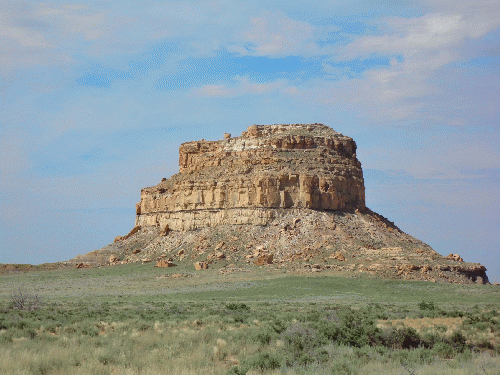
Fajada Butte, Chaco Canyon, New Mexico, contains an astronomical device called the 'Sun Dagger'.
(Image by Rationalobserver, Author: Rationalobserver) Details Source DMCA
The cataclysms the priest refers to are the ones the Hopi recall in their ceremonies and myths, but we shouldn't consider the word "myth" synonymous with "fable". These aren't metaphorical or allegorical tales. These stories transpire on such a grand scale that they can surely seem fantastic, yet White Bears tells us the Hopi believe these geological upheavals really happened; it's part of their history, and they also believe that beings from elsewhere in the universe helped them survive these destructions and relocate to another continent, so internalizing the stories and accurately perpetuating them for successive generations is to the Hopi a matter of religious and cultural obligation. That's the point of the ceremonies. Consider as well that Plato's account of Atlantis is also trivialized as a fable (or allegory) by academics, despite its detail and matter-of-fact-tone, based on the faulty conclusion that it just couldn't possibly be true.

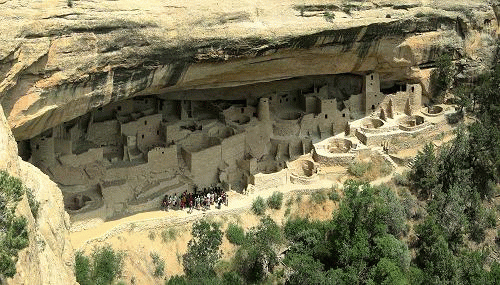
Chetro Ketl Great Kiva Plaza, Chaco Canyon, New Mexico, USA
(Image by NPS, Author: National Park Service (United States)) Details Source DMCA
[Added section] White Bear spoke about a man he'd known named Aapa, one of the great visionaries of the time, who belonged to the Clan of the Badger as did White Bear's grandfather. He said that while men like Aapa are sometimes called "medicine men" the term is not quite accurate. "The events that I experienced with him, and the things he showed me were filled with mystery. Often he used his third eye," White Bear said, referring to the brow chakra or "eye of wisdom" related to the pineal gland. "One day he said to me that one could pass from the physical side of one's life towards the spiritual side. The border between the two is hardly perceptible, and all those who see with their third eye can cross it," he continued. "Aapa also showed us how one can see the other side of the earth using the moon. He showed us and taught many things that you could not believe without seeing them yourself. He did these things in the presence of my parents, and as the oldest son, I could assist him. I could tell you more about it, but for somebody who did not himself live such experiments, it would be difficult to believe or understand. He told us that all this knowledge came from the fourth floor of the building [at Palatquapi] and that he learned it through his ancestors," he said.
White Bear explained that these "holy" men who devote their time to the important task of walking the "narrow path" are confronted with many dangers and temptations, yet there have always existed such men who achieved this high goal. Today such a man is called "Naquala", meaning adviser or benefactor, and it reflects his renunciation and devotion to his duties as a guide for his people. Such a man does not let himself divert from the path of truth.
"To those who had achieved this goal, the Kachinas granted them the favor of immortality; they could leave our earth without being dead. That already existed in the town of Taotooma (Tiahuanaco). These people really left us in their human bodies towards an unidentified planetary system. The Kachinas had encouraged us to learn as much as possible so we could attain the highest rank. They always reminded us that life was in front of us and that we never should forget what we had learned in this University," White Bear said. "They also said to us that in the future misfortunes would happen and that we must do everything to remain close to the divine capacity." He elaborates:
"For centuries the people of Palatquapi remained on the right path and everything was harmonious, but after some time certain clans started to leave and settle elsewhere. As the new colonies moved away, the people had less contact with their teachers, the Kachinas. The men who had reached the highest level of the University were sent as delegates to these new colonies. They used their third eye to choose young people to whom they could transmit their knowledge. But finally many colonies lost the contact with our guides and left the right path. Inside the clans and also in between the various clans disputes arose that resulted in the separation of the clans. More and more people left Palatquapi for Yucatan where they built cities and created great civilizations.
Again a time occurred when even spiritual guides chose the side of the sinners; they also left the right path. And the time came where our people were again separated. The most important clans that left Palatquapi were the Clan of the Snake and the Clan of the Bow. But important elements of these two clans remained in Palatquapi, and it was these people who continued to obey the laws of the Creator. I must explain here the structure of our clans so that you understand the repercussion such a schism can have.
Let's take the Clan of the Snake as an example. As is true of all the clans, the Clan of the Snake is composed of several groups. In their case there are six clans because the snake has six heads. The highest group in the Clans of the Snake is the Kaatooya clan. Kaatooya is the snake that represents the direction west implying sunset or death. According to the tradition of the Clan of the Snake, Kaatooya is the most important snake because it is he who pronounces the verdict when we leave the Earth.
Now you can see how we use and speak about symbols. People think that we do not know anything else, but this is false because we know what is behind the symbols. In this case Kaatooya is the most important divinity of the Clan of the Snake, but we speak about him as of a snake.
Some of the Clans of the Snake in Palatquapi had become disobedient towards their divinity, Kaatooya, and left. But three clans: West, East, and North, remained with their divinity. This is why we can say that part of the Clan of the Snake had left the city but another part remained in town. In the case of the Clan of the Snake, those who left later started a war against their own highest divinity.
As I said, the clans that started from Palatquapi built many cities. Some ruins of these cities were later found, but more will be discovered in the future. This way there will be more evidence of our traditions. The capital of the Clan of the Bow was the great center of Tikal. One found a sculpture of a stone head there with a snake in the mouth. It is about the Saaviki divinity. Later I will tell you a history about it."
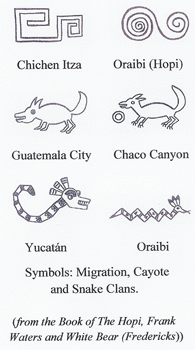
White Bear tells us that Yucatan was populated by the very powerful Clan of the Snake, who built many cities, their capital being at Chichen Itza. On many rocks in the area one can see a serpent with feathers. The chiefs of these clans had left Palatquapi because they wanted to reign themselves, and they soon felt themselves as strong as the leaders of Palatquapi. They left the right path. During the whole first phase of separation, Palatquapi had always been the true center, and the other cities such as those in Yucatan were secondary sites. But the emigration weakened the power of Palatquapi, and its chiefs concluded that war was unavoidable.
At the same time many of the clans remained attached to traditional beliefs, and the majority of them remained in Palatquapi. Also some of the emigrants were, despite everything, able to remain on the right path because they had never taken part in the destruction of the old worlds; they were the elected people. When the initiated people of very high rank felt the danger, they went to the other cities in order to obtain a reunification, but they could no longer influence those in power. Disputes arose. Parts of the Clan of the Snake and the Clan of the Bow that had left Palatquapi fought each other, and finally, wars destroyed the cities. "The continual attacks against the divine laws caused such a perversion and disorder in all the area that people simply did not want live there anymore. All was degraded and nobody could fulfill his religious obligations correctly. They could only leave again in migration," White Bear said. "Some of these clans settled here in Shongopovi, then in Oraibi, and finally in Hotevilla. This is why still today in Hotevilla we celebrate the Feathered Serpent," he said, adding:
"During those terrible times in Palatquapi and Yucatan, the Kachinas left us. Since then, all we can do is follow their example. When they left, they said to us: 'From now on you can only rely on yourselves.'
Perhaps you wonder how this misfortune could affect Palatquapi and Yucatan in spite of the presence of the Kachinas. Well each time in the past that something of the same kind arrived, that was not the plan of the Kachinas but that of men. The Kachinas warned them, but the majority of men wanted to conquer and make war. They did not listen to the sermons and counsel and continued to violate the laws of the Creator. This is why many clans and people were destroyed. When the clans were fighting the Kachinas did not interfere. They did not want to interfere because the Earth belongs to men. It is men who are responsible for their acts themselves. What men do, they do it themselves, and they will undergo the consequences of it. The day of punishment is not here yet, but it approaches."
[end of added section]
White Bear tells us that after many of the clans had left the true spiritual center of Palatquapi (Palenque), a period of cultural decay ensued and it became more difficult for people to fulfill their religious obligations. Some of the spiritually oriented clans migrated north (this took many generations) to the "barrier of ice", the glacial ice sheet that covered much of North America thousands of years before immigrants from Asia crossed the Aleutian Islands land bridge. The ice sheet, extending close to the contemporary US/Canadian border, prevented further passage north, he said, and when they arrived (from the south), the chiefs had contrary opinions about what to do next. Certain clans remained faithful to the ancient beliefs, while others began to alienate themselves from them. They began to develop their own set of ideas and teachings and eventually decided to abandon the migration and return to Palatquapi. When they finally arrived there, they encountered a developed, well-functioning city and its people who remained true to the old ways. Seeing the prosperity and harmony of Palatquapi's inhabitants, the new arrivals became envious, and conflict between the two groups created an atmosphere of hostility that made it nearly impossible for them to live together peacefully. Consequently, the newcomers were forced to settle outside the city, which they resented. These people belonged to the powerful Clan of Fire, the reigning clan during the First World (Tokpa) that finally caused its destruction. "Desire and jealousy pushed the Clan of Fire to attack Palatquapi. We keep the memory of this combat alive in some of our ceremonies in which the heroes of these wars are evoked," White Bear said, showing that Hopi ceremonies often depict real events in remote history.
One of the clans that had remained in Palatquapi and did not continue its migration was the Aasa Clan. Aasa means "mustard seeds", which White Bear said were a crucial part of the Hopi diet when they first came to Oraibi. The name of the clan was transformed later into "Astak", but at the time it still was the Aasa Clan. People of this clan obeyed their chiefs and remained faithful to the lessons of the Kachinas. White Bear related the following account about a family of the Aasa Clan:
"Among them was a family with three children--a girl and two boys--who played a big role in this event of our tribal history. The girl was called 'Hahawooti'. She was very obstinate and scarcely listened to her parents. She was strong, however, and while still a girl she would carry out heavy work when her brothers, 'Chackwaina' and 'Heoto', were absent.
Palatquapi, surrounded by a wall of stones, was well protected. The city had already been repeatedly attacked, but it had always successfully defended its population and vanquished the enemy. When the Clan of Fire began its attack, Heoto ran towards the house to warn his parents. The mother was cutting Hahawooti's hair. She had laid out the hair on the left side of the head and now was combing the right side. At this point Chackwaina burst into the house to report what had happened. Then he looked at his sister and said, 'You always have acted according to your own will and never have obeyed or listened to our parents. Now we will see whether you are courageous, and if you can help us to defend the city.' Hahawooti answered her brother, 'I will show you,' and not waiting for her mother to fix the hair of the right side, Hahawooti took the bow and the arrows and ran out of the house.
This is why in the ceremony she carries a bow and a quiver of arrows, and it's the reason her hair is loose on one side. She really showed courage during the combat, but it was her brother who had encouraged her. All three fought courageously, but it was Hahawooti who guided the people. They chased the enemy out of the city and drove them away. Never again did they return to attack the city. Hahawooti, Chackwaina, and Heoto became Kachinas thanks to their exploits. During the ceremony, the dancers representing the three heroes repeat and imitate their gestures, and testifying to their great courage, they are not obliged to engage with the other Kachina dancers. They have a determining role and can leave the row. They carry black masks, which signify that they are now initiated beings and no longer human. Black symbolizes everything that is mysterious and known only by the Creator."
Elaborating on the ceremony, White Bear explained that on one side of Chackwaina's face a moon is drawn and on the other side a star. The moon, while far from the earth, is still visible, and it draws our attention to the vast distances in the universe and emphasizes our even greater distance from the stars. The star is a sign of the planetary system where the Kachinas live although this star and its planets are not yet known by astronomers. "They will be discovered only at the end of the Seventh World. It will be then that [humanity is] informed of the Confederation of Planets [graf 3], but with current scientific knowledge it is not possible to get there. So you see that during our ceremonies the actions of Hahawooti and her brothers play a big role," White Bear said. "It is in this manner that we keep our history alive in our memory so we know exactly what occurred."
--end
(Article changed on April 14, 2016 at 06:08)
(Article changed on April 14, 2016 at 06:12)
(Article changed on April 14, 2016 at 06:13)
Authors Website: http://theswillbucket.com
Authors Bio:
teacher and reporter