| Back OpEdNews | |||||||
|
Original Content at https://www.opednews.com/articles/Economist-Robert-Pollin-B-by-Joan-Brunwasser-Bernie-Sanders-2016-Presidential-Candidate_Clinton-Bill_Economy_Healthcare-160408-649.html (Note: You can view every article as one long page if you sign up as an Advocate Member, or higher). |
|||||||
April 8, 2016
Economist Robert Pollin: Bernie Will Create Green New Deal
By Joan Brunwasser
I am convinced that Sanders has a credible approach for advancing a Green New Deal and has the commitment to fight for it. He will also have a massive political movement behind him that he has ignited. The total history of both Bill and Hillary Clinton is to cozy up to big business and do their bidding, while throwing out concessions to everyone else, as needed, to advance their own political careers.
::::::::

My guest today is Robert Pollin, distinguished professor of economics and co-director of the Political Economy Research Institute at the University of Massachusetts-Amherst.
JB: Welcome to OpEdNews, Bob. You recently wrote a piece that appeared in The Nation entitled, Bernie Sanders Will Make the Economy Great Again [March 29, 2016]. How confident are you about that and why?
RP: The title for the article was actually not chosen by me, but rather by the Nation editors. The language of the title is a bit over-the-top for my tastes. But it nevertheless captures the overall spirit of my argument reasonably well. The things that I am extremely confident about regarding Sanders' main economic policy proposals are what I myself did write in the article. Two key summary points are these: 1) "All of his major proposals are grounded in solid economic reasoning and evidence;" and 2) "A Sanders economy will be fully capable of growing at healthy rates. But more than just growing, a Sanders economy will also deliver standards of well-being for the overwhelming majority of the U.S. population as well as the environment in ways that we have not experienced for generations." I am happy to defend these claims against all critics.
JB: Interesting that it was the Nation editors that wanted this very strong title - to stimulate interest, perhaps? And there are critics galore, from media pundits to Hillary and her representatives. So, this is a great time to combat their arguments that Bernie is simply an idealist and his numbers don't add up. Please address your first point, Bob.
RP: In the article, I focus on four major areas of Sanders' overall program: Medicare for All; a $15 minimum wage; a Wall Street trading tax, to pay for free college tuition; and overall economic growth. For the first three cases, I go over major points, and provide detail as well.
The discussion on Medicare for All is straightforward: the U.S. currently spends approximately 7 percent more of overall GDP than other advanced economies on healthcare. This amounts to about $1.3 trillion in excessive spending, which goes mainly to private insurance companies and pharmaceuticals. If we see countries such as Germany, France, the UK, Canada, Japan, and Australia spending so much less than we do in the U.S. on health care, and getting better overall health outcomes, it simply can't be possible that the U.S. is incapable of devising a system that is roughly akin to those in these comparison countries. The Sanders program is based on that simple idea. The details matter, but these can be worked out later.
On the $15 minimum wage and the Wall Street trading tax, I go through in the Nation article details of the extensive research I myself have done on these matters. The numbers do add up, in this specific sense. We can implement a $15 minimum wage (as is now being done in California and New York City, among other places), without workers facing declining employment opportunities. The economy will need to adjust, since this represents a doubling of the minimum wage. But the adjustments are not that difficult--reducing worker turnover and absenteeism, and raising prices modestly in heavily affected sectors, such as fast food.
With the Wall Street tax, my co-authors and I recently showed that, given U.S. financial market conditions today, the tax could conservatively raise $300 billion per year in revenue, equal to 1.7 percent of U.S. GDP. This is enough to cover the free college tuition program four times over. It would then leave more than $200 billion to cover the major public investments in green energy and infrastructure that Sanders also favors.
When you add up these measures, the Sanders program is capable of delivering a more egalitarian, and more green economy through realistic policies. There is also no reason for these measures to be a barrier to healthy economic growth. Indeed, many features of the program will support growth, such as the strong infrastructure investments, and the single-payer health program, since this will lower health-care costs for businesses.
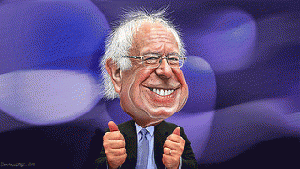
JB: No one would ever accuse me of being a "money person" but what you say sounds perfectly reasonable. How do you explain all the pot shots being taken at Bernie and his plan by liberal economists including Paul Krugman, who usually makes a lot of sense to me?
RP: I can't explain the motives behind the extreme hostility by Krugman and other liberal economists, and I don't want to speculate. All I can say is that in my view, their hostility--including name-calling and ridicule--is totally unwarranted based on trying to consider the proposals Sanders has made as serious analytic propositions. Of course, the Sanders campaign hasn't worked out all the details of these programs. They haven't come up with a big model that forecasts economic growth that would result from these models. Such matters are very time-consuming and demanding, and even when you work at it a long time diligently, there is still a good chance that your economic growth forecast will not be accurate. Nevertheless, as a professional economist, I know the literature from which I can confidently conclude that the proposals are broadly workable and consistent with healthy economic growth. Whether the proposals are politically feasible is another story. But if Sanders were to get elected president, what would be understood as politically feasible will have obviously shifted dramatically right then and there.
JB: Do you have a horse in this race, Bob?
RP: I am most definitely for Bernie Sanders, as I hope is clear from the article. I have written at length--including a 2003 book, CONTOURS OF DESCENT--on why I think Clintonomics was a disaster for most people, in the U.S. and elsewhere. I summarized many of the main themes of that book in another recent Nation piece. I see Hillary as basically an extension of the neoliberal model within the Democratic party--that is, aggressively pro-business, but making minor concessions to non-business groups to establish a distinction between themselves and Republicans, in order to harvest the Democratic Party constituencies for themselves. This model has dominated the Democratic Party since Bill Clinton. It is long past time to overturn it, and restore something like a Green New Deal. That is how I would characterize the Sanders program.
That said, I have had only minimal contact with the Sanders campaign, and have certainly not been paid one dime by the campaign.
JB: Got it. Thanks for the link. Anything you'd like to add before we wrap this up?
RP: I would just add this: At this point in the political cycle, when the candidates are fighting to attract voters in primary elections, it is not reasonable, or even relevant, to expect candidates to have fully-worked out economic policy proposals. Hillary Clinton or Bernie Sanders aside, I think it is fair to say that Paul Krugman doesn't have a fully worked out framework for restoring a well-functioning financial system, to take this one example. Nor do either Clinton or Krugman have reliable economic forecasts of how much growth will change due to the policies she is favoring. The main issues, at this point, are the general tenor of each program, and whether one can trust that either candidate will truly fight for a strong and effective agenda that supports well-being for the overwhelming majority of people and the environment. I am convinced that Sanders has a credible approach for advancing a Green New Deal and has the commitment to fight for it. He will also have a massive political movement behind him that he has ignited. The total history of both Bill and Hillary Clinton is to cozy up to big business and do their bidding, while throwing out concessions to everyone else, as needed, to advance their own political careers.
Thanks so much for talking with me, Bob. It was a pleasure!

***
The original Nation piece that sparked my interest: Bernie Sanders Will Make the Economy Great Again 3.29.2016
Two of my interviews with Pollin's colleague, Gerald Friedman:
Econ Prof Protests Gross Distortion of Work by WSJ and Clinton Campaign 1.19.2016
Economist: Sanders Plan Means Millions of New Jobs 2.14.2016
Collin's latest book: Greening the Global Economy
Authors Website: http://www.opednews.com/author/author79.html
Authors Bio:
Joan Brunwasser is a co-founder of Citizens for Election Reform (CER) which since 2005 existed for the sole purpose of raising the public awareness of the critical need for election reform. Our goal: to restore fair, accurate, transparent, secure elections where votes are cast in private and counted in public. Because the problems with electronic (computerized) voting systems include a lack of transparency and the ability to accurately check and authenticate the vote cast, these systems can alter election results and therefore are simply antithetical to democratic principles and functioning.
Since the pivotal 2004 Presidential election, Joan has come to see the connection between a broken election system, a dysfunctional, corporate media and a total lack of campaign finance reform. This has led her to enlarge the parameters of her writing to include interviews with whistle-blowers and articulate others who give a view quite different from that presented by the mainstream media. She also turns the spotlight on activists and ordinary folks who are striving to make a difference, to clean up and improve their corner of the world. By focusing on these intrepid individuals, she gives hope and inspiration to those who might otherwise be turned off and alienated. She also interviews people in the arts in all their variations - authors, journalists, filmmakers, actors, playwrights, and artists. Why? The bottom line: without art and inspiration, we lose one of the best parts of ourselves. And we're all in this together. If Joan can keep even one of her fellow citizens going another day, she considers her job well done.
When Joan hit one million page views, OEN Managing Editor, Meryl Ann Butler interviewed her, turning interviewer briefly into interviewee. Read the interview here.
While the news is often quite depressing, Joan nevertheless strives to maintain her mantra: "Grab life now in an exuberant embrace!"
Joan has been Election Integrity Editor for OpEdNews since December, 2005. Her articles also appear at Huffington Post, RepublicMedia.TV and Scoop.co.nz.