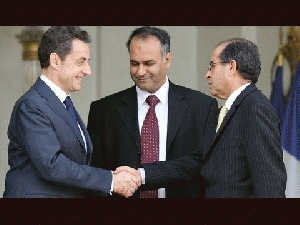
Libya -- so predictably -- has all but completely collapsed, spending years now drowning in instability, anarchy, fractured militia rule, sectarian conflict, and violent extremism. The execution of Saddam Hussein was no vindication of that war nor a sign of improved lives for Iraqis, and the same was true for the mob killing of Qaddafi.
::::::::
The immediate aftermath of the NATO bombing of Libya was a time of highgloating. Just as Iraq War advocates pointed to the capture and killing of Saddam Hussein as proof that their war was a success, Libya war advocates pointed to the capture and brutal killing of Muammar el-Qaddafi as proof of their vindication. War advocates such as Anne-Marie Slaughter and Nicholas Kristof were writing columns celebrating their prescience and mocking war opponents as discredited, and the New York Times published a front-page article declaring: "U.S. Tactics in Libya May be a Model for Other Efforts." It was widely expected that Hillary Clinton, one of the leading advocates for and architects of the bombing campaign, would be regarded as a Foreign Policy Visionary for the grand Libya success: "We came, we saw, he died," Clinton sociopathically boastedabout the mob rape and murder of Qaddafi while guffawing on 60 Minutes.
Since then, Libya -- so predictably -- has all but completely collapsed, spending years now drowning in instability, anarchy, fractured militia rule, sectarian conflict, and violent extremism. The execution of Saddam Hussein was no vindication of that war nor a sign of improved lives for Iraqis, and the same was true for the
mob killing of Qaddafi. As I
wrote the day after Qaddafi fled Tripoli and Democratic Party loyalists were prancing around in war victory dances: "I'm genuinely astounded at the pervasive willingness to view what has happened in Libya as some sort of grand triumph even though virtually none of the information needed to make that assessment is known yet, including: how many civilians have died, how much more bloodshed will there be, what will be needed to stabilize that country, and, most of all, what type of regime will replace Qaddafi? ... When foreign powers use military force to help remove a tyrannical regime that has ruled for decades, all sorts of chaos, violence, instability, and suffering -- along with a slew of unpredictable outcomes -- are inevitable."
But the much bigger question was when (not if, but when) the instability and extremism that predictably followed the NATO bombing would be used to justify a new U.S.-led war -- also exactly as happened in Iraq. Back in 2012, I asked the question this way:
"How much longer will it be before we hear that military intervention in Libya is (again) necessary, this time to control the anti-US extremists who are now armed and empowered by virtue of the first intervention? U.S. military interventions are most adept at ensuring that future U.S. military interventions will always be necessary."
[Subscribe to Glenn Greenwald] Glenn Greenwald is a journalist,former constitutional lawyer, and author of four New York Times bestselling books on politics and law. His most recent book, "No Place to Hide," is about the U.S. surveillance state and his experiences reporting on the Snowden documents around the world. His forthcoming book, to be published in April, 2021, is about Brazilian history and current politics, with a focus on his experience in reporting a series of expose's in 2019 and 2020 which exposed high-level corruption by powerful officials in the government of President Jair Bolsonaro, which subsequently attempted to prosecute him for that reporting.
Foreign Policy magazine named Greenwald one of the top 100 Global Thinkers for 2013. He was the debut winner, along with "Democracy Now's" Amy Goodman, of the Park Center I.F. Stone Award for Independent Journalism in 2008, and also received the 2010 Online Journalism Award for his investigative work breaking the story of the abusive detention conditions of Chelsea Manning.
For his 2013 NSA reporting, working with his source Edward Snowden, he received the George Polk Award for National Security Reporting; the Gannett Foundation Award for investigative journalism and the Gannett Foundation Watchdog Journalism Award; the Esso Premio for Excellence in Investigative Reporting in Brazil (he was the first non-Brazilian to win); and the Electronic Frontier Foundation's Pioneer Award. The NSA reporting he led for The Guardian was also awarded the 2014 Pulitzer Prize for Public Service. A film about the work Greenwald and filmmaker Laura Poitras did with Snowden to report the NSA archive, "CitizenFour," directed by Poitras, was awarded the 2015 Academy Award for Best Documentary.
In 2019, he received the Special Prize from the Vladimir Herzog Institute for his reporting on the Bolsonaro government and pervasive corruption inside the prosecutorial task force that led to the imprisonment of former Brazilian President Lula da Silva. The award is named after the Jewish immigrant journalist who was murdered during an interrogation by the Brazilian military dictatorship in 1977. Several months after the reporting began, Lula was ordered released by the Brazilian Supreme Court, and the former President credited the expose's for his liberty. In early 2020, Brazilian prosecutors sought to prosecute Greenwald in connection with the reporting, but the charges were dismissed due to a Supreme Court ruling, based on the Constitutional right of a free press, that barred the Bolsonaro government from making good on its threats to retaliate against Greenwald.
After working as a journalist at Salon and The Guardian, Greenwald co-founded The Intercept in 2013 along with Poitras and journalist Jeremy Scahill, and co-founded The Intercept Brasil in 2016. He resigned fromThe Intercept in October, 2020, to return to independent journalism.
Greenwald lives in Rio de Janeiro, Brazil with his husband, Congressman David Miranda, their two children, and 26 rescue dogs. In 2017, Greenwald and Miranda created an animal shelter in Brazil supported in part through public donations designed to employ and help exit the streets homeless people who live on the streets with their pets.