| Back OpEdNews | |||||||
|
Original Content at https://www.opednews.com/articles/Chinese-Stock-Market-Syndr-by-Joel-Joseph-Chinese-Central-Committee_Chinese-Communist-Party_Market-Manipulation_Marketing-160127-519.html (Note: You can view every article as one long page if you sign up as an Advocate Member, or higher). |
|||||||
January 27, 2016
Chinese Stock Market Syndrome
By Joel Joseph
We should not let the meltdown in Chinese stocks lead to a recession in the United States.
::::::::
Chinese Stock Market Syndrome: Don't Let it Bring Us Down
By Joel D. Joseph, Chairman, Made in the USA Foundation
It appears that China's economy has caught the flu and we must stop it from spreading the fever to the United States. In the last several months China's stock market has plunged 44%. During the Great Crash in 1929 stocks tumbled 47% from September to November, and then fell much further over the next several years. In 2008, the U.S. stock market plunged 44%, but recovered much more quickly than during the Great Crash. The U.S. stock market has declined by ten percent this year already. Enough is enough.
"Chinese syndrome" refers a hypothetical nuclear-reactor accident in which the fuel would melt through the floor of the containment structure and burrow into the earth. "Chinese Stock Market Syndrome" means a severe stock market crash in China leading to a meltdown in the world economy.
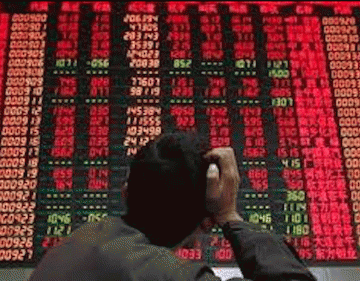
China's Economy is Shaky
China's real economy is in real trouble, but the U.S. economy is not. Credit insurer Euler Hermes forecasted the number of corporate insolvencies to rise 25% this year in China. HSBC China Economist Julia Wang said in a report recently that China had unsold housing inventory of 1.8 billion square meters (19 billion square feet of space or 436,000 acres of floor space), which could house up to 90 million migrants from rural areas. This is more housing space than all of New York City! These are empty apartments, ghost towns that were built on credit, with billions in debt that is now past due.
In contrast, the U.S. economy is doing relatively well. Our banks are much stronger than they were in 2008. Reserves are double what they were before the Great Recession. There are no major bankruptcies like AIG, GM and Lehman Brothers that threatened the economy eight years ago. Our consumers are cautiously saving money now, while in 2007 we had a negative savings rate. Unemployment is at 5%, a ten-year low.
During the past five years the United States has increased its manufacturing employment by more than 500,000. Part of that increase was caused by a rise in costs in China, and part was due to increased U.S. tariffs on solar panels and other products that China illegally dumped into the United States.
The Threat Posed by China
In order to stimulate its economy, China plans to drive its currency down so that it can sell more products overseas into the United States and European markets. Japan has successfully done this. The Japanese yen has been devalued by 50% in the past three years despite the fact that Japan runs a massive trade surplus with the United States. We must not let any country unfairly compete by manipulating its currency.
During the past year, the Chinese Yuan has decreased in value by 6.5%. Most economists believe that the Chinese currency is 20-40% undervalued.
A bipartisan group of U.S. Senators, Rob Portman (R-OH), Sherrod Brown (D-OH), Jeff Sessions (R-AL), Charles E. Schumer (D-NY), Lindsey Graham (R-SC), Debbie Stabenow (D-MI), and Richard Burr (R-NC), introduced The Currency Undervaluation Investigation Act last year. The Currency Undervaluation Investigation Act. S 433, would utilize U.S. trade law to counter the economic harm to U.S. manufacturers caused by foreign currency manipulation, and provide consequences for countries that fail to adopt appropriate policies to eliminate currency undervaluation. The bill would require the Commerce Department to treat currency manipulation as an illegal subsidy and impose countervailing duties.
In the House of Representatives HR 820, the Currency Reform for Fair Trade Act, was introduced by a bipartisan group of 39 members of Congress (12 Republicans and 27 Democrats). This proposal would allow tariffs to counter currencies that were "fundamentally undervalued." The House and Senate bills are very similar.
The U.S. Congress should impose tariffs on China, and other nations, who manipulate their currency to gain an unfair advantage in trade. Congress should pass HR 820 or S 433 to protect manufacturing jobs in the United States.
Authors Website: http://www.calrecycles.com
Authors Bio:
CEO of California Association for Recycling All Trash, www.Calrecycles.com and CEO of Genuine-American Merchandise & Equipment, www.genuine-american.com, manufacturers of tennis equipment in the USA (Tennis Wellbow, Good Vibe vibration dampener and Mother Deuce: a children's book about tennis.www.genuine-american.com) Former Chairman, Made in the USA Foundation, economist and lawyer, author of 18 books and hundreds of articles.