| Back OpEdNews | |||||||
|
Original Content at https://www.opednews.com/articles/North-Dakota-Landowner-Sti-by-Georgianne-Nienabe-Big-Oil_Dakota_North-Dakota_Oil-160121-411.html (Note: You can view every article as one long page if you sign up as an Advocate Member, or higher). |
|||||||
January 21, 2016
North Dakota Landowner Still Fighting Enbridge and Winning
By Georgianne Nienaber
North Dakota Grand Forks District Judge Debbie Kleven ordered Canada's Enbridge Energy Partners to pay farmland owner James Botsford $45 thousand of $60 thousand in attorney fees. Judge Kleven also ruled that Enbridge would lose their easement if the proposed pipeline is not completed within five years.
::::::::
Big oil lost a skirmish in late December when North Dakota Grand Forks District Judge Debbie Kleven ordered Canada's Enbridge Energy Partners to pay farmland owner James Botsford $45 thousand of $60 thousand in attorney fees. Judge Kleven also ruled that Enbridge would lose their easement if the proposed pipeline is not completed within five years. North Dakota Pipeline Company LLC (NDPL) had sued Botsford and his wife for the right to an easement over farmland located in Emarado, ND. NDPL is a joint venturebetween Enbridge Energy Partners and Williston Basin Pipe Line LLC, an indirect subsidiary of the Marathon Petroleum Corporation. Marathon will be the line's anchor shipper. The corporation is qualified to do business in North Dakota through theNorth Dakota Public Service Commission (NDPC), but is registered in Delaware. Marathon Petroleum is funding 37.5 percent of the Sandpiper Pipeline Project and will hold an approximate 27 percent interest in the North Dakota Pipeline Company when the Sandpiper Pipeline is completed.
On the issue of eminent domain, Judge Kleven sided with Enbridge and issued a final order of condemnation that granted North Dakota Pipeline Company a 99-year easement to construct a 24-inch pipeline to transport oil across the Botsford land. The Botsfords would still have the right to the land for "surface agricultural uses."
Botsford's land is a lynchpin in the proposed $2.6 billion Sandpiper Pipeline, a project that would carry Bakken crude oil from western North Dakota to refineries in Superior, Wisconsin. It remains to be seen how the recent collapse of oil prices will affect the proposed pipeline, which is also facing stiff opposition in neighboring Minnesota.
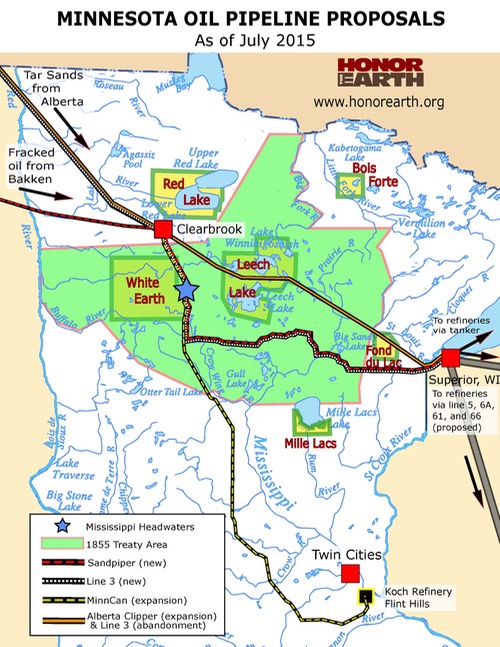
The line is proposed to carry fracked oil from the Bakken Oil Field across the White Earth Reservationand endangered wetlands in northern Minnesota. The Sandpiper includes a new 375,000 barrel per day, 233-mile, 30-inch diameter line to be built extending the system from Clearbrook, MN to connect with the Lakehead Pipeline terminal at Superior, Wisconsin. Minnesota tribal nations are faced with a potential oil super corridor through sacred wild rice and fishing waters. In December, the Minnesota Supreme Court denied petitions by Enbridge to vacate a Minnesota Court of Appeals decision requiring an Environmental Impact Statement.
When the Botsford case originally reached North Dakota Central Judicial Court in August 2015, the filing by the oil company claimed a right to exercise power of eminent domain, allowing the Enbridge subsidiary to enter and condemn Botsford's land, use right of way, casements, and the property for the construction, maintenance, or authorization of the Sandpiper Pipeline. In August testimony Botsford told the judge that there was a possible leak from an older pipeline on an adjoining parcel that Botsford owns. When Botsford mentioned the Enbridge record of over 800 spills and leaks in the past decade, Enbridge (NDPL) objected and the judge disallowed the statement into the record. A jury trial was avoided when NDPL and Botsford reached an agreement whereby certain issues were reserved for appeal and that the judge would determine compensation for attorney fees.
The heart of the Botsford's legal response at that time was the "Abusive overreach of the use of eminent domain by a (foreign) corporation for private gain," Botsford said. "They (Enbridge) want a 99 year lease that they get whether the pipeline is built or not and that they can sell to any other entity for any other purpose at any time in the 99 years. Eminent domain to take private property is supposed to be restricted to a particular public purpose."
Botsford argued that the condemnation order on his property exceeded statutory authority because it seeks an easement to survey, locate, construct, operate, and maintain (including cathodic [corrosion] ), activities necessary for the transportation of crude petroleum and ANY product, "by-product and derivative thereof."
The court agreed with Botsford that the language of "crude petroleum and any product, by-product and derivative thereof" is too broad. "Oil" in this case is defined by North Dakota statute and means oil and hydrocarbons produced at the wellhead in liquid form, excluding gas.
Botsford filed an appeal in the North Dakota Supreme Court on January 15. The issues on appeal include whether NDPL abused the power of eminent domain, since Enbridge is a Canadian company using U.S. law for its own profit purposes. Secondly, if the court upholds eminent domain, Botsford is demanding that the pipeline carry only North Dakota oil and not Alberta tar sands oil carried by that pipe or another adjacent pipe that would fit in the easement. The rejection of TransCanada's Keystone XL expansion project has limited the ability of volatile tar sands oil to reach U.S. refineries.
In an email, Jim Botsford offered an analysis that directly relates to pipeline protests in Minnesota. If the courts ultimately rule that Enbridge gets an easement through Botsford's lynchpin property, it should be contingent on the Sandpiper receiving approval all the way to the refineries on Lake Superior. "If the whole thing isn't approved then it's a pipeline to nowhere, and no public purpose is served," Botsford wrote.
Whether there will be any international market for Alberta crude, given the current crash of oil prices, depends on the impact of the addition of Iranian oil in the marketplace and China's appetite for crude.
That question may be moot, since Alberta's crude is partially landlocked due to the U.S. rejection of the Keystone XL. However, the State Department has quietly allowed the Alberta Clipper project to move forward with little public scrutiny.
Also known as Line 67, the Clipper and the Keystone were both proposed for the purpose of transporting tar sands oil from Alberta to the United States in huge quantities. The Enbridge tar sands pipeline would be bigger than the Keystone XL. President Obama may have condemned the Keystone XL, but the Clipper has been quietly allowed to move forward. If completed, this hodgepodge of pipelines would deliver 850,000 barrels per day from Alberta to Houston.
Despite media reports that oil production is at a standstill in North Dakota, the North Dakota Industrial Commission Department of Mineral Resources says oil production in November 2015 was 1,176,314 barrels per day (preliminary), while the all-time high was 1,227,483 barrels per day in December 2014. Rig counts are down and employment is falling, but oil flows near record production.
Still, Botsford is standing firm on his small parcel; planting his banner on ancestral farmland and fighting the seemingly invincible forces of big oil. This story continues to steal a page from the saga of Jeanne d'Arc, La Pucelle d'Orleans, a teenage girl who fought the seemingly unbeatable English army at Orleans in the fifteenth century, and won.
Authors Website: http://www.georgianne-nienaber.com
Authors Bio:
Georgianne Nienaber is an investigative environmental and political writer. She lives in rural northern Minnesota and South Florida. Her articles have appeared in The Society of Professional Journalists' Online Quill Magazine, the Huffington Post, The Ugandan Independent, Rwanda's New Times, India's TerraGreen, COA News, ZNET, OpEdNews, Glide Magazine, The Journal of the International Primate Protection League, Africa Front, The United Nations Publication, A Civil Society Observer, Bitch Magazine, and Zimbabwe's The Daily Mirror. Her fiction expose of insurance fraud in the horse industry, Horse Sense, was re-released in early 2006. Gorilla Dreams: The Legacy of Dian Fossey was also released in 2006. Nienaber spent much of 2007 doing research in South Africa, Rwanda and the Democratic Republic of Congo. She was in DRC as a MONUC-accredited journalist, and was living in Southern Louisiana investigating hurricane reconstruction and getting to know the people there in 2007. Nienaber is continuing "to explore the magic of the Deep South." She was a member of the Memphis Chapter of the National Academy of Recording Arts and Sciences and is a current member of Investigative Rorters and Editors.