| Back OpEdNews | |||||||
|
Original Content at https://www.opednews.com/articles/TenOne-Medicare-for-All-N-by-Joan-Brunwasser-Action-Alerts_Activists_Awareness_Chicago-150913-440.html (Note: You can view every article as one long page if you sign up as an Advocate Member, or higher). |
|||||||
September 13, 2015
TenOne: Medicare-for-All National Student Day of Action on 10/1/15
By Joan Brunwasser
We had been inspired by the widespread involvement of students in the White Coats 4 Black Lives die-in that fall and we wanted to do something similar to energize and strengthen the student single payer movement.TenOne is a nationwide action of medical students and allies to raise awareness about the failings of our private health insurance system and what we need to do to fix it -which is to expand and improve Meicare to all.
::::::::
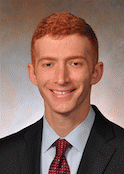
My guest today is Scott Goldberg, a fourth year medical student at the University of Chicago's Pritzker School of Medicine and a board member of Physicians for a National Health Program. Welcome to OpEdNews, Scott.
JB: I understand you are helping to coordinate a national day of action, coming up soon. What can you tell us about it?
SG: Thank you for having me, Joan. Yes, I am one of the medical students from Students for a National Health Program (SNaHP) helping to plan the TenOne Medicare-for-All National Student Day of Action. SNaHP is the student section of the national organization, Physicians for a National Health Program, which has around 20,000 doctors and students who advocate for single payer health reform. The idea for TenOne came out of the SNaHP annual summit last February in Chicago. It was our 4th and largest summit thus far, with over 170 students in attendance. We had been inspired by the widespread involvement of students in the White Coats 4 Black Lives die-in that fall and we wanted to do something similar to energize and strengthen the student single payer movement. In short, TenOne is a nationwide action of medical students and allies to raise awareness about the failings of our private health insurance system and what we need to do to fix it -- which is to expand and improve Medicare to all.
JB: Before we get to the nitty gritty of the October action, can you tell us why single payer is so important to you and your fellow medical students?
SG: Well, for me, I became committed to single payer in 2009 after hearing a talk by Dr. David Himmelstein, one of the co-founders of PNHP. He presented so much evidence that national health insurance, as practiced particularly in Canada, is the most efficient, economical, and just way to provide high-quality, affordable, universal health care access. And that the United States is the only industrialized country in the world, despite our vast wealth, that doesn't have some form of universal health insurance. But it wasn't until I began medical school, and started working in the hospital, especially during my third year clinical rotations, that I saw first-hand how devastating our system is on patients' lives. I remember one Spanish-speaking woman who was unable to receive a lung transplant at our hospital because we weren't "in-network." We had to send her to another hospital after developing a trusting relationship with her. I've seen patients die because they couldn't get the care they needed in time. This just does not happen in other first-world countries. So I'm sure my fellow medical students working on this issue feel the same way as I do -- that no person, regardless of socioeconomic status, race, ethnicity, or whatever, should be denied something as fundamental to human life as medical care.
JB: Everything you say makes perfect sense to me, Scott. I covered the medical student die-in when it happened and it was an amazing statement. What kind of participation are you getting for this current action day?
SG: SNaHP now has 43 chapters at medical schools across the country. I think this is double the number just four years ago. For TenOne, we have 30 chapters participating as of now. Many of these chapters will be holding actions during the day including teach-ins and rallies. At night, all chapters will be holding a candlelight vigil remembering the approximately 25,000 people that die each year due to uninsurance and the millions more who suffer due to underinsurance. In cities like New York, Philadelphia, Chicago, Los Angeles, and Boston, a number of chapters from different schools will be working together to host one large nighttime action. Also, TenOne is sponsored by a number of other national medical student organizations including American Medical Student Association, Latino Medical Student Association, White Coats 4 Black Lives, Universities Allied for Essential Medicine, and Pre-health Dreamers. I can't think of another student-led nationwide action for single payer that has been done before.
JB: I'm curious if any of the medical schools push back against these single payer actions. Are any students fearful that their participation might affect their careers going forward?
SG: In my three years since starting a student chapter of PNHP, I've never had any push back from my medical school. In fact, I think our chapter is the most active on campus and has widespread support from the student body. Many of the faculty and administrators on campus support national health insurance (NHI) and are encouraged by our dedication to the cause. I've never heard of any other schools pushing back against single payer actions, but I can't say definitively if there have been.
I think some medical students may be anxious about throwing themselves into single payer advocacy for fear that it may affect their careers somehow. But I can say, from my own experience, that it has not affected my career thus far. And there are examples of outspoken faculty members on campus who don't face repercussions for their beliefs. This idea that speaking out for something as fundamental and urgent as universal health care is threatening to your career is something we need to dismiss. Advocating for single payer is not a Democratic or Republican issue. It is at the core of what it means to be a doctor, which is doing everything in your power to help your patients.
JB: I'm glad you haven't experienced or witnessed any push back but I also understand that many students have taken out huge student loans. And that factor can affect everything, including decisions like participating or not in an action like this. What kind of press coverage have you arranged for TenOne? I ask because if you don't get enough coverage, isn't it like the proverbial tree falling in the forest with no one around to hear?
SG: It's true, student loan debt is a major problem. In fact, in countries like Canada, medical education is free. In HR 676, the house bill that would establish national health insurance, there is a provision making medical education free. But the idea that student loan debt affects one's decision to participate in actions is not something I've ever heard from my interactions with other students across the country. As medical students, we are paying a lot of money to schools and so they want to support us in whatever we do.
As for press coverage for TenOne, we're talking with national media outlets like OpEdNews! We also have upcoming interviews with other outlets like The Union Edge. We have national and local press coverage lined up for TenOne. And I think the power of this event is not just to generate media attention. No nationwide action like this has ever been done before. We are raising awareness, empowering students, and generating the basis for a broad-based movement for single payer.
This is not a one-off event just to attract media attention. This is the first in a series of actions to build a movement capable of achieving NHI. 99% of Americans suffer due to expensive, inadequate health care and we are bringing them into the movement. Single payer reform would be the greatest social and economic reform in this country's history, and so it will take time, energy, and a national movement to achieve. We often overlook that students have been at the forefront of social movements throughout history. The Civil Rights Movement in America was started by college students, specifically the Student Nonviolent Coordinating Committee.
JB: Again, quite true. Anything you'd like to add before we wrap this up?
SG: I hope those who read this go to student.pnhp.org to find a TenOne event in their area to attend. This day of action is led by students, but meant for everyone! Also, I'd like to encourage anyone who reads this to start having conversations with their friends, family, colleagues, whomever about the need for single payer health care. Canada passed national health insurance in the 1970s, but activists began having small, informal gatherings in their homes about reform as early as the 1910s. Although we face serious barriers to passing NHI including the enormous wealth of the health insurance and pharmaceutical industries, a majority of Americans currently support government-funded, privately delivered health care. We have the numbers, we just need to unify ourselves.
JB: Thanks so much for talking with me, Scott. Looking forward to TenOne and its aftermath!
***
Scott has supplied some links:
Students for a National Health Program blog: student.pnhp.org --> there are great articles on here about Single Payer from medical students
TenOne Facebook event page
Physicians for a National Health Program website:www.pnhp.org
some of my coverage on PNHP as well as student-run action:
White Coat "Die-Ins" by Medical Students Highlight Police Brutality 12.10.2014
AMA Med Students Back State Laws to Achieve Universal Health Care 11.18.2014
Thousands will Die from 25 States' Medicaid Opt-Out, Research Shows2.13.2014
Dr. Margaret Flowers on the Upcoming Supreme Court Decision and the Future of American Health Care 4.2.2012
Update on Single Payer from Dr. Margaret Flowers1.16.2011
Re-examining the New Health Care Legislation with Dr. Steffie Woolhandler 4.19.2010
Authors Website: http://www.opednews.com/author/author79.html
Authors Bio:
Joan Brunwasser is a co-founder of Citizens for Election Reform (CER) which since 2005 existed for the sole purpose of raising the public awareness of the critical need for election reform. Our goal: to restore fair, accurate, transparent, secure elections where votes are cast in private and counted in public. Because the problems with electronic (computerized) voting systems include a lack of transparency and the ability to accurately check and authenticate the vote cast, these systems can alter election results and therefore are simply antithetical to democratic principles and functioning.
Since the pivotal 2004 Presidential election, Joan has come to see the connection between a broken election system, a dysfunctional, corporate media and a total lack of campaign finance reform. This has led her to enlarge the parameters of her writing to include interviews with whistle-blowers and articulate others who give a view quite different from that presented by the mainstream media. She also turns the spotlight on activists and ordinary folks who are striving to make a difference, to clean up and improve their corner of the world. By focusing on these intrepid individuals, she gives hope and inspiration to those who might otherwise be turned off and alienated. She also interviews people in the arts in all their variations - authors, journalists, filmmakers, actors, playwrights, and artists. Why? The bottom line: without art and inspiration, we lose one of the best parts of ourselves. And we're all in this together. If Joan can keep even one of her fellow citizens going another day, she considers her job well done.
When Joan hit one million page views, OEN Managing Editor, Meryl Ann Butler interviewed her, turning interviewer briefly into interviewee. Read the interview here.
While the news is often quite depressing, Joan nevertheless strives to maintain her mantra: "Grab life now in an exuberant embrace!"
Joan has been Election Integrity Editor for OpEdNews since December, 2005. Her articles also appear at Huffington Post, RepublicMedia.TV and Scoop.co.nz.