| Back OpEdNews | |||||||
|
Original Content at https://www.opednews.com/articles/The-real-problem-with-coll-by-Neal-Herrick-College_College-Admissions_College-Recruiting_Education-150823-924.html (Note: You can view every article as one long page if you sign up as an Advocate Member, or higher). |
|||||||
August 23, 2015
The real problem with college sports - Part 3 of 3 parts
By Neal Herrick
In his excellent Aug.17, 2015 article in The Nation, "The absurd, cowardly and morally bankrupt NLRB decision against the Northwestern football union", Dave Zirin points out many of the reasons the NLRB decision is irrational, partial and unjust. This article focuses on the negative implications of the decision to the integrity and quality of higher education in the US.
::::::::
The real problem with college sports-- Part 3 of a series of 3 parts
In his excellent Aug.17, 2015 article in The Nation, "The absurd, cowardly and morally bankrupt NLRB decision against the Northwestern football union", Dave Zirin points out many of the reasons the NLRB decision is irrational, partial and unjust. This article focuses on the negative implications of the decision to the integrity and quality of higher education in the US.
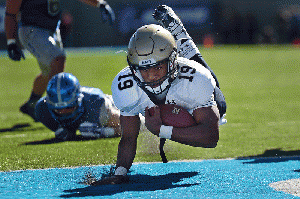
Warrior Games athletes honored at Navy-Air Force football game 141004-D-DB155-022
(Image by (From Wikimedia) EJ Hersom, Author: EJ Hersom) Details Source DMCA
The present non-union, commercialized college sports system teaches students that spectator sports, money, power and glory trump education. The creative writing courses supervised by college presidents teach students that to "tell" (to attempt persuasion by telling) is to "blow smoke into the wind." In order to teach or persuade, writers must write of behaviors that model positive values and negative values and their different consequences. This is known as "showing."
The same principle applies when university presidents, boards of regents and chancellors of education attempt to teach values to their students. If they would like students to place a high value on education, for example, they should show by their actions that they place a high value on it themselves.
Allowing commercialized sports to dominate universities is not placing a high value on education. Paying coaches 60-70 times the average salary of full professors is not placing a high value on education. In order to model behavior that is respectful of education, presidents and boards of regents should hold coaching staffs to the same standards of behavior applied to the academic faculty. If faculty members are, as we hope they are, required to fly economy class on business trips, coaches should also be required to fly "in the back of the plane." More importantly, coaches should be paid salaries no higher than those paid instructors, assistant professors, associate professors and full professors in the academic departments.
Universities, we assume, would like their students to value the teaching of courses in philosophy and the classics. However, when they pay their football and basketball coaches millions of dollars a year[1] and the average salary of a full professor hovers around one hundred and thirty thousand,[2] they "show" both students and faculty what and who they value. The efforts of coaches to recruit strong, coordinated and quick athletes are "shown" beyond question, to be considered by university presidents and boards of regents as far more "worthy" than the efforts of professors to stimulate the minds and inspire the aspirations of students. University presidents would be well advised to listen to their professors of creative writing. They should "show" students that they value learning more than commercialized college sports.
The following quote illustrates a specious argument sometimes used to justify commercialized college sports
"College sports undeniably have their benefits, creating university pride and an identity that no philosophy or classics program will ever match" [3]
Statements similar to the one quoted above are sometimes used to suggest that commercialized college sports have their "up-side." This argument has little merit. Teaching students to take pride in their university because it has recruited athletes who are quicker, faster, stronger and more coordinated than the athletes recruited by other schools is not beneficial to the students. Neither is it beneficial to students' education when they are taught to base their identities on the qualities of others -- certainly not on qualitie4s such as quickness, speed and coordination.
On the other hand, providing students with access to courses (including courses in philosophy and the classics), inspiring them to aspire and teaching them skills that lead to productive and satisfying careers are all beneficial to them and to higher education.
It is the commercialized aspect of Div. I and Div. II sports that makes them undesirable. Intramural sports at all levels and Div. III sports are extremely desirable. Providing a place and a context within which students are encouraged to test and exchange their opinions and ideas with teachers and fellow students in an informal setting is essential to quality higher education.
I admired my (pre-commercialization) football and track coaches and am grateful to my 1950's University of New Hampshire presidents for UNH's then essentially amateur sports programs. I am especially grateful for UNH's intramural sports program. Intramural sports give students opportunities to participate in sports -- as well as to watch them. Students can learn much from each other and from professors while participating in non-commercialized sports and other extra-curricular activities. The dance club, the debating team, the intramural softball league, the school newspaper and many other extra-curricular activities make significant contributions to higher education. On the other hand, the impact of commercialized college sports on higher education is negative.
Division III sports support higher education. Imagine a college with coaches paid no more than professors, with no athletic scholarships, with affordable tuitions and sports events attended largely by students, families of students and faculty. Actually, no imagination is req1uired. We have many such schools. Most of them are private. Many of them are in Div. III. Some of them are totally free. For example, Berea College in Kentucky provides all-expenses-paid education. How does Berea do it? For one thing, it requires students to do most of the work done in other schools by paid employees. For another, it does not support a commercialized sports program.
What to expect from the NCAA
The NCAA could reform college sports by a few strokes of the pen. It could limit bowl eligibility to schools that (1) give only scholarships based on need and academic merit (2) guarantee every student the opportunity to participate in intramural sports and (3) pay their coaches amounts comparable to those paid instructors, assistant professors, associate professors and full professors in their academic departments. This would "accentuate the positive and eliminate the principal negative" aspects of college sports. If it also created a need for more professional sports teams (as it well might), the market would meet this need. However, it is unrealistic to suppose that the NCAA, which profits greatly from present arrangements, will assist in altering these arrangements.
The unionization of students would be a "ray of hope"
The possibility that students may unionize is a ray of hope for ending commercialized college sports. Universities in many other countries have true student unions. Their members have the opportunity to influence university educational policies and conditions through collective bargaining. In the process, they become more politically aware and better prepared for involvement in politics after they graduate. In the US, on the other hand, student unions are not representative bodies .This is not to say that they do not contribute to higher education. For example, they provide places where students can meet, socialize and discuss. Meeting, socializing and discussing are consistent with the goals of higher education.
Student involvement in the development of university policies and programs could best be accomplished by a constitutional amendment (already needed) to bolster our declining labor unions. This amendment would grant all workers, as well as students, the specific and protected rights to organize and join unions and to bargain collectively. It would be important to the de-commercialization of college sports and even more important to the narrowing of our national income gap.
Middle and lower income families have the most to gain from an explicit "right to organize" amendment covering employees. Students and "student athletes" have the most to gain from eliminating athletic scholarships, increasing academic scholarships, paying coaches academic salaries, expanding intramural sports programs and reducing tuitions. These reforms would make higher education more available to students and prospective students. They would result in "student athletes" being paid for their work. Those who could would go directly into the "big leagues" and those who couldn't would be spared the years now spent working in college for no pay --- unless they chose to attend college in order to get an education.
There is no doubt but what the reform of college sports is an extremely difficult proposition. A great many influential people and organizations benefit from the present arrangements. However, it is an effort well worth making, especially when the income gap would be addressed by the same means. It is disheartening that the NLRB has taken a decision that is harmful to both students and student athletes and that places a roadblock in the way of de -commercializing college sports and enhancing our system of higher education.
[1] The salaries of the coaches of the top nine basketball teams in the 2014 NCAA tournament ranged from $2,630,000 (Memphis) to $9, 832,000 (Duke). USA Today, "Sports", Apr. 2, 2014. According to a
(Article changed on August 23, 2015 at 09:11)
Authors Bio:
Neal Herrick is author of the award-wining After Patrick Henry (2009). His most recent book is (2014) Reversing America’s Decline. He is a former sailor, soldier, auto worker, railroad worker, assistant college football coach, door-to-door salesman, bureaucrat, reporter and peace activist. He received his BS from the University of New Hampshire and his PhD from the Union Graduate School. He retired from the University of Michigan as a visiting professor