| Back OpEdNews | |||||||
|
Original Content at https://www.opednews.com/articles/House-Members-In-Israel-fo-by-James-Wall-Congress_Israel_Israel-Firsters_Israel-Lobby-150807-746.html (Note: You can view every article as one long page if you sign up as an Advocate Member, or higher). |
|||||||
August 7, 2015
House Members In Israel for Obama-Bashing
By James Wall
While President Barack Obama was speaking about the people's business, and his Kennedy-like preference for diplomacy over war, freshman members of the U.S. House of Representatives were either 5,000 plus miles away in Israel, or preparing to go there to be feted and educated by a foreign power which opposes the nuclear agreement the U.S. has reached with Iran and major European powers.
::::::::
Reprinted from Wallwritings
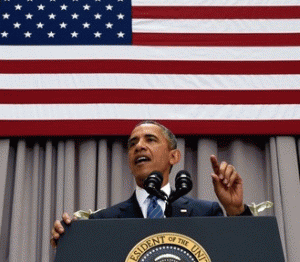
On Wednesday, August 5, President Obama spoke for an hour at American University, the site of the 1963 speech by President John Kennedy, when Kennedy outlined his vision for peace with the Soviet Union during the early age of nuclear threats.
While President Barack Obama was speaking about the people's business, and his Kennedy-like preference for diplomacy over war, freshman members of the U.S. House of Representatives were either 5,000 plus miles away in Israel, or preparing to go there to be feted and educated by a foreign power which opposes the nuclear agreement the U.S. has reached with Iran and major European powers.
A U.S. delegation of Democratic freshman congress members had been in Israel for two days when Obama spoke. Their freshman Republican colleagues will join them in Israel August 8.
In his American University speech, President Obama was blunt and insistent. This is how Obama's speech was reported by ABC news:
"President Barack Obama assailed critics of his Iran nuclear deal Wednesday as 'selling a fantasy' to the American people, warning Congress that blocking the accord would damage the nation's credibility and increase the likelihood of more war in the Middle East.
"Besides challenging opponents at home, Obama cast Israeli Prime Minister Benjamin Netanyahu as an isolated international opponent of the historic accord, saying, 'I do not doubt his sincerity, but I believe he is wrong.'"
The President explained what was in the agreement:
"'The agreement would require Iran to dismantle most of its nuclear program for at least a decade in exchange for billions of dollars in relief from international sanctions. But Netanyahu and some critics in the U.S. argue that it would not stop Iran from building a bomb.'
"The president's blunt remarks, in an hour-long address at American University, were part of an intense lobbying campaign by the White House ahead of Congress' vote next month to either approve or disapprove the international agreement. ...
"The stakes are high, Obama said, contending that it isn't just Iran's ability to build a bomb that is on the line but also 'America's credibility as the anchor of the international system.'"
Those Democratic freshman congress members who may or may not have heard the Obama speech, are traveling in Israel (all expenses paid) courtesy of an educational nonprofit "affiliated with" the American Israel Public Affairs Committee (AIPAC), the American Israel Education Foundation, AIPAC's charitable arm.
What "affiliated with" means is that AIPAC runs the trip while its "education foundation" pays the bills.
The two congressional trips -- this year with 22 Democrats, and 36 Republicans -- are a fixture in Washington, an AIPAC travel-educational reward for recently elected House members every two years.
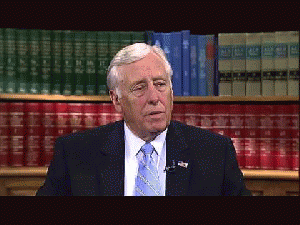
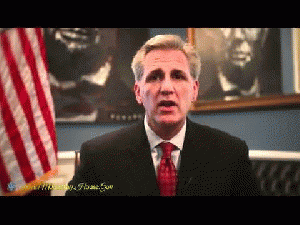
The Washington Post reports that shepherding the new members on this trip are House Minority Leader Steny Hoyer (D-Md.), whose Democratic trip began August 3, and Republican Majority Leader Kevin McCarthy (R-Calif.), who will shepherd his party's members on their trip, which begins August 8 (see above).
"Hoyer and McCarthy's offices declined to share the names of the lawmakers traveling on the trip, as did AIPAC.
"But PowerPost confirmed the trip includes a number of House Democrats that many lobbyists consider critical votes on the deal, including Reps. Ted Lieu (D-Calif.), Mark Takai (D-Hawaii), Brendan Boyle (D-Pa.), Gwen Graham (D-Fla.), and Hoyer himself."
These Democrats should be watched as the September 17 deadline approaches.
This year's trip comes during the 60-day study period when new members will be confirmed in their decision on whether to support their President on a crucial foreign policy issue, or else support a foreign leader, Israeli Prime Minister Benjamin Netanyahu.
Republican House members are expected to say no to the agreement. After President Obama's expected veto of the House bill, the GOP will have to deliver sufficient votes to override that veto.
The Hill reports that Israel is especially eager to meet (solidify relations?) with three freshman members, Reps. Martha McSally (R-Ariz.), Carlos Curbelo (R-Fla.) and Mimi Walters (R-Calif.).
McSally, a retired Air Force colonel and the first U.S. female combat pilot, told The Hill, "I've had six deployments to the Middle East and Afghanistan in my time in uniform, and I've been over to Israel as a tourist."
She added that this is a critical time to be going "to hear from our close ally." McSally is on record as opposing the deal. So why does she need to "hear from our close ally" if her mind is already made up?
We can only hope that the retired colonel found time to hear her Commander in Chief's speech Wednesday as she prepared to head for Tel Avi to hear from "our close ally."
The New Yorker's Robin Wright writes that Obama "framed the deal as the latest step in a half century of American policy to avert nuclear confrontation, invoking Kennedy's diplomacy during the Cuban missile crisis and the arms negotiations with the Soviet Union launched by Ronald Reagan."
"Under both Democratic and Republican Presidents," he said, "the historic Non-Proliferation Treaty and the SALT and START treaties introduced arms control..."
Obama mentioned that he had been forced to make a lot of tough calls as President. "But whether or not this deal is good for American security is not one of those calls," he said. "It's not even close."
The Republican-introduced resolution of disapproval of the agreement with Iran will be voted on no later than September 17th.
Obama called this congressional vote "the most important since its vote on the 2003 invasion of Iraq."
"Without naming George W. Bush, the President contrasted his own use of diplomacy with Bush's rush to war, noting that the Iraq adventure cost nearly a trillion dollars, took thousands of American lives, and left Iraq ripped apart by sectarian violence.
"Obama condemned the 'knee-jerk partisanship' in Washington, which renders every decision made to be a disaster, a surrender. 'You're aiding terrorists! You're damaging freedom!' He also went after lobbyists and pundits who had suddenly become 'arm-chair nuclear scientists.'"
California Republican Ed Royce, Chairman of the House Committee on Foreign Affairs, introduced language for the resolution of disapproval Tuesday.
"'The agreement gives Iran permanent sanctions relief, but in exchange only temporarily restrains Iran's nuclear program,' Royce said. 'If this agreement goes through, Iran gets a cash bonanza, a boost to its international standing, and a lighted path toward nuclear weapons.' The United States will be less able to challenge Iran 'across the board,' he said. 'As Iran grows stronger, we will be weaker to respond.'"
Among American Jews, the American Israel Public Affairs Committee (AIPAC) is lobbying hard against the agreement. The more liberal JStreet has supported it.
Democratic Jewish members of the House are especially important to the White House as it works to obtain a needed vote total to sustain an Obama veto.
Robin Wright reports on a setback for the White House, in which, "three Jewish Democrats -- Representatives Nita Lowey and Steve Israel, of New York, and Ted Deutch, of Florida -- announced Tuesday that they will vote against the deal.
"Lowey is the top Democrat on the House Appropriations Committee. Deutch is the senior Democrat on the House Middle East subcommittee."
The only international opposition to the agreement is, of course, Benjamin Netanyahu, the Prime Minister of Israel, usually touted as "America's closest ally in the Middle East."
In a Webcast address to American Jewish organizations (and anyone else who turned in) on Tuesday, Netanyahu made his case that the deal "would give Iran two paths to a bomb: either by keeping to the terms of the deal over its limited time period -- after which it will be a "threshold nuclear-weapons power" -- or by violating it outright."
Playing his usual fear card, Netanyahu told his American Webcast audience, as he will no doubt tell his two congressional delegations who are, or will be, in Israel for their educational tour: "As a result of this deal, there will be more terrorism, there will be more attacks, and more people will die," Netanyahu warned.
To counter this fear campaign by Netanyahu, Robin Wright adds that in his speech:
"Obama ticked through the main arguments against the deal. To cheat, Iran would have to build a massive covert operation and many covert facilities. 'No nation in history has been able to pull off such subterfuge when subjected to such rigorous inspections,' he said.
"The prohibition against making a bomb is permanent -- not limited to any of the ten-to-twenty-five-year time frames for various aspects of a program. U.N. inspectors will be allowed daily access to nuclear sites, as well as the right to look at suspicious undeclared sites. 'This access can be with as little as twenty-four hours' notice,' Obama said. 'And while the process for resolving a dispute about access can take up to twenty-four days, once we've identified a site that raises suspicion, we will be watching it continuously until inspectors get in.'
"He argued that proposals to walk away from the deal and either maintain sanctions or try to get better terms were 'selling a fantasy.'"
Obama again "invoked Kennedy" when he appealed to Americans to contact their representatives in Congress during the final weeks of debate. Also in his speech, Obama said:
"'The world avoided nuclear catastrophe, and we created the time and the space to win the Cold War without firing a shot at the Soviets. The deal with Iran, reached after twenty months of negotiations...builds on this tradition of strong, principled policy diplomacy."'Should Congress prevail in undermining ...this strong, principled policy diplomacy, we would have reached a shameful moment in U.S. foreign policy.'"
Looking back on these days prior to the final September 17 vote in Congress, we will have to remember two traveling congressional delegations who by their trips to Israel, will have contributed mightily to that shame.
Leaders of the two congressional delegations did not release the names of the members on the trip. The website Mondoweiss, however, posted this picture of 20 of the traveling Democrats.

President Reuven Rivlin, House Minority Whip Rep. Steny Hoyer and Democratic Congressional delegation to Israel met in Jerusalem to discuss the IranDeal and other regional matters.
(Image by Photo Credit: Mark Neyer, GPO) Details DMCA
The Washington Post concluded that "Democrats are expected to be the swing votes in the pact because most Republicans already oppose the agreement...
"Congress can vote to reject the nuclear agreement, but it would take a two-thirds majority in both the House and Senate to override a presidential veto of any attempt to derail the deal."
Whatever the outcome of the final vote on the Iran nuclear agreement, history will record that three freshman Democrats chose not to travel with the delegation to listen to Obama-bashing on foreign soil.
They chose diplomacy over "a fantasy," as President Obama put it this week.
Their names: Representatives Don Beyer (D-Virginia), Debbie Dingel (D-Michigan) and Norma Torres (D-California). Remember them well.
Authors Website: http://wallwritings.wordpress.com/
Authors Bio:
James Wall served as a Contributing Editor of The Christian Century magazine, based in Chicago, Illinois, from 1999 through 2017. From 1972 through 1999, he was editor and publisher of the Christian Century magazine. Many sources have influenced Jim's writings over the years, including politics, cinema, media, American culture, and the political struggles in the Middle East. He has made more than 20 trips to that region as a journalist, during which he covered such events as Anwar Sadat's 1977 trip to Jerusalem, and the 2006 Palestinian legislative election. He has interviewed, and written about, journalists, religious leaders, political leaders and private citizens in the region.
Jim served for two years on active duty in the US Air Force, and three additional years in the USAF (inactive) reserve. He can be reached at: jameswall8@gmail.com