| Back OpEdNews | |||||||
|
Original Content at https://www.opednews.com/articles/What-we-can-do-now-to-help-by-Franklin-Lamb-Culture_Hague_Humanitarian_Interpol-150314-214.html (Note: You can view every article as one long page if you sign up as an Advocate Member, or higher). |
|||||||
March 14, 2015
What we can do now to help stop Iconoclasm by Da'ish (IS)
By Franklin P. Lamb
Visitors sometimes hear this point of view and they are reminded, as this observer was recently, surprisingly by a Syrian university professor in Aleppo, "Sir, what matters most now is the condition of people not old stuff!"
::::::::
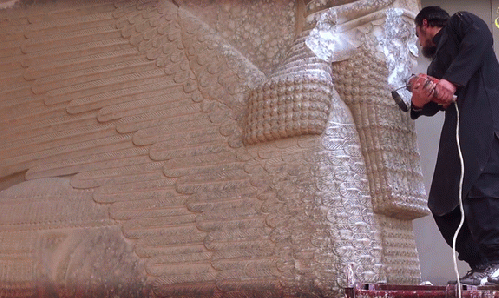
National Museum of Syria, Aleppo
Iconoclasm, the deliberate systematic attacking or destroying of religious images as religiously heretical is clearly a crime against humanity everywhere it occurs. Today in Syria, Iraq and elsewhere iconoclasm is spreading outrageously. It continues to irreparably destroy our shared global heritage. Our past and identity are in the crosshairs of religiously and socially misguided iconoclasts who are bent on erasing our history.
Yet some are asking why we should care all that much right now given all the other societal problems internationally. Isn't the seemingly cliquish-chic handwringing over archeological sites and old stone fragments, carvings, pots and writings just another form of cultural colonialism? Seemingly to placate old people who may have been raised near these sites and appear obsessed with them?
Visitors sometimes hear this point of view and they are reminded, as this observer was recently, surprisingly by a Syrian university professor in Aleppo, "Sir, what matters most now is the condition of people not old stuff!" Before our meeting ended the professor did qualify her comment a bit and explained that her loved ones and her friends including many university students and faculty, had suffered such devastation, lost homes and jobs including lack of water and electricity, and many don't have much food. Such that foreigners should know these days that archeology is down the list of many war victims concerns.
One of her students, during a stroll across campus explained that what Daesh is doing to Syria can be compared to an act of nature like a grass fire rolling across the landscape. Pining over the loss of a museum here or there is pretty minor compared to the death and destruction they are inflicting upon people who do not share their views. According to another graduate student enacting legislation against destroying cultural sites is probably a waste of time because all sides in a conflict ransack valued historical sites of their enemies as a way of punishing the other side. And as a form of psychological warfare to humiliate enemies, like abusing family members. "You know something about conditions now for average people in Syria. We are so tired and beaten down. Just trying to survive should be everyone's priority don't you think?"
As one spends time in Syria these days with the honor of meeting many decent, smart and caring people, some of whom become cherished friends, it is normal to keep track of and assess the many horrifying impacts of the continuing armed-conflict on their lives. From the beginning of the conflict many visitors, certainly this one, thought that the suffering among Syrian inside and refugees outside their beloved country would wind down and rebuilding of lives and infrastructures was not far off. Unfortunately, events have proven otherwise with few signs and little hope of peace coming soon as the latest social-economic indicators document the bleak prospects.
A just released UN study on the impact of the Syrian crisis makes plain that the condition of people in Syria has never been worse in modern times. Violence has intensified with the expansion of black markets, the erosion of sovereignty and rule of law, increasing dependence upon external support, deepening economic exposure and loss of economic security. Conflict-related transnational networks and criminal gangs are engaging in human trafficking and abuse, pillage, smuggling, kidnapping and extortion, recruiting combatants while at the same time they loot and sell Syria's national and historical heritage.
Current life quality indexes resulting from the destruction of Syria's economic foundations and citizen well-being document what we have already witnessed in Syria and among her refugees in four neighboring countries. Total economic loss since the start of the conflict until early 2015 is estimated at USD 202.6 billion, with damage to capital stock accounting for 35.5 per cent of this loss. Total economic loss is equivalent to 383 percent of the GDP of 2010 in constant prices. The UN estimates that the total volume of GDP loss is estimated at USD 119.7 billion, of which USD 46.1 billion was generated in 2014. GDP contracted by 9.9 per cent in 2014 compared to the previous year.
The country continues to be plagued by lack of jobs and the unemployment rate surged from 14.9 per cent in 2011 to 57.7 per cent or numbering 3.72 million by the beginning of 2015. This has been one factor leading to a hollowing population as it fell from 20.87 million persons in 2010 to only17.65 million people by the beginning of 2015 After the unresolved Palestine refugee issue, refugees from Syria now constitute the second largest refugee population in the world with an estimated 3.33 million refugees fleeing Syria as of early of 2015. According to recent UN studies, over half the population (52.8 per cent) has been dislodged as people left their homes looking for safer places to live. The decent into poverty in Syria continues in early 2015 as just over 80% Syrians lives in poverty. 2014 was the deadliest year of the conflict in Syria, with more than 76,000 Syrians killed. Aid access has not improved: 4.8m people in need reside in areas defined by the UN as "hard to reach", one million more than in 2013. Needs have increased: 5.6m children are in need of aid, a 31% increase since 2013. At the same time, the humanitarian response has decreased compared to needs: In 2013, 71% of the funds needed to support civilians inside Syria and refugees in neighboring countries were provided. In 2014, this had declined to 57%.
So what can we do now that the continuing destruction of our cultural heritage has sparked a fresh round of global outrage? How can we hope to save other heritage sites under IS and other extremists and looters control short of defeating the entrenched jihadists militarily which appears highly unlikely anytime soon.
Many suggestions have been heard by this observer in Syria including by local officials and citizens who are on the front lines trying to preserve and protect the cultural heritage that we all share.
Syria and Iraq's cultural heritage which belongs of all of us needs our help. Today international law needs to be changed in hopes of stopping the current iconoclastic onslaught, and prevent future ones. Yet with the United Nations Security Council is polarized and politicized and has done little to fulfill its obligations. Existing international agreements are weak and not effectively enforced.
Among proposals being discussed, and some even being implemented on a discrete ad hoc local basis, by patriotic Syrians. Some but by no means all proposals being discussed and hopefully to be implemented include:
Buy the looted objects off the jihadists, looters and errant regular citizens and secure them in safety vaults somewhere until the fighting ends, This has actually been done in Syria with modest success but given its sensitivity, without much publicity.
We can all help raise awareness in our communities and instruct our politicians to tighten and enforce current national and international laws and to ratify the instruments of international humanitarian law that protect cultural heritage. Specifically the Convention for the Protection of Cultural Property in the Event of Armed Conflict (The Hague 1954) and its two Protocols (1954 and 1999), as well as the Convention on the Means of Prohibiting and Preventing the Illicit Import, Export and Transfer of Ownership of Cultural Property (Paris 1970); to implement them swiftly and efficiently into national legislation and in accord with their spirit and overarching goal to preserve cultural heritage, and to observe and enforce them.
We can and must support new dedicated groups like Heritage for Peace and more than two dozen NGO's recently formed that are working to protect archeological sites in Syria and Iraq.
In each of our communities we must work on strengthening our national capacities, training for soldiers, more resources, experts on the ground, and better coordination with armed forces, Interpol, and other actors while encouraging volunteer organizations willing to send international volunteers experts as Cultural Heritage Monitors on the scene. Their work would be to assess, protect, and investigate cultural property destruction and looting. All this while working with locals of all religions and ethnicities who want to protect our and their cultural heritage. In other words we need to establish the cultural equivalent of the Red Cross and Blue Shield providing an emergency response to cultural property at risk from armed conflict.
The United Nations and international regional organizations under whose auspices national, multi-national or private forces may be deployed, including peacekeeping operations, have an obligation to incorporate the principles of cultural property protection in the authorization of any forces deployed under their mandate or authority. Moreover, their commanders must ensure that cultural property protection is integrated into all Rules of Engagement as well as to incorporate cultural property protection into all pre-conflict, conflict and post-conflict stabilization planning. As part of the UN's and other regional deployments, there must be serious pre-deployment training in cultural property protection for such forces in general, and of their officers in particular; and to create expert/liaison officers for cultural property protection in such forces.
In addition the United Nations Security Council must explicitly prohibit trade in cultural materials illegally removed from all areas of conflict and occupation.
As Irina Bokova, the Director-General of UNESCO explained in the context of Syria's tragic humanitarian crisis pointing out that for some the state of Syria's cultural heritage may seem secondary: "I am convinced that each dimension of this crisis must be addressed on its own terms and in its own right. There is no choice between protecting human lives and safeguarding the dignity of a people through its culture. Both must be protected, as the one and same thing--there is no culture without people and no society without culture."
Nor, in this observers view can there reasonably be any question about choosing between people and property because we are exactly our lands, our archeological sites, our museums, our icons and our religions. All of us would choose to have lives saved first, but no one can deny how impoverished these lives will likely become if stripped of their human rights to their culture.
Authors Website: http://mealsforsyrianrefugeechildrenlebanon.com/
Authors Bio:
Since 2013, Professor Franklin P. Lamb has traveled extensively throughout Syria. His primary focus has been to document, photograph, research and hopefully help preserve the vast and irreplaceable archaeological sites and artifacts in Syria.
Like Iraq, Syria is the cradle of civilization, and as such it has been a rich source of our shared global culture and historic heritage. Already endangered from illegal excavation, looting, international trafficking and iconoclasm; the theft and destruction of these sites has greatly increased as a result of the conflict in the Middle East.
Many of the endangered archeological sites and artifacts are over 7,000 years old. The oldest remains found in Syria are from the Paleolithic era (c. 800,000 BCE). The most endangered artifacts and archaeological sites currently are in Tell Halaf, the north of Syria near the Turkish border with Syria. These archaeological sites date as far back as 5,500 BCE. They include archeological sites and artifacts of the Babylonian, Sumerian, Egyptian, Assyrian, Phoenician, Aramaic, Greek, Roman, Byzantine, Umayyad, Ayyubid and Ottoman civilizations and empires.
Professor Franklin Lamb has also been working, sometimes under dangerous circumstances, to record and photograph the war damage done to religious icons, images, monuments, and ancient structures that span pre-Roman civilizations, and structures such as Islamic mosques, Christian churches and Jewish synagogues.
Professor Lamb is working tirelessly to record and photograph these sites and artifacts because they are in danger of complete destruction for religious, political and illegal trafficking reasons, especially due to the ongoing wars in the Middle East.
Professor Franklin Lamb's website and his latest book, "Syria's Endangered Heritage, an International Responsibility to Preserve and Protect" presents exclusive and never published before photographs, records, data, articles, and interviews from across the whole of Syria. His book can be purchased at his website http://www.syrian-heritage.com/.
In addition to Dr. Lamb's urgent archaeological work he is also deeply committed to rescuing and aiding refugee children in Syria. He is a volunteer with the Lebanon, France, and USA based "Meals for Syrian Refugee Children, Lebanon (MSRCL)", which seeks to provide hot nutritional meals to Syrian and other refugee children.
Lamb says that the goal of MSRCL is to be able to provide one meal a day to 500 children. More donors are needed in order for him to reach that goal. At $2.25 per meal x 500 children per day ($1,225), the budget for a month (30 days) requires approximately $36,000. Over 95% of each donation goes directly towards the cost of each meal. The MSCRL volunteer teams give their time, energy and even their own money to help the refugee children so that they will not become part of the "lost generation" of Syria.
Lamb's books and publications include "Pollution as a Problem of International Law"; "International Legal Responsibility for the Sabra Shatila Massacre"; "Israel's 1982 War in Lebanon: Eyewitness Chronicles of the Invasion and Occupation", "The Price We Pay: A Quarter Century of Israel's Use of American Weapons against Civilians in Lebanon in addition to the three volume set, "Palestine, Lebanon & Syria Palestine, Lebanon & Syria (Commentary and Analysis 2006-2016)." Due out during Fall 2016, in English and Arabic, is "The Case for Palestinian Civil Rights in Lebanon: Why the Resistance Sleeps."
Dr. Lamb's most recent book is "Syria's Endangered Heritage: An International Responsibility to Preserve and Protect". www.Syrian-heritage.com
Lamb's Academic Credentials include: BA, and Law Degrees from Boston University, Master of Law (LLM) Master of Philosophy and Doctor of Philosophy from the London School of Economics (LSE); Diploma in International Air & Space Law from the University College of London; Post-Doctoral Studies at Harvard University Law School of East Asian Legal Studies Center, specializing in Chinese Law; International Legal Studies at Cambridge University in the United Kingdom; Studied Public International Law at The Hague Academy of international Law, at the International Court of Justice, in The Hague, Netherlands.
Lamb's Professional and Political Activities include Assistant Professor of International Law, Northwestern College of Law, Portland, Oregon and Assistant Counsel to the US House of Representatives Judiciary Committee, During the Administration of President Jimmy Carter, Lamb was elected for a four year term to the Democratic National Committee, representing the state of Oregon. Lamb served on the Democratic National Committee Judicial Council with California Congresswoman Nancy Pelosi as well as the Platform Committee on East-West Relations. Professor Lamb served on the presidential campaign staff for Presidential Candidate Edward M. Kennedy of Massachusetts.