| Back OpEdNews | |||||||
|
Original Content at https://www.opednews.com/articles/Why-the-Country-Needs-a-Po-by-Robert-Borosage-Candidates_Capitalism_Democratic-Party_Democratic-Socialism-150217-487.html (Note: You can view every article as one long page if you sign up as an Advocate Member, or higher). |
|||||||
February 17, 2015
Why the Country Needs a Populist Challenger in the Democratic Primaries
By Robert Borosage
Polls show Democrats want a contest, not a coronation, for their presidential nomination. There are two compelling reasons for a challenge in the Democratic primaries: We need a big debate about the direction of the country, and a growing populist movement would benefit from a populist challenge to Hillary.
::::::::
Reprinted from Campaign For America's Future
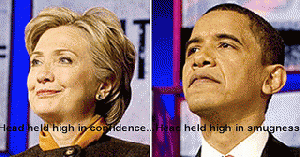
Polls show Democrats want a contest, not a coronation, for their presidential nomination. The press yearns for a primary contest, if only to have something to cover. A raft of reasons are floated for why a challenge would be useful, most of them spurious.
Hillary Clinton doesn't need a contest to get her campaign shipshape. She's already been central to three presidential campaigns, as underdog, incumbent and, disastrously, overwhelming favorite. She has every high-priced operative in the party. If she doesn't know how to put together a campaign by now, an upstart challenger won't help.
Some suggest a challenger could move Hillary to the left, as if Hillary Inc. were a bloated ocean liner needing a plucky tugboat to put it on the right path. But the Clintons are adept at running more populist than they govern. Hillary found her populist pitch in 2008 when it was too late to save her. She's knee deep in pollsters and speechwriters. She won't need a challenger to teach her the lines.
There are two compelling reasons for a challenge in the Democratic primaries: We need a big debate about the direction of the country, and a growing populist movement would benefit from a populist challenge to Hillary.
The Divide
This isn't conventional wisdom. Matt Yglesias argues that Clinton is the prohibitive favorite for the nomination not because of experience, name recognition or the Clinton money machine but because no large ideological divisions separate Democrats. New Dems have embraced the social liberalism they once dreaded. Foreign policy differences are minimal. All Democrats sing from President Obama's populist songbook. All favor raising the minimum wage, pay equity, investment in infrastructure, bank regulation.
New York Sen. Charles Schumer agrees that the "differences among Democrats are small compared to the chasm on the Republican side." Democrats, he argues, are united on "fundamental issues," like the minimum wage, pay equity, paying for college.
In fact, there are deep divides between the party establishment and the Democratic wing of the Democratic Party. All affirm, finally, that this economy works only for the few and not the many. But after that, the differences are immense.
The center of the party -- which Hillary occupies -- argues that our extreme inequality just happened, sort of like the weather. Globalization and technology did it. Republican trickle-down economics made it worse. We can fix it with sensible reforms packaged as "middle-out economics." Everyone gets a "fair shot," as the president puts it, echoing Bill Clinton, "and everyone plays by the same set of rules."
The Democratic wing of the party understands, as Sen. Elizabeth Warren has put it, that extreme inequality is the result of the "rules being rigged" by the few to favor the few. The deck is stacked. Playing by the same set of rules doesn't change the outcome if the rules are rigged. The core structures of our politics and our economy have to be changed to get a clean deal.
On fundamental issues, all Democrats stand in sharp contrast with Republicans, but they divide dramatically among themselves. Consider:
Globalization. Republicans basically defend current global trade and tax policies, seeking mostly to find new ways to reduce corporate taxation. Obama, and most likely Clinton, support more corporate trade deals and would move to a territorial system that exempts corporations from paying taxes on money earned abroad. For the populist wing, the global trade and tax strategies have been catastrophic, running up record deficits, shipping jobs abroad, and lowering wages at home. The president's call for "fast track trade authority" will spark a furious debate, pitching the broad base of the party against Obama, Republicans and the Wall Street wing.
Incomes Policy. Republicans oppose every measure to lift wages for working people, except tax credits, which provide a backdoor subsidy to low-road employers like Walmart. All Democrats favor strong reforms for low-wage workers -- minimum wage, pay equity, paid sick and vacation days, revised overtime and more. But Democrats divide on empowering those in the middle or curbing the avarice at the top. While sporadically expressing support for unions and the right of workers to organize, both Obama and Bill Clinton were essentially AWOL when it came to pushing for reforms. Populists understand that strong unions are vital if the rewards of growth are to be widely shared. They also argue that reform of our perverse CEO compensation policies -- which give CEOs multimillion-dollar incentives to loot their own companies -- is critical to insuring workers share in the profits and productivity they help to generate.
Shared Security. Republicans want to privatize, voucherize and/or cut our already threadbare safety net. Obama and Clinton would defend Social Security, Medicare and Medicaid, although both flirt with a grand bargain that would result in cuts. Populists believe that Social Security should be expanded, not cut, to meet what will be a growing retirement crisis. We also argue for extending Medicare to all, finally guaranteeing all Americans affordable health care.
Wall Street and Financialization. Republicans have already begun to whittle away at the bank reforms, and argue that deregulation is vital to growth. Obama and Clinton pledge to defend the current reforms. But the big banks are bigger and more concentrated than ever. Populists argue that too big to fail means that they are too big to exist, and would break them up. Populists urge a financial speculation tax to curb the Wall Street casino, and want bankers, not just banks, held accountable for their crimes.
Tax and Invest. Republicans want lower taxes on the rich and corporations and more cuts in programs for the vulnerable. Obama supports modest increases in taxes on the rich and "revenue neutral" tax reform for corporations. Populists want the rich and corporations to pay their fair share of taxes. That means income from wealth should be taxed at the same rates as the income from work, higher tax rates on the very wealthy, estate taxes that will curb the growth of dynastic wealth, and corporate tax reform that raises revenue and closes loopholes.
Republican budgets would basically shutter the domestic capacity of government -- but so would Obama's projections. Populists -- as detailed in the budgets offered by the Congressional Progressive Caucus -- would expand dramatically public investments in everything from rebuilding America to providing a fair start for every child, with world-class public education from preschool through college or advanced training.
Climate and the Green Industrial Revolution. Republicans remain wedded to drill, baby, drill. Obama and Clinton espouse an "all of the above" energy policy, with Obama making significant strides in expanding renewables. Populists want the U.S. to adopt a manufacturing strategy that will aim explicitly to capture the lead in the green industrial revolution that is already sweeping the world.
Global Security. Republicans, with few exceptions, have become a war party, supporting more U.S. intervention in conflicts across the globe. Obama has sought to avoid doing "stupid sh#t," even while sustaining a war on terror that extends into 120 countriesat last count. Clinton wants purposefully to run to Obama's right. Both would increase military spending. Populists argue that America can't police the world and is exhausting itself trying to do so. We want the empire of bases dismantled, our allies to bear a fair share of the burden, Pentagon waste and abuse curbed, a smaller military used only as a last resort. Clinton's bellicosity -- from Iraq to Libya to Syria and Ukraine -- would drain our future.
Corruption. Republicans rail against crony capitalism, while defending Big Oil subsidies, big money in politics, and erecting obstacles to voting. Obama and Hillary oppose the Republican reaction, but are skilled practitioners in big money politics. Populists want to clean out the stables, close the revolving door between Wall Street and Washington, curb the role of big money, and expand democracy.
The differences with Republicans are apparent. But so too is the divide among Democrats. The center offers attractive reforms, but would do little to alter the ways the rules are rigged. The space for a populist challenger is apparent.
The Emerging Movement
Occupy Wall Street forced inequality onto the national agenda. The post-Ferguson #BlackLivesMatter demonstrations brought the institutionalized racism of our criminal justice system to national attention. Movements have transformed Americans on civil rights, women's right, the environment, gay rights and more.
But the education and engagement of Americans on an economy that does not work for them has only just begun.
Our elections do not feature serious issue debates. The mainstream media highlight the horse race and polls, even early, when they are at best meaningless indications of name recognition. The candidates adopt poll-tested stump speeches and canned answers designed to appeal to what they believe their listeners want. The debate formats preclude any extended argument.
But a populist challenger in the Democratic primaries can reach out to, engage and help educate a new generation of activists. He or she could use public debates to expose fundamental differences to a broader audience. Most Americans pay little attention to politics amid the daily struggle to stay afloat. Presidential campaigns -- beginning with primaries -- attract more attention. And importantly, activists get involved, get inspired or turned off.
A strong populist challenger would add fuel to what is already a rising movement on the left of the Democratic Party. Sen. Elizabeth Warren would take gender out of the equation, and pose a stark contrast to the Wall Street wing of the party. Sen. Bernie Sanders would provide a stentorian voice, defining the divide in direction and priorities that the country must choose. Former Sen. Jim Webb could issue a patriotic indictment of our failed global policies. Their arguments would reach citizens who are struggling to make sense out of a world that seems out of kilter, and a politics that seems more and more dominated by big money and entrenched interests.
This is fertile ground that needs tilling. A primary challenge won't on its own build a movement, but it can surely help fertilize one.
Authors Website: http://www.ourfuture.org
Authors Bio:
Robert L. Borosage is the president of the Institute for America's Future and co-director of its sister organization, the Campaign for America's Future. The organizations were launched by 100 prominent Americans to challenge the rightward drift in U.S. politics, and to develop the policies, message and issue campaigns to help forge an enduring majority for progressive change in America. Most recently, Borosage spearheaded the Campaign's 2006 issues book, StraightTalk 2006, providing activists and candidates with distilled messages on kitchen table concerns, from jobs to affordable health care. Borosage also helped to found and chairs the Progressive Majority Political Action Committee, developing a national base of small donors and skilled activists. Progressive Majority recruits, staffs, and funds progressive candidates for political office.
Mr. Borosage writes widely on political, economic and national security issues for a range of publications including The Washington Post, the Los Angeles Times, and the Philadelphia Inquirer. He is a Contributing Editor at The Nation magazine, and a regular contributor to The American Prospect magazine. He is a frequent commentator on television and radio, including Fox Morning News, RadioNation, National Public Radio, C-SPAN and Pacifica Radio. He teaches on presidential power and national security as an adjunct professor at American University's Washington School of Law.
A graduate of Yale Law School, with a graduate degree in International Affairs from George Washington University, Borosage left the practice of law to found the Center for National Security Studies in 1974. The Center focused on the tension between civil rights and the national security powers and prerogatives of the executive branch. It played a leading role in the efforts to investigate the intelligence agencies in the 1970s, curb their abuses, and hold them accountable in the future. At the Center, he helped to write and edit two books, The CIA File and The Lawless State.
In 1979, Borosage became Director of the Institute for Policy Studies, a research institute that drew its inspiration and fellowship from the major democratic movements of our time -- anti-war, women's, environmental and civil rights movements. Borosage helped to found and guide Countdown 88, which succeeded in winning the congressional ban on covert action against Nicaragua. Under Borosage's direction, the Institute expanded its fellowship, launched a successful publications program, and developed a new Washington School for congressional aides and public interest advocates.
In 1988, Borosage left the Institute to serve as senior issues advisor to the presidential campaign of the Reverend Jesse Jackson. He traveled the country with Jackson, writing speeches, framing policy responses, and providing debate preparation and assistance. He went on to advise a range of progressive political campaigns, including those of Senator Carol Moseley-Braun, Barbara Boxer and Paul Wellstone. "