| Back OpEdNews | |||||||
|
Original Content at https://www.opednews.com/articles/Frontline-Slings-Mud-at-Pu-by-Natylie-Baldwin-International_Other_Propaganda_Putin-150205-114.html (Note: You can view every article as one long page if you sign up as an Advocate Member, or higher). |
|||||||
February 5, 2015
Frontline Slings Mud at Putin
By Natylie Baldwin
Karen Dawisha is not the most credible source on Russia or its president. Making a documentary program with no other academic or journalistic experts on Russia, government officials or business people is short sighted. Not performing due diligence as to the dubious claims she and the handful of others on Frontline make smacks of propaganda.
::::::::
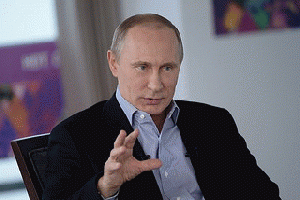
Is Karen Dawisha the Credible Expert She Claims to Be?
The recent Frontline program called "Putin's Way" is largely based on the work of Miami University professor Karen Dawisha. Author of the recently released, Putin's Kleptocracy, she has been making the rounds of talk shows and has had her book reviewed by all the major newspapers and magazines, including the New York Times, New York Review of Books, Washington Post, Wall Street Journal and the Economist.
However, if a more critical eye is put to Dawisha's work, one may realize that she is not the most credible source on Russia or its president. Making a documentary program with no other academic or journalistic experts on Russia, government officials or business people is short sighted. Not performing due diligence as to the claims she and the handful of others on the program make, does not serve the interests of informing viewers about Russia's political history, economy or current leadership.
Dawisha's book about Putin's alleged corruption is admittedly based on a lot of rehashed claims made over the years by various people with an axe to grind but no substantive evidence. Furthermore, a lot of the sources cited are conveniently not available for verification for one reason or another as is admitted by Dawisha's cheerleader Anne Applebaum (1), including supposed evidence from court cases that were dismissed, material collected by Russian and European journalists which have vanished from the internet (presumably this material was not available for review offline) and out of print Russian legal journals.
It should also be noted that this is Dawisha's first book on Russia related issues in 17 years, which makes one wonder how up to date she is on the topic. Her original British publisher declined to go ahead with the book, fearing violation of libel laws, which indicates that they were not confident of her sources upon closer scrutiny. (2)
Even in her articles promoting the book, Dawisha does not provide a balanced and accurate depiction of the issues. For example, in a New York Times article from December 3, 2014 called "Bad Mannered Russians in the West," Dawisha makes the following statement:
"The market increasingly recognizes the risk of dealing with Russian companies, the largest of which is Gazprom. Despite having the world's largest net profits, Gazprom was trading at one-third the stock market valuation of Exxon Mobil, due to what is widely regarded as rampant and Kremlin-directed corruption." (3)
Yes, there are issues with Gazprom, but the latter part of that statement is interesting when one considers that Transparency International's most recent report states that the Russian gas company scored higher than Apple, Amazon and Google, which are notorious for having poor scores, while another state owned fossil fuel company, Rosneft, actually scored higher than Exxon Mobil. (4) The World Bank has also ranked Russia at 62 on their recent "ease of doing business" list, moving up from 120 (out of 180) in 2011. (5) How is this possible under the extreme and incorrigible conditions of corruption that Dawisha contends represent Russia uniquely under Putin?
It's not exactly a news flash that corruption is still an issue in Russia, but to provide no historical context about the dynamics of corruption in Russia is misleading at best.
90% of all corruption in Russia is estimated to be at the local level. (6) Part of the reason this kind of corruption persists is due to the strong historical roots of getting essential things done via "connections" and its associated prestige rather than the rule of law as a foundation. This was the case in Czarist Russia as tributes were typically paid in the form of goods or money to officials as part of the feudalist-like system, which was gradually dismantled in the rest of Europe but continued in Russia. Due to Russia's sprawling geographic size and lack of a developed transportation system, interaction with the outside world and the attendant exposure to new ideas was hindered through the 19th century.
Russians' relationship with governmental authority was modeled on the administrative state system inherited from the Mongols in the 13th century. Consequently, Russians' social contract had never been that of a citizen with rights or sovereignty but as subjects that were granted stability and varying amounts of social protection in exchange for submission to state authority. Submission was enforced by a harsh bureaucracy. (6) (7)
This arrangement of deference to authority and reliance on "connections" to obtain necessities continued under the Soviet system with deference to authority demanded in exchange for security, stability and a degree of social protections. There was also the Communist Party bureaucracy with party managers who lorded over their respective regions.
When Dawisha claims to have had a revelation that Russia is not a democracy that is failing but an authoritarian system being built successfully under Putin, she is misleading the audience. Anyone who is acquainted with Russian history knows that Russia has had authoritarian rule for 1,000 years and has only been developing toward any kind of democracy for 25 years. It is a not full-fledged democracy yet, but it is more democratic and less authoritarian than it has been in its history, with the exception of Gorbachev's brief period of rule.
As has been well documented elsewhere, corruption had reached its heights in Russia in the 1990s under the leadership of Boris Yeltsin when vast fortunes were made by a small group of well-connected Russians (the eventual oligarchs) who bought up the Soviet Union's major industries and resources at fire sale prices through schemes that were often authored and encouraged by Western economic "advisors."
Along with the powerful class of oligarchs that came to control the Kremlin in the 1990s were the 89 regional governors throughout the country who ruled their respective fiefdoms, enriching themselves through massive bribery. Lower on the food chain were local officials who earned paltry salaries and bilked new entrepreneurs for bribes in exchange for signing off on official documents as well as contriving inspections on charges of flimsy or non-existent violations, requiring the payment of additional bribes for clearance.
At the beginning of Putin's presidency in 2000, he brought the oligarchs to heel by striking a deal with them: in exchange for keeping their ill-gotten wealth, they would have to start paying taxes and stay out of politics. In other words, Putin wanted to end the arrangement whereby billions that were made by a small group of well-connected Russian predators were funneled out of the country and into foreign accounts while millions of Russians sunk into poverty, lost their savings, were not paid salaries or pensions and faced an inflation rate of 2500% at its height. (8) (9)
This was also an attempt to address a system that had degenerated to the point where two associates of Yeltsin's economic czar, Anatoly Chubais, were caught red-handed leaving a government building with $500,000 cash for Yeltsin's 1996 re-election campaign. Tape recordings later emerged in which Chubais and his accomplices are heard discussing how to hide evidence of their illicit activities and how to use PR tactics to deflect accusations of wrongdoing in the political sphere. (8) (10)
Whitewashing Mikhail Khodorkovsky
This brings us to the issue of why Frontline chose Yeltsin-era oligarch Mikhail Khodorkovsky as one of the other supposedly authoritative sources on the state of corruption in Russia. He is indeed an expert, but not because he is an activist for economic or democratic transparency, but because he was the wealthiest and most ruthless of the 90s era bandits. As head of Yukos Oil, he bristled at having any boundaries placed on his behavior, eventually violating both aspects of the deal with Putin.
At the time of Khodorkovsky's arrest at Novosibirsk airport in October of 2003, he had reportedly succeeded in buying a huge number of votes in the Duma four weeks prior to elections. Having control of Russia's legislature would have allowed him to alter laws whereby he could effectively seize control of Russian oil and gas deposits and pipelines. Furthermore, he could have legislation passed that would position him for the Russian presidency. (11)
Additionally, Khodorkovsky was colluding with powerful players in the West to sell a stake ranging from 25 to 40 percent in Yukos Oil to Exxon Mobil and Chevron, giving the West major influence over decisions relating to Russian fossil fuel resources, the engine of the country's economic growth and recovery. The final details of the sale were set to be ironed out when Putin intervened. (11) (12)
Of course, Khodorkovsky's cadre of friends in the West, like war profiteer Bruce Jackson, speculator George Soros, and Stuart Eizenstat -- a veteran of the Clinton administration's Treasury Department -- immediately set up a PR campaign characterizing the Putin government as the bad guys bullying an innocent "dissident" oligarch who only yearned for Western style democracy. A major lobbying effort to get Khodorkovsky freed was undertaken, but the Russians were simply not buying into it. To this day, Khodorkovsky is despised by the majority of Russians for his antics. (13)
This contextual background on who Khodorkovsky really is was, of course, not provided by Frontline. Did It ever occur to Frontline that the audience might find this information useful in determining the credibility of Khodorkvosky to speak about corruption in today's Russia?
The Claims
In the opening moments of the Frontline program, we hear from Lt. Col. Andrey Zykov, a former police investigator, who starts off by telling the audience that there has always been corruption in Russia but that it has never been built into "such a meticulous system" until Putin came into power. As we have already discussed above, this is a misleading presentation of Russia's post-Soviet history with corruption.
Zykov then tells us that Putin could be held criminally liable "based on evidence that has been gathered. Absolutely, yes." However, he never provides the gathered evidence to anyone who is able to verify its credibility. Instead we are treated to only his claims that Putin signed orders and documents that somehow demonstrated unauthorized use and/or transfer of funds while he was deputy mayor of St. Petersburg. Zykov's supposed summary of evidence detailing Putin's personal corruption was one of those items that was conveniently deleted from YouTube. But not before it was viewed by Karen Dawisha who intermittently shows stills from a video on her computer with Zykov holding some documents -- documents that could be anything.
If the evidence was so credible and incendiary against a major world leader, why didn't Zykov take it to a receptive Western investigative journalist or media outlet? And why wasn't the documentation saved anywhere else? Again, all we have is Zykov sitting at a table on a video that had been posted to YouTube holding some unidentified documents. Shouldn't someone who has been a police investigator be able to come up with a better way to preserve and present such critical evidence?
Zykov's allegations of Putin's corruption during his time working in St. Petersburg are contradicted by several other sources. Sharon Tennison, founder and president of Center for Citizen Initiatives (CCI), has been working in Russia since 1983 and personally interacted with Putin when he reviewed a program proposal for her at Marienskii City Hall in 1992. Although, it was impossible to know who he would go on to become, Putin made an impression on Tennison at the time as the only Soviet/Russian official in her experience who had not asked for a bribe or favor to obtain approval. Tennison also developed extensive contacts with young entrepreneurs throughout the country, including in the St. Petersburg area. Several of these entrepreneurs stated that Putin was the only local bureaucrat who never charged a bribe for registering their businesses. (6) (14)
Additionally, Jack Gosnell, who, as US Consul General, worked alongside Putin in the mayor's office in St. Petersburg, has stated publicly that Putin was always "straight up, courteous and helpful" when they collaborated on the creation of joint ventures and other ways to promote relations between the US and Russia. (14)
This characterization of Putin is further supported by Russia expert Allen Lynch's well-respected 2011 political biography, Vladimir Putin and Russian Statecraft. Lynch covers Putin's time as deputy mayor of St. Petersburg extensively, stating:
"For much of this time, given (mayor Anatoliy) Sobchak's frequent and protracted absences and his preoccupation with national affairs, Putin assumed the functions of acting mayor. He supervised the drafting and implementation of countless international business deals and policy reforms. These transactions did not always go according to plan, and no doubt many profited handsomely from Putin's admitted inexperience in these matters. During his attempt to establish municipal oversight over a series of casinos, for example, the city was cheated. In another case, the city was fleeced for $120 million for two shipments of cooking oil. Although during this period his mother bought a choice apartment at an exceptionally low price at a city auction, Putin didn't seem to enrich himself personally. In the one specific public charge of corruption that was brought against him, Putin sued in court for slander and won".
"Putin was not corrupt, at least in the conventional, venal sense. His modest and frankly unfashionable attire bespoke a seeming indifference to personal luxury. While as deputy mayor, he had acquired the use of the summer dacha of the former East German Consulate and even installed a sauna unit there, but when the house burned down in the summer of 1996, his $5,000 life's savings burned with it. To have accumulated only $5,000 in five years as deputy mayor of Russia's second largest city and largest port, when hundreds of less well-placed Russians were enriching themselves on government pickings, implies something other than pecuniary motives behind Putin's activities. Commenting on her husband's way of life, Lyudmila Putin noted: 'He was never at home".I was left alone with the kids, my in-laws and a miserable apartment. We didn't have a stick of decent furniture. And we hardly had any money to buy anything with.'
".In sum, Putin was honest, certainly by Russian standards. He lived simply and worked diligently." (pp. 32-33) (15)
A former city councilor of St. Petersburg who supposedly ran an investigation, Marina Salye, explains on Frontline that there was an agreement to provide food aid to the city of St. Petersburg during Putin's time in the mayor's office. She holds up a document written in Russian that, she claims, shows that the money for the program disappeared "without a trace" and that no food came. Frontline never clarifies whether an independent person who understands the Russian language and administration ever examined the document to confirm its authenticity. Salye later states that her and her fellow city council members "concluded that Putin and his assistant should be fired."
What Salye does not specifically allege on camera is that this was an act of corruption or dishonesty on Putin's part. Any problems with the food aid could have been due to Putin's relative inexperience and the chaos and heightened corruption that was occurring at the time in the country, as Lynch alluded to in the above passage from his book in connection with parties "profiting handsomely from Putin's inexperience in these matters." The assumption that it was personal corruption by Putin is made specifically by Dawisha.
As security analyst Gordon Bennett explains in his 2002 report, Vladimir Putin and Russia's Special Services, with respect to Putin's time in the mayor's office in St. Petersburg, "If Putin had as much dictatorial power as had been suggested, he and Anatoliy Sobchak would have made sure they won the municipal elections in 1996." They did not. (16)
Further into the Frontline program, we are provided with the well-worn ominous innuendo about Putin's past in the KGB. In actuality, Putin was a low-level analyst stationed in Dresden for the bulk of his career. He wasn't some James Bond style assassin and high-level KGB officials didn't even seem to be aware of him. (15)
When he returned to Moscow from East Germany in 1990, he actually turned down a promotion to "the headquarters of the KGB's foreign intelligence operations," opting to keep his family in St. Petersburg where they had secure housing, which would have been difficult to obtain in Moscow. (15)
When a disenchanted Putin finally left the KGB voluntarily, he went public with his former ties to the agency, including, as Lynch detailed in his book, announcing it intentionally on a television program so it could not be used to blackmail him in the future. (15) This is different and more blase than the version the Frontline audience is treated to in the interview with filmmaker Igor Shadkhan, which implicitly spins the episode as Putin wanting to burnish an image as some sort of KGB tough who wanted to intimidate everyone.
Claims about Putin's lavish Spanish villa are also trotted out without question. However, an investigation by none other than Putin nemesis Alexei Navalny revealed that Putin does not own the villa in question but Zoya Ponomareva, the daughter of a Russian parliamentarian, does. (17)
Conspiracy theories surrounding the Moscow apartment bombings in 1999 are dusted off as well. These theories generally entertain the idea that Putin and the FSB were behind the bombings as false flag operations to catapult Putin into the presidency.
Gordon Bennett, formerly with the Conflict Studies Research Centre, made a salient point discrediting this theory when he underscored the fact that it was primarily propagated by the late exiled oligarch and Putin enemy Boris Berezovsky and those connected with him. Berezovsky never was able to present any substantive evidence of the accusation when pressed to do so. Interestingly, Berezovsky only made these accusations after Putin had moved against his media empire. (16)
Lynch calls these claims against Putin and the FSB "tendentious. " He points out that Russian military operations, overseen by Prime Minister Putin, were already underway in response to the Chechen incursion into Dagestan when the bombings took place, thereby nullifying the purported motivation for Putin and the FSB to manufacture a terrorist attack. (15)
These kinds of unsubstantiated claims and innuendo are par for the course among most of those interviewed for the Frontline program, led by Dawisha -- lots of smoke offered but ultimately they seem to come up short in producing actual verifiable evidence of the fire.
It is unclear if Dawisha is just being sloppy with her research and fact-checking or if she is knowingly playing fast and loose with the truth in order to further the currently fashionable and profitable agenda of hysterical Russia bashing and Putin demonization.
What's more disturbing is that Frontline gave her practically free reign to frame the issue of Putin's alleged personal corruption, without doing due diligence and consulting with sources that might provide facts inconvenient to Dawisha's assumptions, like Allen Lynch, Gordon Bennett, Jack Gosnell, Sharon Tennison or many of the business people who have stated that their actual interactions with Putin have been open, honest and fair.
When people who call themselves academic specialists and journalists accuse a leader of personal corruption and involvement in the murder of his own citizens for political gain based on dubious information, old discredited theories and innuendo, it can only be interpreted as propaganda designed to inflame tensions that are already dangerous with a nuclear armed power. It is the height of irresponsibility.
References:
(1) Applebaum, Anne. "How He and His Cronies Stole Russia." New York Review of Books. December 18, 2014.
nybooks.com/articles/archives/2014/dec/18/how-he-and-his-cronies-stole-russia/
(2) E.L. "A Book Too Far." The Economist. April 3, 2014.
economist.com/blogs/easternapproaches/2014/04/russia
(3) Dawisha, Karen. "Bad Mannered Russians in the West." New York Times. December 3, 2014.
nytimes.com/2014/12/04/opinion/bad-mannered-russians-in-the-west.html?_r=0
(4) Euractiv. "Google, Amazon, and Apple Less Transparent than Gazprom, Says Report." October 11, 2014.
euractiv.com/sections/infosociety/google-amazon-and-apple-less-transparent-gazprom-says-report-309757
(5) World Bank. "Doing Business -- 2015."
doingbusiness.org/data/exploreeconomies/russia#
(6) Tennison, Sharon. The Power of Impossible Ideas: Ordinary Citizens' Extraordinary Efforts to Avert International Crises. Odenwald Press. 2012.
(7) Szamuely, Tibor. The Russian Tradition. Martin Secker & Warburg, Ltd. 1974.
(8) Klein, Naomi. The Shock Doctrine: The Rise of Disaster Capitalism. Picador. 2007.
(9) Wedel, Janine. "The Harvard Boys Do Russia." The Nation. May 14, 1998.
thenation.com/article/harvard-boys-do-russia
(10) Hudson, Michael. "The New Cold War's Ukraine Gambit." michael-hudson.com. May 13, 2014.
michael-hudson.com/2014/05/the-new-cold-wars-ukraine-gambit/
(11) Engdahl, William F. "The Emerging Russian Giant Plays its Cards Strategically." Geopolitics-Geoeconomics. October 20, 2006.
engdahl.oilgeopolitics.net/Geopolitics___Eurasia/Russian_Giant/russian_giant.html
(12) Goldman, Marshall. "Putin and the Oligarchs." Foreign Affairs. November/December, 2004.
foreignaffairs.com/articles/60263/marshall-i-goldman/putin-and-the-oligarchs
(13) Clark, Neil. "A Funny Sort of Democracy." New Statesman. November 19, 2003.
newstatesman.com/node/146723
(14) Tennison, Sharon. "Who is Vladimir Putin? Why Does the US Government Hate Him?" Global Research. May 8, 2014.
globalresearch.ca/who-is-vladimir-putin-why-does-the-us-government-hate-him/5381205
(15) Lynch, Allen. Vladimir Putin and Russian Statecraft. Potomac Books. 2011.
(16) Bennett, Gordon. Vladimir Putin and Russia's Special Services. Conflict Studies Research Centre. August, 2002.
studies.agentura.ru/centres/csrc/putin.pdf
(17) Bershidsky, Leonid. "The Spanish Palace That Is Not Quite Vladimir Putin's." Bloomberg View. January 19, 2015.
bloombergview.com/articles/2015-01-19/the-spanish-palace-that-is-not-quite-vladimir-putin-s
Natylie Baldwin lives in the San Francisco Bay Area. Her fiction and nonfiction have appeared in various publications including Sun Monthly, Dissident Voice, Energy Bulletin, Newtopia Magazine, The Common Line, New York Journal of Books and The Lakeshore. She is co-author of Ukraine: Zbig's Grand Chessboard & How the West Was Checkmated, forthcoming from Tayen Lane Publishing.
Authors Website: http://natyliesbaldwin.com/
Authors Bio:
Natylie Baldwin is the author of The View from Moscow: Understanding Russia and U.S.-Russia Relations, available at Amazon. Her writing has appeared in Consortium News, RT, OpEd News, The Globe Post, Antiwar.com, The New York Journal of Books, and Dissident Voice.