| Back OpEdNews | |||||||
|
Original Content at https://www.opednews.com/articles/From-Wharf-Rats-to-Lords-o-by-Meryl-Ann-Butler-Harry-Bridges_ILWU_International-Labor-Solidarity_Labor-Rights-150201-194.html (Note: You can view every article as one long page if you sign up as an Advocate Member, or higher). |
|||||||
February 1, 2015
From Wharf Rats to Lords of the Docks: the Remarkable Story of Labor Leader Harry Bridges
By Meryl Ann Butler
When teenager and Australian merchant seaman Harry Bridges disembarked in San Francisco for a visit in 1919 he didn't know that he'd stay for a lifetime, grace the cover of Time magazine and change the course of American history! It took a British-born actor-screenwriter to shine a spotlight on an Aussie-born labor leader who changed the face of American unions.
::::::::
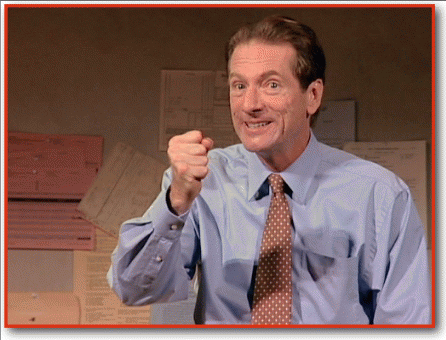
When teenager and Australian merchant seaman Harry Bridges disembarked in San Francisco for a visit in 1919 he didn't know that he'd stay for a lifetime, grace the cover of Time magazine and change the course of American history!
Bridges would be instrumental in forming one of America's most radical and democratic unions, the International Longshore and Warehouse Union. As ILWU President for 40 turbulent years, he was the kingpin of groundbreaking advances in rights for workers. Pro-peace, pro-civil rights, and pro-worker, Bridges stood up for what he believed was right--and Woody Guthrie and Pete Seeger sang about him!
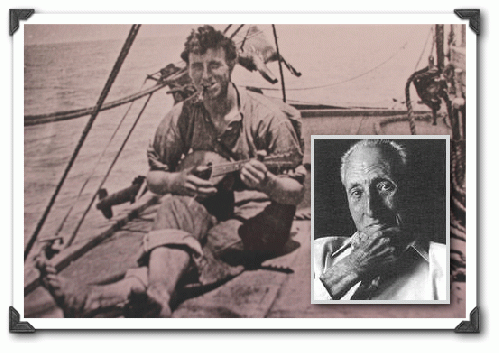
Bridges sparred with American presidents. The US government vilified him, and J. Edgar Hoover and the FBI tried to deport him for over 20 years. But Bridges won out every time.
In spite of that, or perhaps because of it, he is often painfully absent from American history lessons. It took a British-born actor-screenwriter to shine a spotlight on an Aussie-born labor leader who changed the face of American unions.
Ian Ruskin is an actor, playwright, and producer who was classically trained in London at the Royal Academy of Dramatic Art. You may have seen him guest starring on such shows as "Murder She Wrote," "Scarecrow and Mrs. King" and "MacGyver", or you may have heard his voice work in over 100 films and television shows.
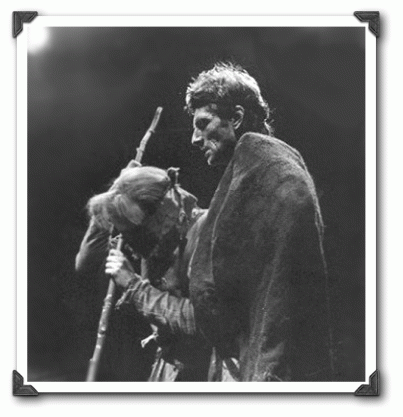
Ian Ruskin as Edgar in Shakespeare's King Lear, late 1970's.
(Image by Ian Ruskin, used with permission) Details DMCA
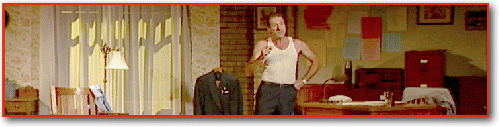
Ruskin offers a captivating glimpse into Bridges' dazzling life in his one-man play From Wharf Rats to Lords of the Docks. The film version was directed and shot by multi-Academy Award-winner Haskell Wexler, and features the voices of Elliott Gould and Ed Asner.

From Wharf Rats to Lords of the Docks aired on PBS for four years to over 150 million Americans. Ruskin continues to offer live performances around the country, and upcoming performances are scheduled at Harvard Law School and Cornell University.
Meryl Ann Butler: Ian, thanks for visiting with us again. I know that Harry Bridges championed many of the issues that we are dealing with in American politics today, and I want to hear about those connections, but first, can you tell us how you happened to write a play about Bridges...and what inspired you?
Ian Ruskin: I was finding anything but inspiration as an actor in Los Angeles. When work came it never seemed to have any real meaning or importance, nothing to really challenge or uplift the audience or me. All that changed in 1994 when I played Harry Bridges--who I had never heard of before--in the play, Citizenship: the Harry Bridges Story. This was a true story about a man fighting for equality and democracy and workers' rights, a long way from the sound stages of "MacGyver"!
When we presented it to his union, the ILWU--an audience that knew what it meant to fight for your rights--the reaction was stunning, a huge standing ovation, and I knew I had found a story worth telling! I had never written anything before, but I had also never experienced an audience quite like this before. I felt that I had been given a gift if I had the courage to take it. And so, six years of procrastination later, I took the leap and wrote the one-man play, From Wharf Rats to Lords of the Docks, and in about 250 performances since then, in all kinds of settings, I have seen how his story touches people and gives them hope and determination to stand up for themselves.
Bridges was a man of great bravery and personal honor who had a strong vision of a better world, and I get to present that vision all over America and abroad. Because of his economic philosophy some saw him as the devil incarnate, but for me and my audiences he is better described as a hero!
MAB: Sounds like it was the one percent who thought he was the devil, and the 99 percent who thought he was a god! I know that Harry Bridges promoted the ideas of a National Health Care System and Social Security, he cautioned against government surveillance, and was concerned about the widening gap between rich and poor...and this was nearly a century ago! And here we are, still dealing with this stuff--Can you share a little about these and the other causes he championed which have direct meaning for us today? What advice would he give us?
IR: It is extraordinary how many of the issues that Bridges faced are still with us today, sometimes in a different form but no less challenging, and that is why I think his story inspires. Yes, he was fighting for a National Health Care System and Social Security in 1930, when many people considered both to be communistic ideas (and it seems that some people still do!) He would see "Obamacare" as a beginning--and a beginning, only.
The government bugged his hotel rooms, tapped his phones and tore through his wastepaper baskets for decades. Cruder methods than today, but with the same attitude that the government must protect itself from many of its citizens.
Coming out of the Great Depression, Bridges saw an ever-widening gap between rich and poor, although the enormous gap today would take his breath away! He saw unions as organizations which could counter this gap; organizations which were for the benefit of workers, workers of all colors, ethnicities, religious beliefs and political associations. So he would still be fighting against the prejudice and discrimination that continues to stain America today.
Bridges saw almost all wars, with the exception of World War Two, as being created for the benefit of the rich at the expense of the worker. So he would be fighting against all the American invasions and orchestrated coups of the last 40 years, just as he was against the Korean and Vietnam wars--not always a popular position with his membership. He believed in widespread worker control of the means of production, almost the opposite of the power that global corporations have over our lives today.
Bridges had a great respect for the U.S. Constitution and would be shocked that voting rights are still suppressed and that gerrymandering voting districts steals away democracy. And this applies to both parties. In fact, he said that the union movement should never let the Democratic Party assume that it had their support, and that instead, politicians needed to earn the support of the unions by legislating in the interests of the working people.

Harry Bridges believed in international solidarity and he had great success in supporting and being supported by workers around the world. The ILWU would send delegations made up of their members (rather than union officers) to meet the workers of the world. Fighting against the massive and unrelenting power of our global corporations would be one of his greatest challenges today.
But perhaps most important is that he believed that if you give the working man and woman--in his case the members of his union--all the facts about a situation, most of the time they would make the right decision. And MOST of the time, in his opinion, they did. On the occasions when he felt that they didn't, he let them know about it but ALWAYS said that his job was to follow the lead of the membership, wherever it might take them.
MAB: Well, his message certainly seems as important today as it was when he first delivered it!
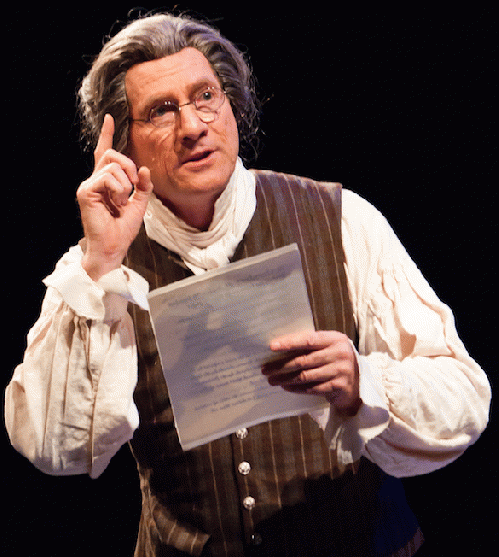
Ian, you also wrote and perform another one-man play--"To Begin the World Over Again: the Life of Thomas Paine," which we discussed on OpEdNews here. At first glance, Paine and Bridges seem so different, yet there must be some similarities, perhaps similar traits in both men, which attracted you to their stories... can you share a bit about that?
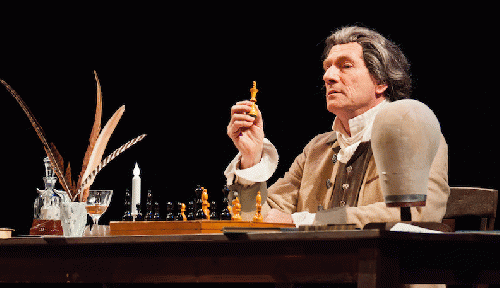
Ian Ruskin as Thomas Paine in To Begin the World Over Again: The Life of Thomas Paine
(Image by Tom Dempsey, copyrighted, used with permission) Details DMCA
IR: I see Harry Bridges and Thomas Paine--both greatly misunderstood figures in history--as being on the same historical arc in the fight for equality and justice, with Karl Marx somewhere in the middle!
And Paine and Bridges had so many personal as well as philosophical similarities. For instance, they were both immigrants to America and each was in his 30's before he began to fully take his place in the world. Both men came from households with two religions (for Paine Church of England and Quaker, for Bridges Church of England and Catholic) and these experiences deeply influenced their attitudes to organized religion. They both spent time at sea, experiences that helped shape their political understanding.
Paine was adamantly against slavery, Bridges was just as adamantly against prejudice and discrimination, particularly against black workers. Both men fought for a more equal society through the re-distribution of wealth. Paine saw graduated taxes on the rich and, mainly upon landed gentry, as the path to this balance; Bridges believed it could be accomplished through union negotiation to redistribute some of the companies' profits back to the workers.
Both men's dreams for Americans, although over 150 years apart, were basically the same: a chance to make a decent living, see your children educated, and have a social structure that would care for the less fortunate. In 1800 Paine was calling for what we now know as Social Security, unemployment benefits, welfare, veterans' benefits and free education, and Bridges spent his life fighting for or trying to protect these same things. We have made some progress since Bridges' time, and much progress since Paine's, but there is still a long way to go and you can be sure that, if they were here, they would be in the thick of the fight.

MAB: Well, they both ARE here, in many ways, because you have brought them, and their ideas, back to life! And while your live performances have reached many people, film can expand this reach out to so many more. As mentioned, your PBS movie about Bridges has reached over 150 million--and it's available in DVD form, too, right? So it will continue to reach more people. And I know you are currently in the process of filming your Thomas Paine story for PBS. These are exciting developments--these important stories from our history have so much relevance today. What do you hope your audiences will take away from these performances?
IR: Making the film of "From Wharf Rats to Lords of the Docks" was thrilling and I worked with amazing people: musicians Jackson Browne, Arlo Guthrie, Sarah Lee Guthrie and Johnny Irion among others and a great crew led by the legendary Haskell Wexler. I have performed the play live to about 50,000 but this was a way to take it to millions. And yes, the DVD is available at the website.

Haskell Wexler (L) directing Ruskin (center) during re-enactment sequences with ILWU Local 13. 2003.
(Image by Ian Ruskin, used with permission) Details DMCA
And now we are in pre-production for the Paine play as we raise post-production fund raising. We're following in the same footsteps, (with many of the same crew including Haskell), and we'll be filming in March! The people at NETA, the National Educational Telecommunications Association, which distributes programs to PBS, are very excited about distributing this project, and we will also offer it to the BBC or Channel Four in England, France Televisions in France and the Canadian Broadcasting Corporation. Paine was, after all, a citizen of the world.
And my hope is that the stories of these two men will show that we can make a difference if we, individually and together, strive for equality and justice. There was nothing extraordinary in the background of either of these men, yet they ended up doing extraordinary things and making the world a better place. A good idea to take home with you.
MAB: Absolutely, "Power to the People!" And readers who want Information about the Paine film can find it here.
I know you have a couple of East Coast performances coming up this month. Can you give us some details?
IR: Yes, I'm performing "From Wharf Rats..." on February 17th at Harvard Law School in Cambridge, MA and on February 19th at Cornell University in Ithaca, NY. Both performances are free and open to the public. (Further details are here.)
So I have exciting months ahead -- great gigs of the Bridges play, filming and editing the Paine play, and the pleasure of telling these two men's stories to all who will listen!
MAB: That is exciting, Ian, and I think the pleasure belongs to the audiences! Thanks for what you are doing to remind all Americans of our roots" I hope your films and performances will help lead to better decisions by voters and government officials--and I think they will. Historically, it's always been the arts that come to the rescue of a broken society, from Shakespeare to Dickens to Steinbeck. I know you have another project in the wings--can you let us in on that secret?
IR: Yes, I have begun research on a new one-man play about inventor, electrical engineer, scientist and visionary genius Nikola Tesla, "the man who invented the 20th Century."
MAB: Well, Tesla and Paine are two of my favorite visionaries--and I'm in awe of Bridges, now that I've seen your DVD! What a trio! Thanks for breathing life into their visions and for visiting with us--we'll look forward to hearing about all your upcoming events and activities!
IR: Thanks as always for your interest in and appreciation of these extraordinary men!
MAB: Yes, all FOUR of you fellas are inspiring! Thanks for visiting with us again here at OpEdNews, and sharing your exciting projects, Ian.
Butler's earlier interview with Ruskin, "How Thomas Paine Still Fights for the Soul of America," is here.
Information about the film, "To Begin the World Over Again: the Life of Thomas Paine," is here.
Authors Website: http://www.OceanViewArts.com
Authors Bio:
Meryl Ann Butler is an artist, author, educator and OpedNews Managing Editor who has been actively engaged in utilizing the arts as stepping-stones toward joy-filled wellbeing since she was a hippie. She began writing for OpEdNews in Feb, 2004. She became a Senior Editor in August 2012 and Managing Editor in January, 2013. In June, 2015, the combined views on her articles, diaries and quick link contributions topped one million. She was particularly happy that her article about Bree Newsome removing the Confederate flag was the one that put her past the million mark.
Her art in a wide variety of media can be seen on her YouTube video, "Visionary Artist Meryl Ann Butler on Creativity and Joy" at http://www.youtube.com/watch?v=UcGs2r_66QE
A NYC native, her response to 9-11 was to pen an invitation to healing through creativity, entitled, "90-Minute Quilts: 15+ Projects You Can Stitch in an Afternoon" (Krause 2006), which is a bestseller in the craft field. The sequel, MORE 90-Minute Quilts: 20+ Quick and Easy Projects With Triangles and Squares was released in April, 2011. Her popular video, How to Stitch a Quilt in 90 Minutes with Meryl Ann Butler can be seen at http://www.youtube.com/watch?v=PrShGOQaJQ8
She has been active in a number of international, arts-related projects as a citizen diplomat, and was arts advisor to Baltimore's CIUSSR (Center for Improving US-Soviet Relations), 1987-89. She made two trips to the former USSR in 1987 and 1988 to speak to artists, craftpeople and fashion designers on the topic of utilizing the arts as a tool for global wellbeing. She created the historical "First US-Soviet Children's Peace Quilt Exchange Project" in 1987-88, which was the first time a reciprocal quilt was given to the US from the former USSR.
Her artwork is in collections across the globe.
Meryl Ann is a founding member of The Labyrinth Society and has been building labyrinths since 1992. She publishes an annual article about the topic on OpEdNews on World Labyrinth Day, the first Saturday in May.
OpEdNews Senior Editor Joan Brunwasser interviewed Meryl Ann in "Beyond Surviving: How to Thrive in Challenging Times" at https://www.opednews.com/articles/Beyond-Surviving--How-to-by-Joan-Brunwasser-Anxiety_Appreciation_Coronavirus_Creativity-200318-988.html
Find out more about Meryl Ann's artistic life in "OEN Managing Ed, Meryl Ann Butler, Featured on the Other Side of the Byline" at https://www.opednews.com/Quicklink/OEN-Managing-Ed-Meryl-Ann-in-Life_Arts-Artistic_Artists_Quilt-170917-615.html
On Feb 11, 2017, Senior Editor Joan Brunwasser interviewed Meryl Ann in Pink Power: Sister March, Norfolk, VA at http://www.opednews.com/articles/Pink-Power-Sister-March--by-Joan-Brunwasser-Pussy-Hats-170212-681.html
"Creativity and Healing: The Work of Meryl Ann Butler" by Burl Hall is at
http://www.opednews.com/articles/Creativity-and-Healing--T-by-Burl-Hall-130414-18.html
Burl and Merry Hall interviewed Meryl Ann on their BlogTalk radio show, "Envision This," at http://www.blogtalkradio.com/envision-this/2013/04/11/meryl-ann-butler-art-as-a-medicine-for-the-soul
Archived articles www.opednews.com/author/author1820.html
Older archived articles, from before May 2005 are here.