| Back OpEdNews | |||||||
|
Original Content at https://www.opednews.com/articles/Clash-of-Cultures-The-Pen-by-Anthony-Barnes-Anti-islam_Charlie-Hebdo_Culture_Hatred-150117-193.html (Note: You can view every article as one long page if you sign up as an Advocate Member, or higher). |
|||||||
January 17, 2015
Clash of Cultures: The Pen vs. The Kalashnikov
By Anthony Barnes
Prettying up anti-Islam hate-speech by calling it "provocative satire" is frighteningly Orwellian in its clever inaccuracy. But it's the only way for some to justify the twisted misapplication of their right of free speech. And while the freedom to express hatred is something worth dying for, in some cases, dying for that cause is not always noble.
::::::::
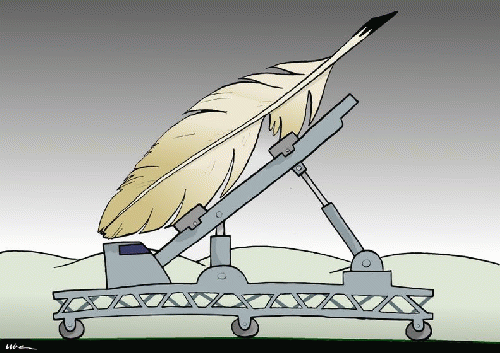
Millions upon millions of Muslims throughout the world are aghast at "Islamists" who pervert Islam. And many, just like some non-Muslim critics, deal with that reality by condemning specific Muslims like ISIL leader Abu Bakr al-Baghdadi, or current al-Qaeda leader Ayman al-Zawahiri. That tactic garners no objection here. Go ahead and ridicule them in any way you like. Mock them, scorn them, isolate them.
But for far too many non-Muslims, ridiculing just one or two obvious Islamic charlatans is wholly unfulfilling. For these folks, the only way to stem their disdain is to condemn the entire religion --starting at the top -- in a conscious effort to incite those millions upon millions of ordinary Muslims who insist that al-Baghdadi is not the Prophet Muhammad and ISIL is not Islam.
And by doing so, they place the lives of those around them in danger from the potential repercussions from al-Baghdadi or al-Zawahiri disciples.
Anyone who's followed the childish antics of French and Danish cartoonist/provocateurs who for years have incited fury among Muslims by creating and printing utterly loathsome renderings of the Prophet Muhammad -- puerile caricatures designed not to stimulate intellectual thought, but to ignite zeal and emotion -- could have seen this coming.
Unfortunately however, far too many were far too busy reveling in the knee-slapping hilarity they find in nauseating, anti-Islam imagery like that of the Prophet Muhammad lying face down being photographed ass-naked while saying: "And my butt? You love my butt?"
But now, because the reaction -- a massacre -- is so much worse than that particular piece of "provocative satire" and all preceding acts of provocation, the laughter has stopped. Instead, millions are now solemnly marching in the streets.
Today, everyone's focus is on the horrible response meted out by "Muslim" fanatics. In this latest clash of cultures, a new war has been declared: The Pen vs. The Kalashnikov. And right now, the high-minded calls for even more provocative exercises of "free speech" seem to outshout the voices of those who say that hate speech, even if free, has consequences. And, consequently, all the laughter and mirth that attended Charlie Hebdo's ghastly series of anti-Islam impressionism has been supplanted by worldwide outrage over the deaths of 17 Parisians, a number that includes nearly a dozen of the magazine's own employees.
Recklessly undaunted by its deadly folly, Charlie Hebno quickly published a special edition, its cover emblazoned with a yet another cartoon depiction of the Prophet Muhammad. Meanwhile, as is so often the case these days, the tragedy has actually become a boon financially for the magazine. Almost instantly, at an average cost of $3.50 per, all 3 million copies -- six times its normal press run -- were snatched up in prize-like fashion as macabre souvenirs of the previous week's carnage.
The magazine's long history of anti-Islam "parody" begs a number of questions: Are there any Muslims on Charlie Hebdo's staff? If so, were they also amused? I'm guessing that there were none, at least not openly. After all, it would seem difficult to crudely ridicule the faith practiced by a co-worker whom you respect even if freedom of speech allows you to do so. In an American workplace that's called verbal abuse; bullying; and yes, hate speech.

Pakistanis protest over anti-Islam cartoons published by a Dutch newspaper in 2008.
And it's all so unnecessary. Most of us with a thirst for plausible intellectual provocation appreciate the fact that from Voltaire to George Carlin, the world has forever been awash in truly great satirists. They and others have altered the thinking of millions by way of a mind-set about satire that is far removed from the primitive, bathroom stall scribblings offered as such and endorsed by the new legion of tunnel-visioned "free speech" mongers that has emerged in the wake of the Charlie Hebdo massacre.
It's probably not too difficult to understand how in the shock and horror of the event, an otherwise enlightened or "polite" society can somehow miss the point. Nevertheless, one need not be a Muslim to be appalled at what those cartoons have represented. Indeed as an atheist, I personally could give a rat's ass about religion. While it serves a purpose, it remains, in my estimation, simply a device that evolved out of a necessity to provide answers to questions raised at a time when mankind's thought processes were at its most primitive stage.
In truth, the fact that this event stems entirely from religious hysteria by fanatics both pro-religious (radical Muslims) and anti-religious (Charlie Hebdo cartoonists) is what makes this massacre so appalling, particularly when considering the innocent victims caught in the middle. But what some might see as more appalling is the world's post-massacre reaction. There have been some who've described this event -- in which an al Qaeda-affiliated sleeper cell murders fewer than two dozen Parisians -- as "France's September 11th." Meanwhile, around a week earlier, Boko Harem, an African-based al-Qaeda-affiliate, in a truly harrowing event that for some odd reason failed to garner a similar level of attention and outrage, reportedly slaughtered two-thousand Nigerian "infidels" in the town of Baga.
France is certainly in many ways, a highly enlightened society. Thus one can expect the French to hold a deep sensitivity for free expression along with abhorrence for expressions of hatred. That's perhaps why France is among several European countries that have made Holocaust denial a crime. Since 1990, you can be jailed in France simply for asserting that the Holocaust never happened. The obvious goal -- to avoid provoking anger among that nation's Jews.
Meanwhile, since 2010, a Muslim in France can be jailed for wearing a burqa. Would the goal of that law be to placate the psyches of those in France who demand full assimilation by Muslims into French society? Whatever the rationale, it's difficult to imagine a similar sanction against religious expression being imposed on followers of the Jewish faith by banning the wearing of Yarmulkas. Jewish citizens of France would rightfully find such a law repugnant.
All this might lead some to wonder if criminalizing the phrase, "Allahu Akbar" (God is great) might not be too far down the line. Right now, a step in that direction would likely surpass any effort to criminalize the strain of Islamophobic hate speech masquerading as "satire" that's become part of the artistic culture in places like France and Denmark.
Noted writer Erica Jong once declared: "Everyone has talent. What is rare is the courage to follow it to the dark places where it leads."
Perhaps utilizing artistic talents to needlessly inflame the most zealous from among more than one billion followers of a religion defined by western culture as archaic can be seen as "courageous." But only to the individual artist who embarks upon that project.
In this case, however, where such provocative forays into creativity's darkness have been repeatedly made, the question becomes: "Is it courage or narcissism that draws an artist into exposing innocents to the dangers that can be found in such dark places?"
Authors Bio:
Anthony Barnes, of Boston, Massachusetts, is a left-handed leftist.
"When I was a young man, I wanted to change the world. I found it was difficult to change the world, so I tried to change my nation. When I found I couldn't change the nation, I began to focus on my town. I couldn't change the town and as an older man, I tried to change my family. Now, as an old man, I realize the only thing I can change is myself, and suddenly I realize that if long ago I had changed myself, I could have made an impact on my family. My family and I could have made an impact on our town. Their impact could have changed the nation and I could indeed have changed the world." - Unknown Monk (1100 AD)