| Back OpEdNews | |||||||
|
Original Content at https://www.opednews.com/articles/The-King-of-the-World--Mr-by-Greg-Maybury-Assassination_Australia_Australian-Politics_Conspiracy-141207-340.html (Note: You can view every article as one long page if you sign up as an Advocate Member, or higher). |
|||||||
December 7, 2014
The King of the World - Mr Johnson Goes to Washington (Part Two)
By Greg Maybury
With the recent release of Phillip Nelson's latest book, the mystery of the JFK assassination may be getting closer and closer to resolution. In this two part series Greg Maybury takes a closer look at the man who succeeded JFK, and the possibility the real conspiracy theorists all this time are the ones still clinging to the official narrative.
::::::::
Power is Where Power Goes
To their tragic, fatal, detriment then, the Kennedy brothers ignored the wisdom of legendary Chinese military strategist Sun-tzu's oft-quoted, maxim: 'keep your friends close, [and] your enemies closer'. Although it's likely Lyndon Johnson (LBJ) was aware of the Sun-tzu dictum, his own more prosaic political maxim -- 'Power is where Power Goes' -- probably served him just as well.
And LBJ's ambitions went beyond just being president; he wanted to be the greatest goddamned commander in chief ever. Yet if he did arrange to take over the Oval Office accordingly, then he may have sold his soul to Old Sulphur Breath to accomplish it. And this was (ahem) one 'hell' of a deal. Moreover, LBJ was convinced that to be a truly great POTUS, he had to be a wartime president. And to be "wartime president", he had to have himself, well, a war. He might have got his war OK, but unfortunately, so did the rest of us!
With or without the JFK rap then, there may still be a little moral causation (trade name: 'karma') to be had in the case of Johnson. As hinted, there has been some suggestion that he'd began to feel remorse for his past, and that even the "master of denial" could no longer keep it all in check. If this be the case, the master of illusion may have morphed into the master of delusion, and from there into the 'servant' of despondency, disillusion and despair, his very own Pandora's Box sans any hope, the one thing the original had going for it.
Phillip Nelson notes in his book LBJ: From Mastermind to "Colossus" that Johnson's grandmother predicted he'd end up in prison -- a prediction he was determined to prove wrong. But it would appear Grandma Johnson was on the money after all -- LBJ metaphorically speaking ended up in a prison of his own making, and may have been in one all along. The downside is that he visited so much misery and tragedy into the lives of millions inside and outside of America whilst inhabiting his own personal panopticon, the legacy of which is still sadly very much evident today.
And yet maybe this was the 'fine print' in the Faustian pact LBJ made with el Diablo in that he would not just forfeit his soul after he was dead, he lost it before the Grim Repo Man came a-knocking. In this case, to paraphrase one of Johnson's favourite expressions, it may have been after all the Lord of Fire and Brimstone that had LBJ's 'pecker in his pocket' the whole time. And as I'm frequently reminded by many God-fearing folk of my acquaintance, for the wicked amongst us, it is He who usually gets the better part of the deal.
As for Johnson's purported desire in his final years to balance the scales, or seek some redemption of sorts in expressing such regrets, we may never know. If he did, it's possible he may have been saying that to portray a more human side for posterity and provide some ballast to his diminished legacy, the poor state of which he'd have been well aware of in his last years, no matter how deluded he was.
According to some folk Johnson -- who had been receiving psychiatric treatment in his twilight years -- may have 'fessed up to his shrink before the Grim Reaper stopped by the LBJ Ranch for his first and last house call. What Number 36 might have spilt his guts about if at all no-one knows, and until and unless those patient records become public, we can all but speculate on both counts. In the meantime it would seem, the Big Fella from Johnson City, TX., like he's been doing for over well over half a century now, will keep us all guessing. Which according to some folk, may have been his intrinsic game-plan from the off.
And if his records are ever released, given his "unique psychopathology" and the extent to which we are now familiar with it, every PhD psychiatry student on the Big Blue Ball would doubtless be willing to give into his/her inner Oedipal proclivities to get a piece of that action. This not to mention every conspiracy theorist and JFK 'tragic' who ever lived and breathed the 11/22 gunsmoke-scented Dallas air. Of this we can be sure. At this point, we have probably only scratched the surface where LBJ's concerned.
And, according to Nelson and many others of a similar mindset, that's just with The JFK Thing.
Give us Liberty, or Give us Death
Richard Nixon is generally portrayed as one of the most deranged, venal, contemptible, amoral, delusional, corrupt, paranoid, criminally inclined, psycho-pathological presidents in modern American history. However, as Nelson illustrates, it is LBJ who ticks all these boxes and others Nixon wouldn't have thought of if he'd 'done an FDR' and served three plus terms, and died on the Oval Office 'john' with his boots on. Up close and personal, avec warts and all, Johnson, as one observer has stated, was a man to see "with the bark off".
Be that as it may, it was what LBJ was like and what he was up to when we couldn't "see" him "up close" that should be of greater interest to us herein, and this doesn't just apply to The JFK Thing. As we will see, LBJ was no One Hit Wonder!
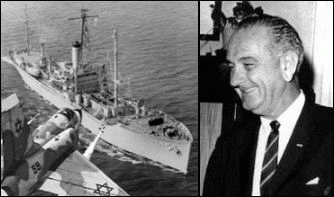
Again Nelson observes, one of the least examined episodes in LBJ's presidency is that in 1967 he "personally ordered" Israel to bomb and destroy the USS Liberty and its entire crew of 294 Americans! And when the mission failed and Sixth Fleet Commanders ordered the rescue of the Liberty crew, Nelson states that LBJ personally ordered that rescue operations be called back, "at least twice". He wanted the boat sunk!
Against all odds, the Liberty survived but after the attack, "34 Americans lay dead" with many, many more injured. The Liberty -- a surveillance vessel -- was defenceless against the firepower of the Israeli armada that descended upon it with "relentless and unspeakable terror". Israel claimed that it was a tragic accident based on "mistaken identification". The U.S. government "accepted" the explanation, after which a massive cover-up ensued, orchestrated by LBJ and his secretary of defense Robert McNamara, and kept under official wraps since.
Now this revelatory nugget may seem for most folks well and truly out of left-field, and it is to be sure not one that gets a lot of airplay. This is despite a number of books written about the Liberty incident, with the following being some highly credible accounts. James Ennes, a retired US Naval Officer and a survivor of the attack, wrote Assault on the USS Liberty, wherein he documents his experience and his own investigations into what actually happened. And investigative journalist Peter Hounam, also wrote Operation Cyanide: Why the Bombing of the USS Liberty nearly caused World War III. Along with the excellent 2002 BBC documentary by Christopher Mitchell, USS Liberty: Dead in the Water, these sources are essential for those wanting to find out more about this incident.
The "official" story of the Liberty is that on June 8, 1967, at the height of the Six Day War with Egypt, the Israelis "accidentally bombed" the ship off the coast of Egypt. Yet this does not tell the full story. Johnson -- who was being crapped on from great heights in the polls over 'Nam and looking down the barrel of a general election loss in 1968, and with the aim in mind to blame Egypt -- "ordered the Israelis to bomb the Liberty" in order to create a casus belli (a pretext for war) so he could secure a Gulf of Tonkin (GoT) style resolution.
This was a clear reference to LBJ's previous 'form' in this regard, which was his politically contrived pretext for massively escalating the whole 'Nam Thing -- [so as] to "explode the world into war". With the Liberty incident, it was much the same MO but this time in the Middle East.
Nelson explains LBJ's 'rationale' this way: in Johnson's demented imaginings, in America "everybody" loves an "outraged and indignant president" who will use the full force of the US Military at the slightest 'provocation', even a U.S. government initiated 'false flag' attack a la the GoT 'Nam sh*t.
And given that the divisive consequences - the blowback - of the Six Day War are very much still with us, the significance of this revelation and America's larger involvement in the conflict takes on a deeper resonance. After noting the "huge shadow" the war cast over the Middle East and the rest of the world, Lance Selfa writes:
"The war thrust onto the world agenda all of the issues still at the center of Middle Eastern politics today....Israel began one of the world's longest-running military occupations, which continues to be one of the greatest sources of Arab resentment against not only Israel, but its main cheerleader, the U.S."
"America, it isn't all just about you!"
Whether politically, socially, or economically then, the United States of America is becoming increasingly divided -- to the point where its very name now evinces ironic, ominously Orwellian connotations.
Moreover, this isn't just about America. To use the popular refrain, "Uncle Sam, it isn't all just about you!" To underscore this, my own country Australia has been dragged into supporting every war America has engaged in since 1945. Of course Vietnam was one such war, with Iraq and Afghanistan being more recent examples.
As with many other of America's allies, there is a growing feeling here Down Under -- especially amongst younger folks -- that unquestioning fealty to U.S. foreign policy and automatic alignment with its military adventurism in the future cannot and should not be guaranteed, and that America's obsession with its own national security (read that: interest) and its increasingly uncertain place in the ever volatile geopolitical order, is rising in indirect proportion to its self-inflicted, indeed, self-fulfilling insecurity.
All this, with the irony that such an obsession and the way in which it is being manifested is actually undermining its own national interest, along with contributing to, rather than mitigating, its own insecurity and instability, and the insecurity and instability of that same "geopolitical order". This "obsession" -- once rationalised then propelled by the fear of the "communist threat" and now by the fear of the "terrorist threat" -- becomes all consuming, for America and its allies, to the benefit of few.
Although in some circles it's not fashionable to say so, both fears/threats were/are far more abstract than existential. Yet therein may lay the key to a deeper appreciation of the factors which underpin this "obsession", along with a greater understanding of the true raison d'être of the architects of the National Security State and the priorities of the private sector beneficiaries of the massive growth of the 'homeland security-industrial' complex.
America's foreign policy then has for too long been driven by the ulterior motive, best exemplified by Eisenhower era secretary of state John Foster Dulles' -- a former Wall Street lawyer no less -- telling observation that, "America does not have 'friends', it has 'interests'".
Whether from this vantage point or from one determined by their own personal insight, people are beginning to wise up to the fact that the United States is not about freedom, opportunity, democracy, life, liberty and the pursuit of happiness as much as it would have the rest of the world -- and its own citizens -- believe. That indeed it is more about imperial ambition, economic colonialism, financial feudalism and 'full spectrum dominance' than truly democratic ideals, ones underpinned by a respect for the desire for universal freedom and genuine sovereign independence, and adherence to the rule of international law.
To underscore the above, it is hard for example to escape the conclusion that the appointment of LBJ's long-time crony Edward Clark to the US Ambassadorship in Australia was made for one key purpose -- to keep a keen eye on the Aussies and ensure our continued commitment in 'Nam. We're talking here the very war Clark's own boss conjured the pretext for then recklessly escalated - a war that had horrendous consequences for millions of Americans and non-Americans alike for decades to come with nothing to show for the industrial scale death and devastation unleashed by Johnson's unhinged hubris and borderline apocalyptic impulses.
For his part, Clark's role in the LBJ narrative generally, and his part in the assassination planning and its cover-up more specifically, was laid bare in Barr McClellan's 2004 book Blood, Money and Power - How LBJ Killed JFK. McClellan, a lawyer in Clark's Texas law firm and as such a former member of LBJ's legal team, provides a compelling and convincing insider account of his own boss's involvement. (McClellan's eagerly awaited sequel -- The Verdict: Justice for John Kennedy, Justice for America -- is due for release early 2015).
LBJ Goes Down (Under)
Although LBJ doubtless had few illusions about Australia's real contribution that in his eyes and those of his key military advisors would have been minimal in the overall scheme of things, nonetheless the political import of our on-going commitment in Vietnam was considerable. LBJ knew pressure would be on the Australian Government to justify with its own people its ongoing role in the war, as even by 1965, the year of Clarke's appointment, he needed to ensure that commitment remained strong.
LBJ's subsequent visit to Australia in 1966 -- the very first by a sitting US president, which for some may be instructive in and of itself -- sparked demonstrations of the like never before seen in our country, as even by this time, the war was decidedly on the nose. By 1972 though, with a new government in power in Canberra, Australia was out of 'Nam finally, much to the chagrin of the later Nixon administration.
Yet what my fellow Australians themselves -- young and old -- would make of all this, again, is uncertain. And what our Vietnam vets would think is even more interesting. "What are we fighting for?" may have been the $64 Q way back then. "What were we fighting for?" may be the more appropriate inquiry now. Or who? It was after all LBJ and his "b*tch of a War" we were all fighting for then! And we might argue that it is at least in part because of his legacy we are still fighting the (not so) good fight back now in Iraq (again), and will continue to do so for the foreseeable future.
And beyond the above, what can we all make of the following?
The prospect of contemplating that a former US Ambassador to Australia -- himself the holder of the most important diplomatic post in the country, and representing the international bastion of liberty, democracy, freedom, and the rule of law -- may have been, at the instigation of, and in collaboration with, the president who appointed him to the role, complicit not just in the perpetration of the Crime of the Century, but in the treasonous removal of the Leader of the Free World from his duly elected office so as to enable the president to whom he now reported -- previously the U.S. vice president -- to take forceful, violent control of the highest political office in the Home of the Brave and the Land of the Free!
And from there, set both countries on the path to a monumentally destructive war that neither country should ever have been involved in from the off.
Whilst a story for another time, this is without mentioning the well documented -- but not widely known or understood -- U.S. interference in the political affairs of Australia, one of its staunchest allies, a covert gambit that provided in part the catalyst for an unprecedented Constitutional crisis and the subsequent removal from office in 1975 of our own duly elected Prime Minister and our whole government!
There can be little doubt that this "covert gambit" was at least an indirect result of the political milieu and emblematic of the 'us and them' mindset of the U.S. National Security State, one that elevated Johnson to power in the first instance and which characterised and sustained his tenure.
As well, it may have provided his successor Richard Nixon the idea that "when the president does it", (whatever "it" might be), "it's not illegal!" Or to extrapolate beyond Nixon and indeed the presidency itself, and go one step further: "When America does it, it is not a crime!"
What does it all mean I hear you ask? How's all that for starters? Do any of us -- Americans and non-Americans alike -- really want to continue down this path any longer?.....Which is blindly acquiescing to the imperial minded psychopathology of a nation that is to all intents and purposes both a law unto itself and a danger to itself and everyone else?
Uncle Sam, it's not all just about you 'old son'. Maybe it's time you just started getting used to it!
Postscript - A Way Forward
With or without any involvement by Lyndon Johnson then, yet taking for granted there was indeed a conspiracy perpetrated by rogue elements of the U.S. Deep State, as with the best of the writers on the subject of the JFK assassination, taken together, what Nelson's work demonstrates is the following:
the undeniable impact of LBJ's ascension to power and the treasonous methods by which it was achieved; the ongoing and profound legacy of his malevolent and disastrous tenure; and the critical need for resolution and closure on this lamentable chapter in the history of this Sometimes Great Nation.
That these "methods" were totally at odds with everything that America ostensibly stands for -- and purportedly continues to fight for on its own behalf and that of the rest of the "free world" -- makes this an existential imperative for all stakeholders if the frequently undervalued principles and ideals of the republic are to triumph over the destructive ambitions and self-serving perversions of empire.
But before Americans can get that "closure", they need to open themselves up to the possibility there might be some dangerous fault-lines in the 'geology' of American democracy and the body politic. Though there is plenty of evidence throughout the Grand American Narrative to support this, they need look no further than The JFK Thing.
To continue the seismic metaphor, a lack of resolution and closure soon could still prove to be the San Andreas Fault of the American polity. And if there is a dramatic shift at anytime, it may not just be California that slides into the ocean; the other states comprising the core imperial domain, in a manner of speaking, could well follow suit.
With such a sense of urgency in mind, there may be one 'simple' way for America and its citizenry to achieve that closure and mitigate the possibility of those "fault-lines" fissuring unexpectedly.
Firstly, the Congress should demand pronto the un-redacted release of all relevant assassination records, reports, documents and evidence, including those of to do with the MLK and RFK murders, and make this information freely available in the public domain.
Secondly, [then] establish a new "Warren" Commission of inquiry into all three murders, with members approved by public vote to ensure transparency and credibility, and terms of reference being publicly decided by a panel of established assassination academics, researchers, investigators and historians.
If indeed the single bullet/lone nutter theory in each case is then confirmed beyond any doubt -- as (ahem) I feel sure it will be -- as a bonus, such an outcome will shut those dangerous, unpatriotic, and just plain irritating whack-job conspiracy theorists up once and for all.
And those folk still wedded to the official findings can have the last laugh knowing full well they were right all along. What's not to like?
Not much from where I'm standing.
End Part Two (of Two Parts)
--*--
Authors Bio:
Greg Maybury is a Perth (Australia) based freelance writer. His main areas of interest are American history and politics in general, with a special focus on economic, national security, military and geopolitical affairs, and both US domestic and foreign policy issues.