| Back OpEdNews | |||||||
|
Original Content at https://www.opednews.com/articles/The-ominous-reason-voter-t-by-David-Sirota-Election-Voting-Issues-News_Elections-And-Campaigns_Journalism_Politics-141124-696.html (Note: You can view every article as one long page if you sign up as an Advocate Member, or higher). |
|||||||
November 24, 2014
The ominous reason voter turnout was so low this election cycle
By David Sirota
What if you held an election and nobody showed up to cover it? Americans have now discovered the answer: You get an election with lots of paid ads, but with little journalism, context or objective facts. That requires two things: a genuine commitment and willingness to do the hard work of serious journalism and enough resources to succeed.
::::::::
Reprinted from Salon
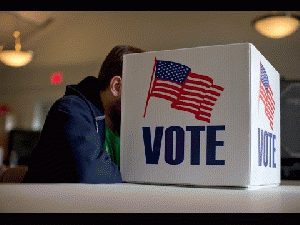
This was increasingly the reality in much of the country, as campaigns played out in communities where the local press corps has been thinned by layoffs and newspaper closures. What if you held an election and nobody showed up to cover it? Americans have now discovered the answer: You get an election with lots of paid ads, but with little journalism, context or objective facts.
Between 2003 and 2012, the newspaper workforce decreased by 30 percent nationally, according to the American Society of Newspaper Editors. That has included a major reduction in the number of newspaper reporters assigned to cover state and local politics. Newspaper layoffs have ripple effects for the entire local news ecosystem, because, as the Congressional Research Service noted, television, radio and online outlets often "piggyback on reporting done by much larger newspaper staffs." Meanwhile, recent studies from the University of Chicago and the Federal Reserve Bank suggest the closure of newspapers can ultimately depress voter turnout in local elections.
Click Here to Read Whole Article
Authors Bio:
David Sirota is a full-time political journalist, best-selling author and nationally syndicated newspaper columnist living in Denver, Colorado. He blogs for Working Assets and the Denver Post's PoliticsWest website. He is a Senior Editor at In These Times magazine, which in 2006 received the Utne Independent Press Award for political coverage. His 2006 book, Hostile Takeover, was a New York Times bestseller, and is now out in paperback. He has been a guest on, among others, CNN, MSNBC, CNBC and NPR. His writing, which draws on his extensive experience as a progressive political strategist, has appeared in, among others, the New York Times, the Los Angeles Times, the San Francisco Chronicle, the Baltimore Sun, the Nation magazine, the Washington Monthly and the American Prospect. Sirota was a twice-a-week guest on the Al Franken Show. He currently serves in a volunteer capacity as the co-chairperson of the Progressive States Network - a 501c3 nonpartisan organization.

In the years before becoming a full-time writer, Sirota worked as the press secretary for Vermont Independent Congressman Bernard Sanders, the chief spokesman for Democrats on the U.S. House Appropriations Committee, the Director of Strategic Communications for the Center for American Progress, a campaign consultant for Montana Gov. Brian Schweitzer and a media strategist for Connecticut Senate candidate Ned Lamont. He also previously contributed writing to the website of the California Democratic Party. For more on Sirota, see these profiles of him in Newsweek or the Rocky Mountain News. Feel free to email him at lists [at] davidsirota.com Note: this online publication represents Sirota's personal views, and not the official views of the organizations he works with.