| Back OpEdNews | |||||||
|
Original Content at https://www.opednews.com/articles/Is-theoretical-physics-dea-by-Jim-Arnold-Light_Mathematics_Physics_Relativity-140813-32.html (Note: You can view every article as one long page if you sign up as an Advocate Member, or higher). |
|||||||
August 13, 2014
Is theoretical physics dead-ending?
By Jim Arnold
It is argued that theoretical physics has been reduced to a heavily defended branch of pure mathematics. A paper that can't be accepted or criticized in the current climate is offered for evaluation, involving an exploration of time as the dynamic aspect of the spacetime continuum, with numerous corollaries that enhance Special Relativity, including an explanation for why the speed of light is absolute and ultimate.
::::::::
Theoretical physics has effectively become a branch of mathematics. An epoch ago, Einstein, a physicist of the old school, first conceived of physical relationships, and only subsequently sought to substantiate them with equations. Hawking, in the new orthodoxy, concluded that entropy could just as easily be reversed, despite the manifest universality of its direction, simply because its formula is indifferent to sign. In quantum theory there is the "probability wave" -- a statistical construct not unlike a Bell curve -- that is commonly confused with a physical wave, leading to all sorts of mathematical (meta-physical) fantasies. Then there is String Theory, which has to calculate to eleven dimensions to achieve even a partial and remote approximation of what happens in four.
Theoretical physics is engrossed with minutia. Not since the foundational reign of Ptolemaic astronomy has the re-evaluation of a paradigm, or the reconciliation of paradigms, been considered so out-of-bounds. The journals are devoted to measurements of particulars and paradigm-saving concoctions of epicyclical remedies, like dark energy and dark matter. The very expensive search for the graviton and the specifications of its expected properties could go on endlessly, undeterred by its enduring elusiveness, and despite its inherent incompatibility with the force-free geometry of the General Theory of Relativity.
Theoretical physics has become a gated community. In small part, it's a reaction to the distractions created by those derided as "cranks" and "crackpots": dilettantes proposing (usually) baseless theories, and clamoring for attention and acceptance. In larger part the wall is for the protection of careers, fellowships, and grants, and a strong sense of professional speciality.
Theoretical progress requires an openness and interest in discovery, not merely an eagerness for confirmation. But there is little evidence today of the discovering sort of interest, by which large amounts of research might be put at risk of being overthrown and rendered useless. In my own experience I've encountered dismissive rejections of a hypothesis without comment, without critique, or sometimes because it isn't confined to research findings based on accepted premises. Whether the hypothesis is right or wrong, such responses are symptomatic of dogmatism and disinterest: an institutional dead-end.
These are contentious claims, I know. How can one person claim to be right about something, and an entire field of science to be wrong? Well, how can one person be reduced to resignation without being refuted?
I've written a paper that explains why light is the ultimate speed, and why it is clocked at ~300,000 km/sec no matter how relatively fast an observer is traveling. By means of an alternative to the Minkowski spacetime diagram I can show graphically why two observers in relative motion will each regard the other's clock as moving more slowly -- the counter-intuitive paradox that has repelled critics of Einstein's relativity theory since its publication. If these explanations are sound, they are significant and important. If not, they should be easily refuted. Sadly, frustratingly, I believe it is a testament to the state of theoretical physics today that the paper can neither be published nor critiqued.
Hypotheses can be easily refuted if actually invalid. I've been approached by someone with an imaginative "theory of everything", based on the idea that everything in the universe is constantly and uniformly expanding in size, and I've refuted it by showing that it's only plausible (if at all) if confined to explanations of relationships between two bodies. I've been approached with a theory that gravity is somehow related to light, and I've simply pointed out that the intensity of gravity doesn't vary with luminosity. Such exercises can sometimes be challenging and even intimidating as potential threats to one's beliefs, but they can also be entertaining as puzzle-solving, and rewarding even to the would-be theorists who can be relieved of further pursuits of wasted efforts.
I'm pasting my paper below in hope that the intelligence and open-mindedness of readers here can rescue me from a mistaken path, if it is indeed mistaken. The ideas and mathematics involved are not beyond the grasp of those with a background in high school physics, and I believe the graphics provide the best explanation of Special Relativity available. If I'm wrong, refutation should be short work for anyone with a protective interest in the integrity of theoretical physics and an inclination to accept the challenge. If I'm right, the responses of critics should at least provide a fascinating glimpse of the present defects in the culture of theoretical physics.
Time as the dynamic aspect of the continuum
By James Arnold
Abstract
The Minkowski diagram, by which the concept of spacetime has been graphically represented and interpreted, is shown to have a pre-relativistic flaw: It depicts the relative motion of a body moving in time as-if it is moving along with the observer's clock, not as it is actually observed, according to its own proper time. An alternative diagram provides an accurate representation of relativistic relationships and enables heuristic insights into the nature of relativistic effects, and of time, light, and gravitation.
Introduction
The concept of four-dimensional spacetime pre-dates relativity theory, but with relativity there is a revolutionary understanding of the covariance of space and time. The prevailing understanding of the relativistic, covariant, spacetime continuum is due primarily to H. Minkowski's geometrical contribution (1908) to Einstein's Special Theory. Minkowski saw in the relativistic interpretation of the Lorentz transformations1 the possibility for a two-dimensional representation of the peculiar interrelationships between bodies having large relative velocities. Assuming the validity of the tenets of Relativity, and assuming the correctness of the geometric representation, it was expected that the graphic would express and corroborate relativity in its mathematical form, that "physical laws might find their most perfect expression" (Minkowski, 1908, 76), and facilitate further insights into the nature of what Minkowski called the spacetime continuum.
Diagramming spacetime
Figure 1 is a typical Minkowski diagram, with the vertical or nearly vertical axes of two reference frames representing time and the horizontal or nearly horizontal axes representing their spatial dimensions. A defining characteristic of the diagram is a diagonal vector or vectors projecting the motion of light relative to the motion of an observer who is moving in time on the vertical axis while "at rest" in space.
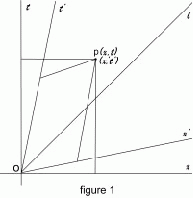
A typical Minkowski diagram. The world-line of the observer is moving in time perpendicular to the space axis. The world-line of a ray of light is depicted as a diagonal in the observerâ??s coordinate system, moving in equal parts of space and time. Point
(Image by James Arnold) Details DMCA
The primary interests in the diagram have generally focused on relative location of events in spacetime, as with point p in figure 1, and on the "light-cones" formed by the relative motion of light-rays. But with attention to world-lines, there can be seen a remarkable, pre-relativistic flaw in the Minkowskian projection: The world-line of a body moving relative to the observer is shown to be moving in space as observed, but moving in time as-if it is moving in synchronicity with the observer's clock, not dilated (slowed) according to theory. In other words, it isn't projected as it should be, compared to the observer's clock, but rather along with the observer's clock.
There is no more important precept in relativity theory than that in describing the relative motion of a body we must specify the frame of reference from which the observation is being made, and we must distinguish the observed body's metrics of space and time from the observer's. If for example it is said that a body is observed to travel 8 light-seconds (ls) in 10 seconds (sec), unless we are to return to the absolutes of classical physics we must specify and distinguish according to whose measures of distance and time. To fully describe the observed motion relativistically is to report that the body travels 8 ls in space relative to an observer's uniform or stationary spatial reference, and a number of sec in time (t') that is relative to the observer's corresponding temporal reference of 10 sec (t), at a relative velocity of v (expressed as .8, proportional to c) 2. The relationship can be expressed by t' = t SQRT(1-v2) per a Lorentz transformation, or alternately by t' = SQRT(t2-x2), with x as the relative distance traveled in space, calibrated in light-seconds, which in the above example yields either 10(SQRT(1-.82)) or SQRT(102-82) = 6. Strictly speaking, therefore, the body under consideration travels a relative 8 ls and 6 sec (its clock is observed to tick 6 seconds), and we measure its travel from a reference frame at 0 ls and 10 sec.
The significance of the distinction between the pre-relativistic and relativistic accounts is most striking in the description of light: When it is said in a Newtonian perspective that light travels (approximately) 300,000 km (1 ls) in 1 sec, we make a relativistic correction and say, as in the above example, it actually travels 10 ls relative to the observer's uniform motion or state of rest in space and 0 sec (t' = 10(SQRT(1-02) or SQRT(102-102)) relative to the observer's duration of 10 sec in time.
To neglect the relativistic correction is to invite a serious error in one's understanding of spacetime, and yet it is an oversight built-in to the Minkowski diagram. The diagonal light-vectors (the "light-cones") in the diagram makes this conclusion unavoidable: To project the world-line of light as moving 10 ls in space and 10 sec in time (a spacetime diagonal, one side of a "light cone" in the Minkowski diagram) is to describe the relative motion of light in space, but in terms of the observer's own reference in time, treated as an independent, absolute measure. This is a critical misrepresentation of a most fundamental precept of relativity theory -- that time is relative and referential.
The Minkowski diagram has prevailed so long, the point cannot be overstressed: It is the clock of the moving body that indicates how it is moving in time, not the clock of the observer. Hence the two-dimensional representation of the world-line of the observed body must express its own clock as measured by the observer, as well as its relative distance traveled.
An alternative diagram (figure 2) conforming to Special Relativity and the Lorentz transformations, and treating both space and time as relative, provides a heuristic representation by means of which, as Minkowski originally envisioned, "physical laws might find their most perfect expression."

The x-axis in figure 2 represents space calibrated in light-seconds, while its perpendicular, the y-axis, represents time calibrated in seconds -- both according to observer A, who is considered to be at rest and moving in time along the y-axis. Vector B represents a body in motion relative to A.
A travels 10 sec in time in the scope of the diagram while "at rest" (i.e., moving perpendicular) to space in time. Body B, which as a matter of convenience is located initially with A at the origin o, moves from the vicinity of A at a velocity, according to A, which takes it 8 ls in 10 sec. The final spacetime coordinates of B according to A (8,6) can be derived from the Lorentz transformations, or geometrically by measurement of the lengths in the diagram. By locating B at 6 seconds in time it is represented that the clock of B has moved 6 sec in the coordinate system of A. (Note that at a velocity of .8c the world-line of B has already transgressed the diagonal of the Minkowskian light-cone.)
The Utility of a relativistic diagram
The so-called "invariant interval" -- a magnitude ascribed to changes in B's location between two events from any coordinate system -- usually given by s = SQRT(x2 - t2) (again, with x proportional to c and calibrated with t), yields a negative square root for relative velocities less than c -- an imaginary number. But the relationship can be just as well transformed to
s = SQRT(t2 - x2)
and expressed in the example by
s = SQRT(102 - 82) = 6
Thereby s, the interval is revealed in the relativistic spacetime diagram not as an abstract imaginary, graphically inexpressible, but as a physical quantity, the proper time, the observed speed of the clock of body B.
A significant implication profiled by figure 2 is that there are actually two invariants involved in a relativistic relationship: 1) the conventionally recognized interval, reinterpreted here as the proper time of B between two events along its world-line, which is invariant when measured from any reference frame, and 2) the equality of spacetime intervals of the world-lines of A and B. In the Minkowski diagram the world-line of an observer is not recognized as being equivalent in length to the world-line of a body being observed; the latter is treated as a function of the observer's time and the observer's measure of distance traveled by the observed, so a ray of light would supposedly terminate at coordinates (10,10) after 10 seconds according to the observer, giving the light a world-line 14.14 in length. But in the relationship shown in figure 2 between an observer and a body in relative motion (now, for the sake of comprehension, substituting s (proper time) for t', letting t and t' represent the lengths of the world-lines of A and B, and setting x = v so that t' = SQRT(s2 + x2)), the spacetime interval of the observer (t) can be shown as necessarily equivalent to any observed world-line:
From the equation for the invariant interval, which was reformulated as
s = SQRT(t2 - x2) we can derive
t = SQRT(s2 + x2)
which equates t with the hypotenuse of the triangle formed of s and x, and therefore also equal to t', which is the hypotenuse. The world-line of B is therefore necessarily equal in length with the world-line of A. We can extrapolate and declare that all world-lines (assuming inertial reference frames3) must be equal in length with all others for any given period, regardless of coordinate system.
It is important to note that both the Lorentz Transformations and the equation for the invariant interval indicate a Euclidean relationship between space and time, and between bodies in relative motion. For although the relationship between clocks in relative motion given by t' = SQRT(t2-x2) is indeed parabolic, as is generally stressed in connection with the Minkowski diagram, the fact that a hypotenuse relates to the sides of a Euclidean triangle by a parabolic function presupposes the right-angle. And as figure 2 shows, the temporal component of any body's relative motion in spacetime is at a right-angle to the observer's space axis, and parallel with the observer's own motion in time.
The spacetime diagram works to represent the relationship determined by the Lorentz transformation only if a body moving uniformly in time is actually moving perpendicular to space. Given that another body in relative motion is also moving perpendicular to space along the time-axis of its own coordinate system, its space axis must be different than that of the body taken to be at rest. Accordingly, figure 3 shows two reference frames at once, with A and B each moving in time perpendicular to space according to their own coordinate system. It depicts, as the Minkowski diagram cannot, the curious phenomenon wherein each observer measures the other's clock as moving more slowly than her own.

Figure 3 is a fully accurate depiction of the relativistic relationship. It expresses the duality that students of relativity often have difficulty comprehending: Each body has its own orientation in spacetime, each moves in time perpendicular to space, and each mirrors the relativistic effects of the other. Both the Lorentz Transformations and the (modified) equation for the invariant interval indicate a perpendicular relationship between space and time for any body (except light) at-rest or moving uniformly. The motion in time of a body A is perpendicular to its orientation in space, and the relative motion of a body B, although proceeding in a relative orientation that is partly temporal, partly spatial according to A, is moving uniformly in time perpendicular to space in its own coordinate system.
The relative motion of light as represented in these terms is especially noteworthy. Whereas the speed of light is commonly expressed as ~300,000 km per second, to fully describe its observed motion relativistically is to report that it travels 1 ls in space relative to an observer's spatial reference, and zero seconds in time relative to the observer's temporal reference of 1 sec, as is given both by the Lorentz transformationsand the equation for the invariant interval. A world-line representing a ray of light in figure 4 therefore has a spacetime interval of 10 but a proper time of zero, and lies directly along the x-axis of observer A. (The interval in this case is s = SQRT(102 - 102).)

The world-line of light doesn't move in time relative to the observer, therefore it is a misrepresentation to place in on a diagonal, which in effect treats the observer's clock as absolute.
The relativistic representation at once provides a visual explanation for c as a limiting velocity (given the invariance of world-lines described above, a vector along the x-axis will have the maximum possible relative extension in space, equal to the observer's extension in time) and an explanation for the invariant measure of c (again by the invariance of world-lines, an observer will always measure light as moving as far along the space axis as she moves along the time axis). These aspects of light have remained inexplicable by adherence to the Minkowski diagram, and have prevented the realization of Minkowski's original vision -- that "physical laws might find their most perfect expression" in a two-dimensional spacetime projection.
The relationships projected in the relativistic diagram can be expressed in terms of three corollaries thus far:
1. The speed of light is a limit. If the world-lines of bodies in relative motion are taken as having the same spacetime interval but with varying spatial and temporal components according to their relative spacetime trajectories, the limiting spatial velocity is the interval of a world-line along the space axis measured in terms of the same interval along the corresponding time axis. (A vector drawn along the x-axis in figure 4 to represent a ray of light extends as far along the x-axis as time elapses for the observer in the duration of the diagram. There is no vector that can extend further (i.e., move faster) in space than one that has a temporal component of zero.)
2. The speed of light is invariant. Due to the equivalence of the observer's and the observed world-lines, each observer will measure light as traveling the same distance in space as time elapses in that observer's reference frame, and though the measure of the spatial distance traveled by a beam of light between events will vary between reference frames, the rate will always be agreed upon.
3. The speed of light and the speed of time are equivalent. Given the equivalence of world-lines, given the perpendicular relationship between space and time expressed by the Lorentz transformations, and given the world-line of light as lying along the x-axis, distance in time must be equal to distance in space: one second in time is the same distance, but in a perpendicular direction, as ~300,000 km in space.
Time as motion in space
As the relativistic diagram shows, and as the Lorentz transformations express, each body has its own clock and moves in time with its own orientation in space; to move in time in one coordinate system is to move partly in time, partly in space according to another; the time of a body considered to be in motion relative to another moves across the space of the other.
It is difficult, perhaps impossible to conceive how our everyday experience could involve "moving", space-wise, in time -- especially when our experience is of "maintaining" or "enduring" (rather than "moving") more-or-less parallel in time with everything we commonly observe. But the difficulty is to be expected, considering that temporal motion is in a fourth dimension, and we are creatures attuned to a three-dimensional experience distinct from our sense of duration. It is even more incomprehensible that to move in time is to move 300,000 km across space -- and in just one second. We don't seem to be moving at any great speed even relative to the stars; how could the whole universe of mass be moving at c in time although even on a galactic scale we seem to be moving as-if in a common-sense, three-dimensional order. It is a question ripe for speculation, but the phenomenon itself has immediate, informative implications.
Time and Momentum
The notion of a spacetime continuum, and of time as moving in space, indicates a dynamic aspect of time than is not fully appreciated even in relativity theory, due in part perhaps to a residue of the pre-relativistic and common-sense regard for space and time as being independent and fundamentally different. But if spacetime is a continuum, if time moves in space, or rather, if a body moves in space by moving in time, then temporal motion must be dynamic, and possessing of momentum and kinetic energy.
The component of relative time in momentum is obscured even in the relativistic formulation p = m0v / SQRT(1-v2/c2).
If for the sake of isolating considerations of space and time in momentum we set m0to unity, and for simplicity, as before, set v proportional to c, we have
pst = v / SQRT(1-v2)
Projecting this on a spacetime diagram in figure 5 with body B impinging on A, we set t to unity, x = vt, and t' = SQRT(1-x2) and thereby arrive at
pst = x/t'
(Note: Having established that s, the "invariant interval" is just the proper time of an observed body, and given the invariance of the length of world-lines, we can henceforth dispense with s, and return to using t' as the relative time of the observed, as in figure 2.)

In a more general expression of t', with t allowed to vary,
t'= SQRT(t2-(vt)2)
t'= tSQRT(1-v2)
(which identifies the geometric source and significance of the Lorentz term 1-v2).
Now allowing m0 to vary, and substituting tr ("relative time") for t',
p = m0vt/tr
thus obtaining a more revealing expression than that with the standard use of the Lorentz term, profiling the dynamic role of time. We can thereby recognize momentum as a function of the relative motion of time in space. In other words, momentum is not just the product of the motion of a mass in time and space, it is directly related to the motion in time by one body in the spatial aspect of the coordinate system of another.
Two more corollaries of the principle of the continuum, the covariance of space and time, follow:
4. Motion in time is dynamic, and possessing of kinetic energy and momentum. Furthermore, it may be inferred that the motion of mass in time is absolute as-such (i.e., motion in time is incessant), and as motion across space, it is the actual basis of kinetic energy.
5. Uniform motion is both relative and absolute. A body that moves in time moves in space, and absolutely; it can only be considered "at rest" as a matter of convenience. Uniform motion in spacetime is, however, relative between bodies, varying in their spatial and temporal components.
Time and Gravitation
Perhaps the most significant benefit of this conception of time is that it can finally account for the energy associated with gravitation in General Relativity. To think of gravitation as a deformation of the geometry of spacetime in the presence of mass has always entailed the problematic of resolving the essentially static principle of geometry with the force-like interactions and sustained pressures between the surfaces of gravitating bodies. But if time is dynamic, and time is relentless, then the evident force between bodies interacting gravitationally can be attributed to the "force" of motion in time: If two bodies are moving freely, divergent in time due to their relative motion, and at least one of them is massive enough to produce a significant curvature of spacetime in its vicinity, the other will veer toward it, and if direct contact is made, there will be a continuous pressure as each continues to seek a vector in time perpendicular to its own orientation in space. This is a precise description of what we observe and experience, it supplies the explanation for the energy that cannot be attributed by the general-relativistic geometric description of gravitation, and it renders the search for a quantum theory of gravity unnecessary and inappropriate.
I've written elsewhere: "The source of the energy usually identified as gravitational can" be attributed to an intrinsic and ceaseless dynamic of mass-energy moving in time, independent of gravitation, and obscured by the conflation of gravitation and inertial acceleration in circumstances when they happen to coincide (as at a gravitational surface) but revealed by a recognition of their fundamental distinction." (Arnold, 2013)
6. "Gravitational energy" is temporal energy. If gravitation is the geometric warping of spacetime in the presence of mass, as geometry it bears no similarity to force, and cannot account for the persistence of weight. The kinetic energy of motion in time across space is entirely adequate to account for motion that is warped by gravitation, and for the continuous pressure (weight) induced at a gravitational surface.
Conclusion
The unique characteristic of time as the dynamic aspect of the spacetime continuum has been largely unexplored, I believe in large part due to Minkowski's original graphic misrepresentation.
By means of a relativistic correction to the Minkowski diagram a number of clarifications and corollaries have been illustrated and propounded: The invariant length of world-lines; uniform motion in time as perpendicular to space and relative motion in spacetime as a different orientation of time to space; the misidentification of the "invariant interval"; the reason c is absolute and invariable; how two reference frames can each regard the other's clock as moving more slowly; that motion in time is absolute and dynamic, and not just the condition but the source of relative motion in space; and that the energy mis-identified with gravitation is due to continuous motion in time.
End Notes
1. The Lorentz Transformations are t' = SQRT((t-v)/(1-v2)) and x' = SQRT((x-vt)/(1-v2)), with t as time, x as distance, and v as velocity proportional to c.
2. As a matter of convenience t is generally multiplied by c so that space and time can be expressed in distances of the same scale. I prefer instead to calibrate them by giving time in seconds (sec) and space in light-seconds (ls).
3. Inertial acceleration and local gravitational influences are incidental, and need not be considered here.
References
Arnold J: Gravitation, force, and time, Eur. Sci. Journal 9, 24, (2013)
Minkowski H: Space and time, in The Principle of Relativity, H.A. Lorentz, A. Einstein, H. Minkowski, and H. Weyl, trans: W. Perrett and G.B. Jeffery, 1923 (1908)
Authors Bio:
A former visitant of UC Santa Cruz, former union boilermaker, ex-Marine, Vietnam vet, anti-war activist, dilettante in science with an earth-shaking theory on the nature of light (which no one will consider), philosopher in the tradition of Schelling, Hegel, Merleau-Ponty, Marx, and Fromm (sigh, no one listens to me on that either), author of a book on wine clubs (ahem), and cast-off programmer of ancient computer languages. Several of my articles on physics and consciousness are online at ResearchGate.net, Philpapers.org, Journal of Consciousness Exploration & Research, and YouTube. And of course there are articles here at Opednews.
I've also had two physics articles published in an obscure but earnest Central European journal (European Scientific Journal http://www.eujournal.org/index.php/esj).