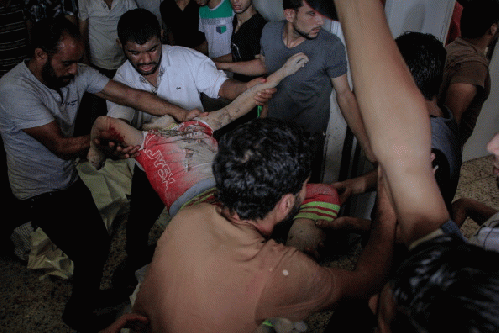
American journalism is frequently criticized with great justification, but there are a number of American journalists in Gaza, along with non-western ones, in order to tell the world about what is happening there. That reporting is incredibly brave and difficult, and those who are doing it merit the highest respect.
::::::::
Cross-posted from The Intercept
"They want to pile up as many civilian dead as they can. They use telegenically dead Palestinians for their cause. They want the more dead, the better."
Joseph Goebbels, November 16, 1941, essay in Das Reich, addressing Germany sympathy for German Jews forced to wear yellow stars:
"The Jews gradually are having to depend more and more on themselves, and have recently found a new trick. They knew the good-natured German Michael in us, always ready to shed sentimental tears for the injustice done to them. One suddenly has the impression that the Berlin Jewish population consists only of little babies whose childish helplessness might move us, or else fragile old ladies. The Jews send out the pitiable. They may confuse some harmless souls for a while, but not us. We know exactly what the situation is."
Rather than lard up the point with numerous defensive caveats about what is and is not being said here (which, in any event, never impede willful media distorters in their tactics), I'll simply note three brief points:
(1) To compare aspects of A and B is not to posit that A and B are identical (e.g., to observe that Bermuda and Bosnia are both countries beginning with the letter "B" is not to depict them as the same, just as observing that both the U.S. in 2003 and Germany in 1938 launched aggressive wars in direct violation of what were to become the Nuremberg Principles is not to equate the two countries).
Click Here to Read Whole Article
(2) In general, the universality of war rhetoric is a vital fact, necessary to evaluate the merit of contemporary claims used to justify militarism (claims that a war amounts to mere "humanitarian intervention," for instance, have been invoked over and over to justify even the most blatant aggression). Similarly, the notion that one is barred from ever citing certain historical examples in order to draw lessons for contemporary conflicts is as dangerous as it is anti-intellectual.
(3) Anglo-American law has long recognized that gross recklessness is a form of intent ("Fraudulent intent is shown if a representation is made with reckless indifference to its truth or falsity"). That's why reckless behavior even if unaccompanied by a desire to kill people -- e.g., randomly shooting a gun into a crowd of people -- has long been viewed as sufficient to establish criminal intent.
One can say many things about a military operation that results in more than 75 percent of the dead being civilians, many of them children, aimed at a population trapped in a tiny area with no escape. The claim that there is no intent to kill civilians but rather an intent to protect them is most assuredly not among them. Even stalwart Israel supporter Thomas Friedman has previously acknowledged that Israeli assaults on Lebanon, and possibly in Gaza, are intended "to inflict substantial property damage and collateral casualties" because "the only long-term source of deterrence was to exact enough pain on the civilians" (which, to the extent it exists, is the classic definition of "terrorism"). The most generous claim one can make about what Israel is now doing in Gaza is that it is driven by complete recklessness toward the civilian population it is massacring, a form of intent under centuries of well-settled western law.
* * * * *
American journalism is frequently criticized with great justification, but there are a number of American journalists in Gaza, along with non-western ones, in order to tell the world about what is happening there. That reporting is incredibly brave and difficult, and those who are doing it merit the highest respect. Their work, along with the prevalence of social media and internet technology that allows Gazans themselves to document what is happening, has changed the way Israeli aggression is seen and understood this time around.
Credit to Jonathan Schwarz, now working with Matt Taibbi's forthcoming First Look Media digital publication, for finding the 1941 article cited here.
[Subscribe to Glenn Greenwald] Glenn Greenwald is a journalist,former constitutional lawyer, and author of four New York Times bestselling books on politics and law. His most recent book, "No Place to Hide," is about the U.S. surveillance state and his experiences reporting on the Snowden documents around the world. His forthcoming book, to be published in April, 2021, is about Brazilian history and current politics, with a focus on his experience in reporting a series of expose's in 2019 and 2020 which exposed high-level corruption by powerful officials in the government of President Jair Bolsonaro, which subsequently attempted to prosecute him for that reporting.
Foreign Policy magazine named Greenwald one of the top 100 Global Thinkers for 2013. He was the debut winner, along with "Democracy Now's" Amy Goodman, of the Park Center I.F. Stone Award for Independent Journalism in 2008, and also received the 2010 Online Journalism Award for his investigative work breaking the story of the abusive detention conditions of Chelsea Manning.
For his 2013 NSA reporting, working with his source Edward Snowden, he received the George Polk Award for National Security Reporting; the Gannett Foundation Award for investigative journalism and the Gannett Foundation Watchdog Journalism Award; the Esso Premio for Excellence in Investigative Reporting in Brazil (he was the first non-Brazilian to win); and the Electronic Frontier Foundation's Pioneer Award. The NSA reporting he led for The Guardian was also awarded the 2014 Pulitzer Prize for Public Service. A film about the work Greenwald and filmmaker Laura Poitras did with Snowden to report the NSA archive, "CitizenFour," directed by Poitras, was awarded the 2015 Academy Award for Best Documentary.
In 2019, he received the Special Prize from the Vladimir Herzog Institute for his reporting on the Bolsonaro government and pervasive corruption inside the prosecutorial task force that led to the imprisonment of former Brazilian President Lula da Silva. The award is named after the Jewish immigrant journalist who was murdered during an interrogation by the Brazilian military dictatorship in 1977. Several months after the reporting began, Lula was ordered released by the Brazilian Supreme Court, and the former President credited the expose's for his liberty. In early 2020, Brazilian prosecutors sought to prosecute Greenwald in connection with the reporting, but the charges were dismissed due to a Supreme Court ruling, based on the Constitutional right of a free press, that barred the Bolsonaro government from making good on its threats to retaliate against Greenwald.
After working as a journalist at Salon and The Guardian, Greenwald co-founded The Intercept in 2013 along with Poitras and journalist Jeremy Scahill, and co-founded The Intercept Brasil in 2016. He resigned fromThe Intercept in October, 2020, to return to independent journalism.
Greenwald lives in Rio de Janeiro, Brazil with his husband, Congressman David Miranda, their two children, and 26 rescue dogs. In 2017, Greenwald and Miranda created an animal shelter in Brazil supported in part through public donations designed to employ and help exit the streets homeless people who live on the streets with their pets.