| Back OpEdNews | |||||||
|
Original Content at https://www.opednews.com/articles/Beyond-Fossil-Fuels--The-by-Burl-Hall-Biodiversity_Change_College_Ecosystems-140417-294.html (Note: You can view every article as one long page if you sign up as an Advocate Member, or higher). |
|||||||
April 17, 2014
Beyond Fossil Fuels: The Ecological Work of Stephen Mulkey of Unity College
By Burl Hall
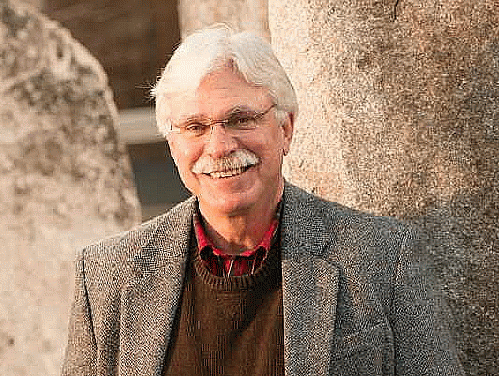
Dr. Stephen Mulkey of Unity College is one who is wide awake. HIs pioneering work as the leader of Unity is instrumental to helping the human race, and the planet to heal. His leadership has been to allow for the evolution of students in relating to the world, and thus lead us into a more natural state of being. This article introduces the reader to this deeply grounded man and his mission.
::::::::
http://www.theunityexperience.com
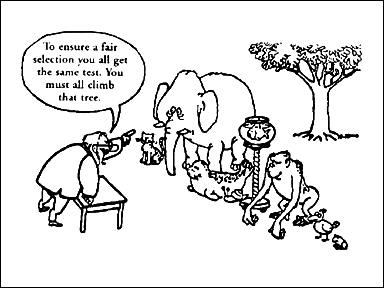
Every morning, children are lined up to be "whisked" off into yellow buses, away from their immediate family, friends and community, only to spend several hours housed in a building that looks like most other schools to receive an education that pretty much mirrors the rest of the country. This is called "standardization" in some vocabularies, and "no child left behind" in the lingo of George Bush. I call it "alienation" from the rich diversity of life.
What are the results of this type of education for our children and future generations? How is traditional education leading to a better living for the people and for the environment? Are children truly being taught to think critically, or are they being dumbed down to "pass the test?" Are children being allowed to unfold their creative abilities? Or is the goal to get them accustomed to standardization, in which the wildly influential creative is frozen stiff in a deadly embrace of uniformity?

http://4.bp.blogspot.com/-yGsl802mVx0/UU4J2WeW4DI/AAAAAAAAAuY/GBbzyJkaTL4/s1600/test.gif
What of college? Is it any better? Or do colleges fill students with mind-numbing materials that serve to isolate them in specializations and alienate the student from the whole of life?
Is education true to its epistemological roots, educare, which means to bring forth? Are the school systems of today more akin to systems of indoctrination than eliciting the rich potentials held within a student?
One educator who doesn't support the uniformity of school systems is Dr. Stephen Mulkey, president of Unity College in Unity, Maine. Through his leadership, the college developed its central focus on sustainability science. This science is at the leading edge of transdisciplinary 21st century environmental problem solving. Under his leadership, Unity has become the first college in the U.S. to divest from investments in fossil fuels. Unity is thus not standardized, and is a leader.
A climate change scientist with study and publishing spanning over three decades, Stephen has pursued research in Eastern Amazonia, Central Panama, and East Africa. He holds a bachelor's degree in fisheries and wildlife, a master's degree in ecology, and a doctorate in ecology from the University of Pennsylvania.
Stephen left his position as a climate change scientist to become Unity College president because he was so impressed with its mission:
Through the framework of sustainability science, Unity College provides a liberal arts education that emphasizes the environment and natural resources. Through experiential and collaborative learning, our graduates emerge as responsible citizens, environmental stewards, and visionary leaders.
In line with this mission, Unity built Terra Haus, the first American college residence designed to meet the European Passive House standard, the highest international standard for energy efficiency. Unity College supports David Orr's contention that, "our buildings teach." From design charrettes to a course that is developing educational materials about the dwelling, Unity students have been a part of the Terra Haus project from the start. Students who live in the house will commit to participating in educational programming, including tours of the house. The college is also partnering with a local energy group to use Terra Haus to promote green building practices, including those used in home weatherization. This 2186 square foot residence is modeled to use the equivalent of 80 gallons of oil per year for space heating, less than 10% of the average heating load for a home this size in this climate.
Stephen believes that ours is the century of environment and sustainability, a crucial concern that has been largely neglected for the past several thousand years. He feels the environment must become our central focus because environmental changes will affect all aspects of our lives. Indeed, he states that according to ecologists and other scientists, climate change is occurring faster than what was predicted a few years ago. Temperature zones are shifting faster than predicted and are changing at such rapid rates that animals and plants can't adapt. Stephen also states that we are hemorrhaging biodiversity, the underlying mainstay of resilience and homeostasis.
One of the wake-up calls for Stephen was his work in the eastern Amazon, where he saw devastated ecosystems. He then realized that research was having minor impact on how we were treating the planet. He also became frustrated that institutional college systems were poorly configured to make changes as needed to meet the problems with the environment.
Ultimately, that led him to taking on the presidential position at Unity.
The goal of Unity College is to train leaders in sustainability, through focus on environmental concerns across the broad liberal arts curriculum. The college emphasizes experiential learning and is rooted in the framework of sustainability science. No matter what a student's major, she will learn to consider all of the angles through Unity's trans-disciplinary approach to education.
This focus on the imperative of sustainability extends beyond the classroom and into the real world through extensive community projects. Unity provides students with an education that meets the demands of the planet earth and an economy in crisis. Stephen and his faculty are convinced that such necessary changes as greening our technology, retrofitting and building our housing stock for sustainability, and developing Earth-friendly agricultural and business practices will provide jobs for the students (plus millions of others) and stabilize the economy.
Sustainability, according to Stephen, has to be THE mission across the curriculum of Unity College. More than that, he feels that it has to be THE mission of humanity in the 21 st century. A primary emphasis of education needs to be on giving students the tools necessary to thrive on this planet. In traditional education, students are given tools to make money, buy goods and services and improve their quality of life. All of which are important. What has been traditionally missing is how we sustainably interact in relation to the planet.
It is people like Stephen who are helping us straighten out our priorities. His is the leadership that will take humanity into the future".and perhaps help it to evolve to its full potential. Yet, the cost of evolution is dying to what we are here and now in order to become more resilient. In challenging the status quo of higher education, it is this transformation that he is encouraging in his students in order to achieve a more connected way of being on this Earth.
Perhaps, besides saving the planet, the work of people like Stephen will foster a sense of belonging that will counter the extreme problems we have with alienation? What is Nature if not our Nature--our Being, our Essence? What is the Self if not our Nature? Perhaps knowing Nature we shall also know ourselves. We may come to know that we have great value within the all-embracing community of the larger Earth family to which we belong.
While these words do not come from Stephen, I do hope you think hard on them. Can the days of alienation come to an end? Can we indeed look out at the world and say, "Yes, this mirrors me and I mirror this. This is my Nature!" Or, do we look out upon Nature and see a wasteland and therefore become that wasteland within ourselves?
Take a close look at this image of Unity College students:

http://www.unity.edu/about_unity
Can you see the joy filled richness inherent in these young people? Where are our riches if not in Nature, both inward and outward? The richness of these students mirror the richness of the environment they celebrate. As they are enriched, so is their world. To change the world, change yourself. The devastation of Nature is the devastation of OUR Nature, which is, neither less nor more, than our Self.
To listen to an interview my wife and I did with Stephen Mulkey, visit: http://www.blogtalkradio.com/envision-this/2014/04/11/educating-leaders-for-the-environmental-century-president-of-unity-college
To learn more about Unity, visit: http://www.unity.edu/about_unity#sthash.4eOO8BxT.dpuf
(Article changed on April 18, 2014 at 06:29)
Authors Bio:
Burl Hall is a retired counselor who is living in a Senior Citizen Housing apartment. Burl has one book to his credit, titled "Sophia's Web: A Passionate Call to Heal our Wounded Nature." For more information, search the book on Amazon.
Burl's philosophy entails the idea that "everything effects and causes everything thing else." His spirituality of Sophia i.e., Wisdom is universal as well as within each of us. He also sees the idea of Chaos as not being "all over the place" but as infinite relationships.
The question I present in my articles speak not so much towards the politicians, but how WE the people can empower ourselves within a planet that is healthy, wealthy and wise.