| Back OpEdNews | |||||||
|
Original Content at https://www.opednews.com/articles/Sunday-Homily-Jesus-Rejec-by-Mike-Rivage-Seul-Gandhi_God_Greed_Healthcare-140228-988.html (Note: You can view every article as one long page if you sign up as an Advocate Member, or higher). |
|||||||
March 2, 2014
Sunday Homily: Jesus Rejects Money and Work: He Embraces 'Back to Nature' Abundance
By Mike Rivage-Seul
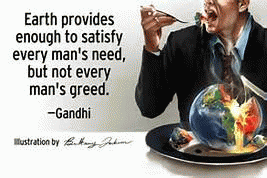
Republicans today would clearly regard Jesus and his apostles as examples of the idle undeserving poor â?? not to say bums â?? living off the donations of hard working people. But in denigrating money and work Jesus was insisting: in God's order, there is abundance for everyone -- or as Gandhi said, enough for everyone's need, but not for their greed.
::::::::
Readings for 8th Sunday in Ordinary Time: IS 49:14-15; PS 62: 2-3, 6-9; I COR 4: 1-5; MT 6: 24-34.
Today's liturgy of the word raises the question of work and money -- always two difficult elements of life for those claiming to follow Jesus' Way. They're difficult because both occupy so much of our attention and lives that they can distract us from what's really important -- what Jesus calls "the kingdom of God." Consequently, in this morning's Gospel selection, Jesus tells us to back off from both money and work while opening ourselves to the abundance of God's Kingdom.
For American workaholics, that's surprising. It's especially challenging for those who love to attack "the undeserving poor" -- that is, workers empowered by government programs even like the Affordable Health Care Act. (I'll get to that in a minute.)
About money Jesus directly compares the worship of God with the common attitude Americans adopt towards money -- or as Jesus puts it, "Mammon" (the name for an idol). It's impossible, Jesus says, to make money the focus of your life while claiming to serve God. In fact money can make us hate God. But that's not the surprising part.
What is surprising is that Jesus' claim comes very close to saying that loving God should make us hate money. That seems to be the meaning of his words recorded in today's selection from Matthew. Jesus says, "No one can serve two masters. He will either hate one and love the other, or be devoted to one and despise the other. You cannot serve God and mammon."
In other words, there's a choice to be made here: serve God or money; hate and despise money or hate and despise God. No one can have it both ways. The text seems to bear that reading, don't you think?
Of course Jesus' pronouncement will lead many to "clarify" his words to mean don't be attached to money. It's the service of money -- it's making money your master -- they would explain, that causes hatred of God.
Okay. But who among us (even financiers, banksters and hedge fund managers) would claim to serve money even though they spend all their waking hours scheming about it. Who would admit that they're attached to money, or have made it their master? Even those 85 individuals proud of owning as much as half the human race would probably deny that they "serve" money or that it's their master. (And if they're right, we can stop our discussion right here!)
On the other hand, those wishing to have it both ways might go further. They might invoke "nature." They might point out we obviously can't do without money; it's a product of nature (human nature) they might say. Some might even argue we can't even do without capitalism and its drive to "maximize profit." Capitalism and profit maximization simply represent the inescapable way the world works. They are reflections of the natural order. If they allow 85 people to own more than half the world, so be it. That's simply natural. (Please hold that thought.)
Such talk about nature brings us to my second point -- Jesus' attitude towards work and those who choose not to. Here he definitely has a "back to nature" approach. And once again, it's surprising. Jesus is not talking about the naturalness of competition or of the law of supply and demand.
In today's reading from Matthew's version of the Sermon on the Mount, Jesus says clearly that the natural order not only minimizes the importance of money (at the very least); it also minimizes the importance of work. "Look at the birds of the air," Jesus says, "they don't sow or reap or store food in barns." Or "Consider the lilies of the field. They neither toil nor spin." Learn from them both. Follow their example.
Say what? Is Jesus intention here to discourage work itself? (Talk about contradicting "American" values!) It's easy to draw that conclusion, I think. After all, he seems to be saying don't sow or reap or store products in warehouses. Don't toil or spin. It's a short step from there to saying, "Don't work!"
Besides that, Jesus seems to have lived out that latter implication. I mean as an able-bodied 30-something, he left his job as a carpenter to wander from village to village in Palestine philosophizing and apparently living on hand-outs. On the road, he had no home and must have sought shelter from friends. Moreover, he got rough fishermen to leave their nets and follow his example of what appears to be idleness as far as economic productivity is concerned.
In fact, Republicans today would clearly regard Jesus and his apostles as examples of the idle undeserving poor -- not to say bums -- living off the donations of hard working people. I mean, does that contradict our Protestant Work Ethic, or what?
And that brings me to that Obamacare business.
Did you follow last month's flap over the Congressional Budget Office's Report on jobs and President Obama's Affordable Health Care Act (ACA)? It said that the ACA would induce 2.5 million people to leave work. They'd escape "job lock" -- i.e. the inability to leave employment because doing so would lose them health coverage.
All hell broke loose.
When Paul Ryan (R-Wis) heard that, hypocrisy demanded that he and his Republican cronies reverse their position on "job lock." Formerly they were against it. In fact a couple of years ago, Ryan said,"[The] key question that ought to be addressed in any healthcare reform legislation is, are we going to continue job-lock or are we going to allow individuals more choice and portability to fit the 21st century workforce?"
Now, however, since freedom from "job lock" represented a boon of the ACA, Ryan and the Republicans had changed their tune. They quickly became opponents of "more choice and portability." Having realized that Obamacare will not eliminate jobs, but increase worker freedom to change jobs or leave the workforce altogether, GOP spokespersons were forced to readopt their familiar tack of demonizing empowered workers and the poor.
This meant that mothers and fathers leaving coveted jobs at McDonalds or as greeters in Wal-Mart to spend more time with their families were characterized as slackers and lazy. According to Ryan, such people lose respect for "the dignity of work." They were worthy of their traditional rank among Republicans' favorite target, the undeserving poor. (Never mind that Ryan has done everything he can to undermine labor's dignity -- but that's another story.)
The point is that Jesus and his sainted friends were not only among the undeserving poor, they flaunted it. They recognized that according to God's natural order, the world belongs to all creatures including the birds and flowers. If its resources were shared according to Jesus' Kingdom values, there'd be enough for everyone -- just as there was for birds and flowers in Jesus' day.
So in minimizing the importance of money and praising freedom from work, Jesus was not being unrealistic or some starry-eyed hippy. Instead (as always) he was proclaiming the Kingdom of God. In God's order, he insisted, there is abundance for everyone -- or as Gandhi said enough for everyone's need, but not for their greed.
Realizing the reality of God's and nature's abundance -- and not giving in to the world's myth of scarcity, overwork, and focus on money -- should give workers and those not belonging to Ryan's 1% courage to demand what is their birthright.
That natural condition is a life without worry about making ends meet and with enough leisure to enjoy life just like the birds and flowers.
Authors Bio:
Mike Rivage-Seul is a liberation theologian and former Roman Catholic priest. His undergraduate degree in philosophy was received from St. Columban's Major Seminary in Milton Massachusetts and awarded through D.C.'s Catholic University. He received his theology licentiate from the Atheneum Anselmianum and his doctorate in moral theology (magna cum laude) from the Academia Alfonsiana in Rome where Mike studied for five years. There he also played club basketball for Eurosport and a team within Rome's Stella Azzurra professional organization. In 1972 he served for a year as coordinator of volunteers in Monsignor Ralph Beiting's Christian Appalachian Project. Then for 40 years, Mike taught theology and general studies at Berea College in Kentucky receiving its Seabury Award for excellence in teaching, Berea's highest faculty award. At Berea, Mike founded its Peace and Social Justice Studies program. He and his wife, Peggy, also organized and started the Berea Interfaith Taskforce for Peace. For years, he periodically taught liberation theology in a Latin American Studies Program in Costa Rica sponsored by the Council for Christian Colleges and Universities. In Costa Rica Mike and Peggy were fellows at the liberation theology research institute, the Departamento Ecumenico de Investigaciones (DEI) headed by the great Franz Hinkelammert. In Mexico, they also served as fellows and program directors in San Miguel de Allende's Center for Global Justice. Mike's studies and teaching have brought him to countries across Europe and to Cuba (on 10 occasions), Nicaragua (12 occasions), Guatemala, Honduras, Mexico, Israel, India, Zimbabwe, South Africa, and Brazil where he and Peggy were associates of Paulo Freire. Mike's languages include Latin, Greek, Hebrew, French, Italian, German, Portuguese, and Spanish. For three years he was a monthly columnist at the Lexington Herald-Leader in Lexington Kentucky. He has contributed more than 400 articles to the online news source OpEdNews where he is a senior editor. He has also published in the DEI's Pasos Journal, in the National Catholic Reporter and Christianity Today. His scholarship has been cited in the New York Times. Mike has authored or edited 10 books including one of poetry and a novel based on his experiences in Cuba. His latest book is The Magic Glasses of Critical Thinking: seeing through alternative fact & fake news (Peter Lang publishers). He blogs at http://mikerivageseul.wordpress.com/ Attempting to appropriate his identity as an ordained exorcist (all Catholic priests are), Mike also reads Tarot cards. He is a lifelong golfer and Chicago Cubs fan.