| Back OpEdNews | |||||||
|
Original Content at https://www.opednews.com/articles/Abdullah-Ocalan-Responds-t-by-Hamma-Mirwaisi-Abdullah-Abdullah_Editorial-Cartoon_Freedom_Guardian-140212-151.html (Note: You can view every article as one long page if you sign up as an Advocate Member, or higher). |
|||||||
February 12, 2014
Abdullah Ocalan Responds to Guardian Editorial
By Hamma Mirwaisi
The Guardian published an editorial article on the occasion of Nelson Mandelaâ??s death. The article included a significant(!) comparison between Mandela and some other names like Jawaharlal Nehru, Aung Sang Suu Kyi, and me.
::::::::
By Hamma Mirwaisi and Alison Buckley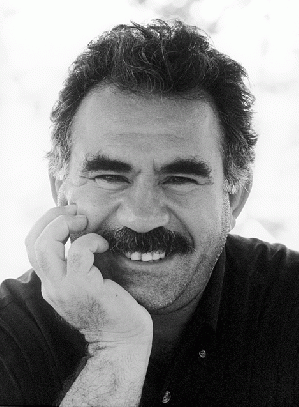
Abdullah %C3%96calan
(Image by (From Wikimedia) Halil Uysal, Author: Halil Uysal) Details Source DMCA
On Thursday 5th December 2013, the Guardian Editorial wrote this comparing Mandela and Ocalan:
" A distant parallel would be with the Kurdish leader Abdullah O calan , who has maintained an extraordinary grip on his supporters from his own island prison and is even now negotiating with the Turkish government on something like equal terms. But Ocalan's cult-like following does not fit the Mandela template. Ocalan is feared and worshipped; Mandela was respected and loved. The secret of Mandela's leadership lay in the almost unique mixture of wisdom and innocence which his character, and a life that kept him off stage for such a long and critical period, combined to produce." (1).
There are millions of people following Abdullah Ocalan's teachings in the Middle East and the world now, because they are founded in the tradition of the great thinkers of that area. Every four thousand years one has arisen to serve humanity.
The human population on earth is going through a critical time, the US capitalist system is failing and the Chinese communist system is faltering. Some of the socialist systems of Europe are struggling to survive while the EU's support of corrupt rulers of the Middle East in order to ensure a supply of raw materials is not enough to rescue Europe from starvation. The Guardian editorial writers obviously have little understanding of how Ocalan's ideas address these problems including poverty, which explains why they branded him the leader of a fearsome cult. And as Ocalan himself indicates in his reply to the Guardian editorial (see below), what power over his people can he enforce from his prison cell?
Further, if his popularity is measured by the number of people reading his writings and fighting for the freedom, self-determination and human rights they advocate whilst displaying his picture in their institutions, perhaps it's because he is providing authentic, transparent leadership for peace in a region ruled by corruption, violence and oppression. And maybe these are also the reasons why he keeps an "extraordinary grip' on his supporters who see his teachings as their only hope for escape from tyranny, brutality and poverty. The followers of the only other so called "god' they are allowed to worship occupy their territory and seek to enslave and kill them, so why wouldn't they venerate a leader who offers them the chance to live under democracy, freedom of conscience and the benefits of the resources of their own land?
As Ocalan suggested in his reply, the writers of the Guardian editorial would do well to evaluate the viewpoints of the participants in and benefactors of the Kurdish struggle, such as those in the now autonomous Syrian Kurdistan region, before offering any further comments and analyses.
Every civilization battling with its demise persecutes new thinkers, instead of listening to them. Just as two thousand years ago another revolutionary Middle Eastern thinker, Jesus Christ, was wrongly persecuted, today the Kurdish leader who is seeking to bring Renaissance and Reformation to the region, is suffering similar treatment from western educated commentators, who have not recognized that Ocalan's theories reflect those of the tradition that has granted them the freedom, human rights and prosperity they enjoy.
Abdullah Ocalan relinquished control of the Kurdish people's struggle for freedom when he was imprisoned fourteen years ago. Nevertheless they have continued without him and will do so until peace is achieved in Kurdistan. Even while incarcerated, Ocalan has aided the peace process whenever he has been permitted by the Turkish Government.
Far from fearing him, the Kurdish people love him. His writings and his new ideas are giving Kurdish people, especially Kurdish women, hope for freedom from dictators and corrupt leaders imposed on them by western and eastern imperialists intent on accessing cheap oil and other raw materials from the Middle East and Asia. Ocalan's response to the Guardian editorial implies that some intellectuals in western countries are prepared to twist the truth to serve specific interests without regard for human rights.
Here it is in full:
On Thursday 5 December 2013, The Guardian published an editorial article on the occasion of Nelson Mandela's death. The article included a significant(!) comparison between Mandela and some other names like Jawaharlal Nehru, Aung Sang Suu Kyi, and me. As long as they approach the issue with a hegemon's mindset, the potentates will certainly continue to make such comparisons among those figures winning the affection of their peoples. However, any comparison has its own inner problems.
The time of the struggles, varying geographic and political conditions and even the characteristic differences between the figures will render such comparisons problematic. First of all, for me, being remembered together with a leader for whom all the world shed tears shows the extent to which our struggle line has taken universal dimensions. It also demonstrates the fact that our case couldn't be explained as a struggle only against an unjust treatment.
Writing on the capabilities of a leader with exemplary methods of struggle and negotiation just after his death needs some more pondering on the history and politics of risk-takers, in order to get a better understanding of the conditions of those who haven't been afraid of struggling in the front line throughout history.
There are clear-cut differences between the front-line strugglers and deskbound analysts. The greatest difference is to witness the death of your comrades and your people, live the experience moment to moment, and do right and wrong. Restricting the esteem and dignity of such an important leader with "the prison' is a beleaguered approach which holds in contempt the self-realized political struggle of a people with over 40 million population voluntarily approving this leader as the representation of their own will. How objective and just would it be to turn a blind eye on the national identity the Kurdish people have achieved after a 40-year-long freedom struggle, and on our peace efforts for a democratic solution to the Kurdish question?
Comparing me with Nelson Mandela in your article, you had referred to me as "feared and worshipped". Here, not only can I see more easily the writer's desire to be the state chronicle of a history which tramples on the world's oppressed, but also I discern the codes of the purposive enmity harboured against both of the compared figures, whose only resource for facing the enslaving, massacre and denial policies are their own self-belief.
It is so evident as to not need proof that a person who has spent the last 14 years of his life in a prison-island alone and under solitary confinement can be a "source of fear" only for those who have put him into chains. The chains speak for themselves.
In reply to those who, instead of analysing the fear spread by the hegemons, are busy giving advice and teaching lessons to those struggling against these hegemons, I should say, in all modesty, that Dear Madiba and me have more parallels than contrasts.
Everybody knows that the ordeal endured during the successful confrontation of the apartheid regime was an accomplishment of not only the South African people, but at the same time of the leader, in whom they had unstintingly confided their fate. No matter their numbers, the many ludicrous comments made on Mandela's credibility come from the quarters which adopt a remote and trivial approach to the "struggle of the oppressed' rather than making a close and reasonable analysis.
The self-organization processes of the communities subjected to suppression and discrimination would differ from the common practices, especially when they begin to make a true analysis of the notion of capitalist modernity. Traditionally, the organizational options of "the book' are already known. But time precedes forward and circumstances change, in company with historical determinism. Changing conditions will bring about changes in the behaviour and attitude of individuals and organizations, either captive or free. When it comes to the PKK, instead of bringing about pragmatic progress, these changes have led to the political and ethical progress of a movement, which has transformed itself on the basis of the struggle for democratic modernity and the developing direct democracy examples in the world.
The 12 September 1980 fascist coup followed by many organized coups against our community as well as the international conspiracy act against me and our movement share one thing in common with other interferences in other struggles of the oppressed; and that is the silence of the international community in the face of these interventions. Despite the progress of international democratic standards in the 21st century, due to the state propaganda characteristic of the international conspiracy, the dehumanization of the struggling leaders held captive still continues, based on poor intellectual standards.
How odd it is that a credible newspaper in Britain has not noticed the recent democratization progress that we have made in Mesopotamia. As far as the approach is concerned, I hope it is nothing more than "odd'. However, looking at the general approach of the article, what I see is not only the "oddness"; rather, every line is a dead giveaway of a hierarchic and "from above' viewpoint.
Here, those opposing peace are accusing us of starting negotiations, dehumanizing me in the eyes of the new generations and also defaming our movement, which has adopted peace and settlement as its main principle. They are running an organized activity to blacken the reputation of our efforts for democratic modernity. How odd it is that racist notions and old propaganda rhetoric, which have even lost their reputation in Turkey, are still being repeatedly covered in the international press.
The only topic to be discussed after Mandela's demise should be the apartheid, a regime which history would remember only with shame. Nobody would keep a memoir of apartheid and its leaders; nobody would shed tears for it; whereas Mandela has become a shining star for the peoples of Africa. Our historical mission is to ensure the ever brilliance of this star for the peoples of the Middle East. The friendship developed on the basis of principled and political integrity between the peoples' movements and particularly our movement, relies on the changing dynamics and the horizontal nature of their policies. To believe that these laws of goodwill and friendship have been developed on the basis of fear can only be explained by complete ignorance of the metamorphosis eras the Kurdish political movement has undergone and failure to observe its democratic inner reflections of the peaceful and negotiating perspective of this movement.
Likewise, negotiation and struggle are both important processes in determining the future of peoples' movements and those leading these processes are figures winning the confidence of the peoples, not "feared' ones. If not so, it wouldn't be possible for these movements to be represented both in the parliamentary system and the local politics, as it wouldn't have been possible to succeed in the years-long armed struggle.
My recommendation to the editorial board of The Guardian is to do more research and analysis on the role of the women in our political movement and the resulting transformative effects. Then, they would certainly encounter such an infinite experience so as to take off their colonialist hat, though ashamedly.
Abdullah Ocalan
The Prison Island of Imrali (2). References1. http://www.theguardian.com/commentisfree/2013/dec/05/nelson-mandela-a-leader-above-all-others
2. http://www.ekurd.net/mismas/articles/misc2014/1/turkey4931.htm
Authors Bio:
Hamma Mirwaisi was exposed to the oppression of Kurds while still a youth, as his education was frequently interrupted by Iraqi government harassment. Forbidden from entering university in 1968, he had little choice but to join the peshmerga (freedom fighter) forces of Mustafa Barzani from 1968 to 1975 in their battles against the Iraqi Government forces.
Although the conflict was resolved by treaty in 1975, he foresaw reprisals by Saddam Hussein's secret service against his extended family. He took his wife and two children to Iran, and in 1976 they entered the US as legal refugees, settling in Valley City, North Dakota.
Mirwaisi completed BS and MS degrees in Electrical Engineering at the University of North Dakota. That led to a technical career, beginning in 1982 at the Sperry Corporation in Minneapolis. Sperry's merger with Unisys Corporation caused the end of his program, and he took up Ph.D. studies in Radio-Frequency (RF) Engineering at the University of Colorado at Colorado Springs. Eventually he returned to work at Honeywell, where he completed his career, becoming the Senior RF Engineer on the Air Force Satellite Communication program.
The tragedy of the Kurds intervened again in 1995. His sister and her two-year-old daughter were drowned while escaping Saddam Hussein's reprisals against the Kurds for their rebellion during the first Gulf War.
He returned to Kurdish affairs in 2004, when the US Army called on him to serve as an interpreter in the second Gulf War. At the end of that assignment, he began seeking American corporate sponsors for the rebuilding of Kurdistan. However, the Barzanis, who controlled the Kurdistan Regional Government, saw the initiative as a scheme to undermine their own influence and expelled Mirwaisi from Iraq. The doors to government and corporate sponsorship of works in Kurdistan (at least those that did not include a Barzani rake-off) slammed shut.
Since then, Mirwaisi has devoted his efforts to spreading the word about Kurdish history and culture through writing and speaking. After his first book, Return of the Medes, he was invited to serve for a year as an honorary member of the Kurdistan National Congress (KNK), a Kurdish parliament in exile that sits in Brussels. He is the author of many other books on Kurdish affairs
The History of the Caucasian People: The Civilizations without Hatred ...
https://www.amazon.com/History-Caucasian-People-Civilizations-without/dp/1543172784/ref=tmm_pap_swatch_0?_enc