| Back OpEdNews | |||||||
|
Original Content at https://www.opednews.com/articles/The-Money-Monopoly-by-Mike-Krauss-Bankers_Bankers_Banks_Credit-131119-816.html (Note: You can view every article as one long page if you sign up as an Advocate Member, or higher). |
|||||||
November 19, 2013
The Money Monopoly
By Mike Krauss
How the Fed extracts the wealth of the United States
::::::::
In a masterful study of the Federal Reserve, Secrets of the
Temple , William Greider observed that the average American
farmer in 1880 knew more about banking and money than most U.S.
college graduates today.
Let me prove that.
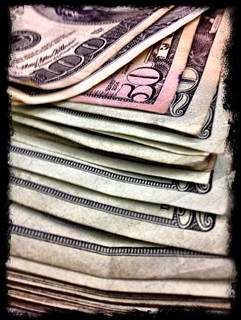
Take a bill from your wallet or purse. Read the side with the
portrait. It says very clearly at the top, "Federal Reserve
Note."
The Federal Reserve is not a part of the federal government. It
receives no appropriation from Congress. It is a private
corporation and its stock is privately traded. The stockholders are
the member banks of the regional Federal Reserve Banks, so its
major stockholders are the largest banks and their owners.
Historically these have been the powerful Wall Street and
European banking families: think Rothschild, Warburg, Morgan,
Rockefeller.
All the bills and coins in circulation today are a tiny fraction
of the supply of money in the American economy. All the rest is
credit, created on the books of the banks "ex nilo" -- out of
nothing.
This money comes into circulation at interest paid to the banks
that create it. A central bank like the Federal Reserve creates the
money supply of the United States, at interest.
The Bank of England was the first privately owned central bank
to control a nation's currency. One of its owners, of the
Rothschild family well understood what that meant and said: "Give
me control of a nation's money, and I care not who makes the
laws."
Big money.
The colony of Pennsylvania escaped the clutches of the Bank of
England and its tax on money by printing its own. It was pure
genius.
Writing in The Wealth of Nations in 1776, Adam Smith
noted: "The government of Pennsylvania, without amassing any
treasure [gold or silver] invented a method of lending, not money
indeed, but what is equivalent to money. By advancing to private
people at interest " paper bills of credit " legal tender in all
payments " it raised a moderate revenue which went a considerable
distance toward defraying the whole ordinary expense of that frugal
and orderly government."
Until the mid 1750s there was broad prosperity in Pennsylvania.
On a trip to London, Ben Franklin let the cat out of the bag. He
noted the widespread poverty he saw there and explained how by
printing their own money and avoiding the need for the notes of the
Bank of England to conduct their commerce, the people of
Pennsylvania insured their own prosperity.
The private owners of the Bank of England went the 1700s version
of ballistic and lobbied King and Parliament (Sound familiar?) to
outlaw this colonial "script." The depression that followed was the
cause of the American Revolution.
Franklin wrote, "In one year the conditions were so reversed
that the era of prosperity ended, and a depression set in, to such
an extent that the streets of the Colonies were filled with
unemployed."
He concluded, "The Colonies would gladly have borne the little
tax on tea and other matters, had it not been the poverty caused by
the bad influence of the English bankers on the Parliament [Again,
sound familiar?]: which has caused in the Colonies hatred of
England, and the Revolutionary War."
The bankers got control. Hamilton fronted for them in the young
United States. Jefferson and Jackson fought them. Lincoln fought
them. Lincoln was assassinated, the bankers once again had control
and the war for control of the nation's supply of money raged
on.
After decades of planning and massive PR and propaganda, having
bought up the support of Ivy League scholars, journalists and the
requisite number of votes in Congress, the Wall Street cartel and
their foreign allies pushed creation of the Federal Reserve through
Congress and got complete control of the nation's money and
credit.
Before you pay your taxes, the money you pay with has already
been taxed by the owners of the Federal Reserve, which for over 100
years have diverted trillions of dollars of interest payments on
our money from the American people into their own pockets.
That is what "central banks" are designed to do: extract wealth
from nations by monopolizing the supply and cost of money and
credit.
The debt ceiling, sequestration, austerity and budget deficit
are a diversion. The U.S. Congress can slash the debt by taking
back control of our money from the Federal Reserve monopoly and
returning it to the U.S. Treasury and the American people, as the
Constitution (Article I, Section 8) wisely provided.
Authors Website: http://www.publicbankingpa.org
Authors Bio:
Author of the forthcoming novel "Pursuits of Happiness," a director of the Public Banking Institute and chairman of the Pennsylvania Project. Mike is an international transportation and logisics executive with broad experience in U.S. government and politics. Mike has lived in the first world and the third world, traveled widely and done business on five continents.