| Back OpEdNews | |||||||
|
Original Content at https://www.opednews.com/articles/Solving-the-Elephant-Poach-by-Panama-Red-Action_Elephant-Slaughter_Elephants_Explaining-131104-467.html (Note: You can view every article as one long page if you sign up as an Advocate Member, or higher). |
|||||||
November 4, 2013
Solving the Elephant Poaching Problem
By Panama Red
An impassioned plea for the righteous murder of those who murder elephants.
::::::::
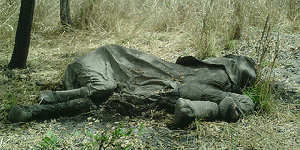
An African elephant carcass lies dessicated after being slaughtered for its ivory.
(Image by USFWS Headquarters) Details DMCA
An African elephant carcass lies dessicated after being slaughtered for its ivory. by USFWS Headquarters
A few months ago you may have seen the feature in National Geographic magazine about the wholesale slaughter of elephants--25 THOUSAND last year alone--for their ivory, and about how the ivory makes its way to China, where it is carved into various trinkets by skilled craftsmen and then somehow gets to the Philippines. One customer there, a seemingly jaded old Catholic cardinal, or bishop (or whatever), collects Jesus-related trinkets and now has a manse chock-full of the stuff. There were some pictures of these items in the N-G article, but apparently the photographer was dissuaded from taking an actual picture of the monsignor's (or whatever's) huge (life-size?) crucifix made of ivory. (Note to Pope Francis: You should maybe look into this.)
The National Geographic piece doesn't account for all the ivory poached each year, but it does go a long way toward explaining the level of jerkitude involved at the consumer end of the ivory chain. From the Philippines, which seems to be the main terminus and transshipment point of all the ivory swag from China, the ivory not converted to holy use goes to other destinations: you can probably buy some in any large coastal city on the planet.
I am of course shocked--shocked, I say--at the non-involvement of the Chinese government in this matter.
For the last twenty-five years, we bleeding hearts have been asking the question, "Why do we let this go on and what can we do to stop it?" Yet, for all that time, we've been making snowballs with our hands--in this country, at least, and in most of the rest of the world as well. (See October 7, 1988 "AFRICAN ELEPHANT CONSERVATION ACT," 16 U.S.C. 4201-4245, as amended 1992.)
Maybe we should pursue the remedy that has worked so well in the preservation of the mountain gorilla: Send in some armed rangers to apprehend the poachers. But wait! That strategy didn't work out so well, actually. Just ask the 300 or so mountain gorillas that are left.
A little while back in the New York Times, the watering hole where we liberal antelope go to drink in the daily blab and become impotently infuriated, I saw this morsel: "As ivory poaching gets more militarized, with rebels and even armies slaughtering elephants across Africa, rangers are wading into the bush to confront hardened soldiers." ["The Price of Ivory," Deadly Risk for African Wildlife Rangers, by Jeffrey Gettleman. (NY Times, Jan 5, 2013.)
On digesting this morsel from the Times, I thought to myself: Well, this is not working out well. You got these underpaid but well-meaning (we'll assume) wildlife rangers confronting the "hardened soldiers" Africa has been turning out since--well, since post-colonialism, actually, and the rangers seem to be getting the worst of it.
I've also thought this: There are many reasons an African might turn to poaching ivory. Well, no. There's only one: Money. Africa is a hard place to live. There is no food, no drinkable water, and if killing an elephant will net me enough money to get by a little longer, to further my cause or feed my family, then chances are I'm going to take my AK-47 and go kill me a elephant. I'll also anyone who tries to stop me.
So over here in the First World, we've been shelling out dough to keep our rangers, our elephant shepherds, if you will, going, and they've been trying. But it ain't working out. Bust one poacher, up pops another to take his place. Because Africa is, as I just said, hard. But this has gone on for far too long.
So, what to do? What to do?
You can't do it from either end. You can't take out this looney archbishop (or whomever) at the consumer end, because he's got more money than God. In fact, the ivory IS God's money--and further, there are many more heartless and selfish bastards like him out there. It's the same at the supply end. You can't take out enough poachers to make a dent.
The Solution to the Problem
Since we can't get at the problem from either end, we have to approach it from the middle. This makes sense, as it is in the middle that the greatest crime actually occurs. And it is in the middle that the chain has its weakest link. Why do poachers poach? Money. Who pays them the money? Why, the broker sitting in Mogadishu or whatever eastern African port where this stuff flows through on its way to China. Take out the broker, and you take out the money. When the broker's brother-in-law shows up to take his place, take him out, too. Continue taking out brokers and it becomes too risky for them to continue buying ivory. The price of ivory becomes too high. The brokers hire guards. You buy a drone. They escalate. You escalate more.
Why, Panama, you say. This sounds like you're advocating murder. Why, yes. Yes, I am. But I'm advocating for elephants, too.
So if there are any well-heeled, ballsy liberals out there reading this, you know what to do.
Every week last year, 500 African elephants were murdered. This carnage can be stopped, and the only way to do it is to do what I've just said.
It's time for the activists to act.
Authors Website: http://www.panamaredmusic.com
Authors Bio:
I was born in Nestlow, West Virginia.
I attended the US Army Information School. I was a stringer for Pacific Stars and Stripes in Tokyo. I went to work for a Korean-language magazine published by the United Nations Command. I gained a lot of experience and knowledge writing feature stories for it, mostly about industrial growth in South Korea.
I first came to Nashville to stay for any length of time in
1972. I became Billy Joe Shaver's guitar player, and we
wrote a couple of songs together, one of which, Bottom
Dollar, has at this time been recorded a bunch of
times. It has become a standard country song, but
standards don't pay; hits pay, but not standards...Shaver and I remain friends, I think. Sometimes when he's up against it I still play guitar for him.
I was standing on a street corner one day, gazing up at
Billy Swan's apartment house when I heard a voice over my
right shoulder saying, "Do you think I ought to call myself
Rich Friedman, Kinky Friedman or Big Dick Friedman?" It
was, of course, Kinky. Now he uses all three on his answering machine at the ranch. We became friends, and
he ultimately coerced me into playing guitar on his first
album, "Sold American", and as player and co-writer on his second, "Kinky Friedman". Later, when I joined the Jewboys, I started using the Panama Red moniker, which I'd carried around in my hip pocket since my post-Army San Francisco days when I'd dealt a little pot.
After the Jewboys I toured the U.S. and Canada with my own bands for a couple of years to no real effect, and moved back to Miami to hang out at Criteria Studios, then a hive of disco activity. Unable to bear the cocaine, I ran away to New Mexico.
A long time went by. There was some writing -- not very memorable, and the editing of a physics textbook. I lived in Santa Fe, Albuquerque, San Francisco, and Seattle. While in Seattle, I recorded my first solo CD, "HomeGrown", which Kinky released on his label, Kinkajou.
I came back to Nashville in 2000, stayed a couple of
months, went to Amsterdam for nearly two years. I came back to the U.S. in December of 2001, made some friends in Muscle Shoals and made my second CD. "Choice Buds".
I've been playing and writing blogs ever since.