| Back OpEdNews | |||||||
|
Original Content at https://www.opednews.com/articles/B-Lab-Helping-Companies-N-by-Joan-Brunwasser-Accountability_Activism_Employees_Interviews-131010-641.html (Note: You can view every article as one long page if you sign up as an Advocate Member, or higher). |
|||||||
October 10, 2013
B Lab: Helping Companies Not Only Be the Best in the World, But the Best FOR the World
By Joan Brunwasser
Traditional businesses are constrained by the need to put profits rather than the health of society first.B Corps are free to pursue a broader set of objectives-they have the legal protection to create value for society,not just for shareholders,while meeting higher standards of accountability and transparency. We help redefine success in business so all companies can not only be the best in the world but best for the world.
::::::::
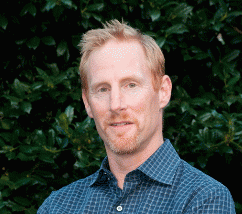
Jay by B Lab
My guest today is B Lab co-founder, Jay Coen Gilbert. Welcome to OpEdNews, Jay. As they say in the song, let's start at the very beginning. Please tell our readers what B Lab is.
JCG: Government and nonprofits are necessary but insufficient to address today's most pressing problems, while business is the most powerful man-made force on the planet. That's why B Lab -- a 501(c)3 nonprofit -- serves a global movement of entrepreneurs using the power of business to solve social and environmental problems.
JB: Great concept! B Lab launched seven years ago. What did you and your co-founders expect you would have accomplished by now? Are you on target?
JCG: We believe in "big, hairy, audacious goals" so to say we are on target would be a failure :). We want to change the very way our society defines success in business. However, we have made incredible progress in the past few years.
We already have a strong community of nearly 800 Certified B Corporations from over 27 countries and 60 industries. These include well known brands such as Ben & Jerry's, Patagonia, Etsy, One PacificCoast Bank and Method Products. We also have some truly innovative, high impact companies serving the emerging market, like d.light solar and Roshan Connection.
Additionally, we are supporting what the Delaware Bar have called a "seismic shift in corporate law", passing benefit corporation legislation in 20 states. As of July, these states include Delaware, the legal home of most venture-backed businesses, the majority of publicly-traded companies, and nearly two-thirds of the Fortune 500 and therefore the most important state for businesses that seek access to venture capital, private equity, and public capital markets. Benefit corporations enjoy legal protection to create value for society, not just for shareholders, while meeting higher standards of accountability and transparency.
Finally, we are helping bring the impact investing marketing to scale, by providing B Analytics, a comprehensive and transparent system for assessing the social and environmental impact of companies and funds. With a ratings and analytics approach analogous to Morningstar investment rankings and Capital IQ financial analytics, we hope to enable investors to invest with a higher purpose and unlock the potential of this emerging asset class.
JB: Encouraging progress! I don't know where to begin! I'm glad about your legislative success but I don't fully understand why you needed the legislation. What can Benefit Corporations do now that they couldn't do before? Can you make this clearer for me and our readers?
JCG: Sure, Joan. The simple fact is traditional businesses are constrained by the need to put profits rather than the health of society first. Current law requires corporations to prioritize the financial interests of shareholders over the interests of workers, communities and the environment. That old conception of the role of business in society is at best limiting and, at worst, destructive.
Benefit Corps enjoy the freedom to pursue a broader set of objectives - they have the legal protection to create value for society, not just for shareholders, while meeting higher standards of accountability and transparency.
Benefit corporations are a new kind of corporation legally required to: 1) have a corporate purpose to create a material positive impact on society and the environment; 2) expand fiduciary duty to require consideration of the interests of workers, community and the environment; and 3) publicly report annually on its overall social and environmental performance using a comprehensive, credible, independent and transparent third party standard.
The benefit corporation legal structure functions as a new and useful tool for everyone. For policy makers and the public interest, it combats the plague of short termism. For business leaders, it helps attract the best talent and turn customers into evangelists. For customers, it offers greater transparency to protect against pretenders. For employees, it promises higher quality jobs where they can bring their whole selves to work every day. And for investors, it mitigates risk, reduces transaction costs, creates additional rights to hold management accountable, and accelerates the growth of a big market opportunity to meet the needs of people who want to invest to both make money and make a difference.
JB: Fabulous! Sounds like a win-win. In theory, why would anyone not want to do it? And, practically speaking, how do you get companies that are traditionally interested in/committed to bottom line profitability to expand their scope and vision to be socially and environmentally progressive? Despite all its pluses, isn't it simply a lot more work?
JCG: Consumers, employees and investors are beginning to demand more from companies. As businesses struggle to stay competitive, they are going to have to expand their definition of profitability and meet the market demand. However, people are trusting company statements less and less. That's where third party certifications and transparent data and metrics come in.
Measuring impact is an investment in the future - it supports long term profitability and sustainability and combats the short-termism that has been plaguing our marketplace. Additionally, while it does require a time commitment, it really isn't as difficult as many are concerned. We make our online B Impact Assessment available for free so that everyone can take the first step and see where they stand.

B the Change stamp by B Lab
JB: Your website lists a number of companies that are certified as B Corporations. I was happy to see that one of them is Dansko, whose clogs I've worn for years. Can you use them as an example? I think it will make the whole process clearer to our readers. What did they do to qualify? How does it work?
JCG: Sure - companies are certified in three steps. First, Dansko had to meet our social and environmental performance standards. This means that they took our B Impact Assessment and earned a minimum score of 80 (out of 200 points). The B Impact Assessment measures the overall impact of a company on its stakeholders (workers, community, environment) and varies depending on the company's size, sector, and location. It's free, transparent and confidential so anyone can take it, whether they wish to become certified or simply see where they stand.

Dansko clog by B Lab
After completing the assessment and a review to verify their answers, Dansko received their B Impact Report [that you can check out here ]. All certified B Corporations make their B Impact Reports available online through their profile page, so everyone can see how they create a better world.
The next step involves meeting our legal requirement, which varies slightly depending on corporate structure and state of incorporation. However, the goal remains the same: to bake sustainability into the company's DNA. This way as a company grows, brings in outside capital, or plans succession, its mission can better survive new management, new investors, or even new ownership. [You can dig into the legal details here .]
Finally, Dansko signed the B Corp Declaration of Interdependence and Term Sheet. This simply makes certification official and reaffirms the company's commitment to our shared vision. With that, we welcomed Dansko into our community (they've been part of the community since 2007, re-certifying every two years).
JB: That helped, thanks. You've currently got B Corps in 27 countries and 60 industries. Tell us a bit about your outreach strategy. Once you crack a specific country or industry, does it make it easier to get others to jump on the bandwagon?
JCG: I'm happy to say we're actually in 28 countries now! The most recent company to certify was Pots n Pans in Vietnam. We are thrilled that social entrepreneurs from new markets are looking to join the B Corp community and pioneer the movement in their home country.
As for strategy, we will mostly be focused on building the global movement through regional partnerships. We currently have one partner in South America called Sistema B , who is focused on four countries (Argentina, Brazil, Chile and Colombia). We are also developing partnerships in Australia and New Zealand, and in Western Europe. Our role is to ensure these partners can scale operations and build community within their region.
That said, we will continuously seek to certify engaged companies, no matter the country. Our hope is to see the number of countries increase, but most importantly, to see the community of certified B Corps strengthen and flourish wherever it's located.
JB: I'm with you there. Can you give us a little personal history, Jay? You started as an entrepreneur yourself. How did that experience morph into B Lab?
JCG: That's right- Bart Houlahan, another B Lab cofounder, and I created and sold AND1, a $250M basketball footwear and apparel company based outside Philadelphia. I led AND1's product and marketing and was AND1's CEO during its period of most rapid growth and decline.
Through this experience, I developed a passion for using business as a force for good. As I said before, government and nonprofits are necessary but insufficient to solve today's greatest challenges. Bart Houlahan, Andrew Kassoy and I cofounded B Lab to serve those entrepreneurs who are using business to create a better world.
However, we identified two systemic challenges that must be addressed if we are to use the power of business to create the greatest positive impact. The first is a lack of standards to help us tell the difference between good companies and just good marketing; and the second is existing corporate law that demands that business prioritize shareholder value maximization to the exclusion of the value created for all stakeholders.
By certifying B Corporations, supporting benefit corporation legislation, encouraging all companies to measure what matters (impact) using the free B Impact Assessment and providing B Analytics to the impact investing market, we hope to help redefine success in business so all companies compete to not only be the best in the world, but the best for the world.
JB: Sounds good to me. I was surprised and pleased to notice when I was looking for baking goods at the grocery store that one of my options was King Arthur Flour, which had a B Corp label on its package. Needless to say, I snatched it up! But there must be more efficient ways for our readers to learn which companies are B Corps so that they can patronize them. Please fill us in.

the coveted B Corp seal by B Lab
JCG: Good point, Joan. With over 850 B Corps, it is hard to keep track. The first place to look is our website . Immediately on the top right of our homepage is our "Find a B Corp" search tool. You can also get to our directory instantly here .
Another great source for B Corp products is the B Corp store on Vine.com . Here you can not only identify certified companies, but also shop instantly. Finally, keep an eye out for our community ad campaign, both on the web and in Ogden publications, such as Utne Reader, Mother Earth News and Natural Home & Garden.
And of course, feel free to follow us on Facebook and Twitter (@Bcorporation) for all the latest news, including announcements welcoming our newest Bs.

2013 Annual Champions Retreat Group by B Lab
JB: Excellent. Very helpful. What's the story behind this group shot, Jay?
JCG: The Champions retreat is our annual gathering of B Corps. Leadership/representation is invited from any certified company. Last month around 300 of us gathered in Boulder, Colorado, including B Corps from New Zealand, Australia, Europe and South America. Essentially it's an opportunity to network, enjoy.
JB: Fun! I read a disturbing article very recently about how a number of big companies, Home Depot and Trader Joe's among them , were downsizing employees to part-time in order to escape providing health insurance ahead of the introduction of the Affordable Care Act. That's disappointing. If a B Corp were to do that, would it be spotted? And if so, would the company be stripped of its B Corp status?
JCG: If a B Corp made this change to their worker practices, it would show up in a reduced B Impact Score. If that reduction resulted in a score below 80 (the performance bar for certification), the B Corp would have a certain period of time to implement new practices (worker, community, or environmental). However, if they were unable to increase their score to 80 or above, they would lose their certification.
JB: That makes sense. What haven't we talked about yet?
J CG: The only thing I would add is that regardless of who you are, there is a way to get involved and B the Change. As an entrepreneur, you can be recognized as a leader by becoming a Certified B Corporation or bake the values of your company into your legal DNA by registering as a benefit corporation . As an employee, you can help your company put its higher purpose into practice by comparing and improving its social and environmental performance using a free educational tool like the B Impact Assessment . You can also support these leaders by prioritizing B Corps in your investment portfolio or with your purchase s. Finally, anyone can help spread the word about a better way to do business and bring B Corps into their offices and home. To find a B Corp simply visit us at bcorporation.net .
JB: It's been an honor to speak with you, Jay. I'm so happy that you and your partners took this dream and ran with it. I hope that more and more consumers, entrepreneurs and investors explore and expand B Corp's many benefits to us all.

B the Change stamp by B Lab
****
all photo credits to B Lab
our facebook page
our free B Impact Assessment
Authors Website: http://www.opednews.com/author/author79.html
Authors Bio:
Joan Brunwasser is a co-founder of Citizens for Election Reform (CER) which since 2005 existed for the sole purpose of raising the public awareness of the critical need for election reform. Our goal: to restore fair, accurate, transparent, secure elections where votes are cast in private and counted in public. Because the problems with electronic (computerized) voting systems include a lack of transparency and the ability to accurately check and authenticate the vote cast, these systems can alter election results and therefore are simply antithetical to democratic principles and functioning.
Since the pivotal 2004 Presidential election, Joan has come to see the connection between a broken election system, a dysfunctional, corporate media and a total lack of campaign finance reform. This has led her to enlarge the parameters of her writing to include interviews with whistle-blowers and articulate others who give a view quite different from that presented by the mainstream media. She also turns the spotlight on activists and ordinary folks who are striving to make a difference, to clean up and improve their corner of the world. By focusing on these intrepid individuals, she gives hope and inspiration to those who might otherwise be turned off and alienated. She also interviews people in the arts in all their variations - authors, journalists, filmmakers, actors, playwrights, and artists. Why? The bottom line: without art and inspiration, we lose one of the best parts of ourselves. And we're all in this together. If Joan can keep even one of her fellow citizens going another day, she considers her job well done.
When Joan hit one million page views, OEN Managing Editor, Meryl Ann Butler interviewed her, turning interviewer briefly into interviewee. Read the interview here.
While the news is often quite depressing, Joan nevertheless strives to maintain her mantra: "Grab life now in an exuberant embrace!"
Joan has been Election Integrity Editor for OpEdNews since December, 2005. Her articles also appear at Huffington Post, RepublicMedia.TV and Scoop.co.nz.