| Back OpEdNews | |||||||
|
Original Content at https://www.opednews.com/articles/What-are-Boom-and-Bust-Al-by-Steve-Consilvio-130704-682.html (Note: You can view every article as one long page if you sign up as an Advocate Member, or higher). |
|||||||
July 4, 2013
What are Boom and Bust? Alternative Economics 101 - Chapter 5: Tax Your Imagination!
By Steve Consilvio
Boom and Bust cycles are not 'natural' events, but the inevitable result of inflation, which is caused by the applied percentages of Taxes, Profit and Interest. The Boom of increased revenue is a Bust of too much expense for someone else.
::::::::
5. What are Boom and Bust?
Boom and bust cycles are more than an economic event. The social, political and cultural fall-out has a significant impact on peoples lives and purpose. Dreams are either fulfilled or destroyed. At one extreme there is renaissance, and at the other civil war.
Boom and bust cycles are a consequence of inflation. The compounding of percentages slowly divides the wealth into two groups: the rich and the poor. We all need each other, but during a civil war, one side claims the other side is expendable. The ideal favors equality, and trading as equals. The reality develops into something quite different, even without factoring in generational differences.
At some point, the poor become too poor to continue paying their bills. This results in bankruptcies, foreclosures and business closings. Every such failure impacts others, directly or indirectly. The bust is caused by the boom. Deficit spending by government is the only possible remedy, which is why deficits have grown so large.
Percentages & Compounding
Inflation has three sources. Profit is only one type of compounding percentages. The other two are taxes and interest. In general, businesses use profit, governments use taxes, non-profits and individuals use interest. The different percentages are constantly compounding.
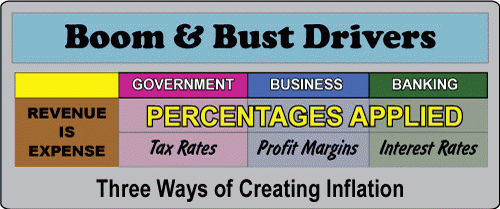
Boom and Bust Drivers by Steve Consilvio
A lot of inflation is hidden on the product side of the transaction. Smaller sizes and goods of lesser quality are sold at the same price as before. While the price did not change, inflation did occur. More goods can be produced faster. Manufacturing skill can sometimes mask an inflationary rise, which is why efficiencies are lauded. Another approach is to find cheaper labor, so the worker carries the burden of inflation rather than the customer.
Compounding percentages have deadly consequences.The disagreement over taxes is why the colonies revolted against the king. Complaints about taxes are common in history. The Communist Manifesto decried industrialism and the descent of men from serfs into paid wage laborers. It was an attack on private ambition and the quest for endless profit by corporations. Our complacency with interest was a main reason why America was attacked on 9/11. Osama bin Laden lays out this complaint in his Letter to America in October, 2002. All three movements are responding to disparities created by the application of percentages. Like the Supply and Demand Theory variants, revolutionaries tend to blame one sector of society, rather than examine how all the elements interact.
Any percentage, no matter how small, or where applied, will eventually result in doubling.The rate of compounding is variable, but not the result. Nations develop massive inflation and debt values because of incremental cause and effect. Corporate and individual debt and wealth accumulate in the same manner.
Albert Einstein discovered the Rule of 72, which calculates the amount of time required to double the principle, based on the percentage rate of a loan. The same formula can be applied wherever percentages are used, not just to loans. A 10% markup doubles the value of an apple more slowly than a 50% markup, but the price will eventually compound. How we handle money and apply percentages has consequences. The difference between a pricing equilibrium and hyperinflation is the difference between renaissance and civil war.
Monopoly
The best known model of boom and bust cycles is the game Monopoly. Henry George was an economist of the late 19th century, and the game was meant to demonstrate his idea that increases in land values impoverish society. It was originally called The Landlord's Game, and was not intended to be a game for fun. People were supposed to learn how society creates the rich and poor as a byproduct of trade. Except for one person, everyone goes bankrupt. It reveals something anti-democratic in the economy. One person will gain all, and everyone else will lose all.
Monopoly is best understood as a generic mathematical model, rather than a land or rent exchange. It does not matter what good is being bought and sold. Monopoly demonstrates that inflation causes wealth to concentrate. The rich and poor are created by mathematical forces, not by political privilege, intelligence or hard work. The winners and the losers are all behaving the same way, so there is no reason to blame anyone specifically for the result. We The People are responsible.
The beginning of the game is the boom cycle. Everyone appears to be getting richer together. This is the Keynesian approach, with the bank pumping more money into the game. Pent up demand is released, and buyers start buying. At this point, nobody owns any much property, so the players are equal. Slowly advantages form, as a result of luck with the dice roll. Eventually a tipping point is reached and the bust cycle begins. The bust cycle is not universal. There is the one person who is gaining from everyone else's losses, which serves as "proof' that the boom cycle is not dead. The data is being misread. The bust cycle is when the rich get richer, and the poor get poorer. It sets the stage for civil war and revolution, not just the end of a game.
The rags to riches phenomenon is considered to be a strength of democratic-capitalism. It is actually a symptom of dysfunctionalism. Rising to the top is not freedom; it is the process of desperation. Volatility causes the rich to fall and the poor to rise. Neither extreme would exist in a properly managed commonwealth.
Probably unwittingly, Monopoly is a model of two allegedly different economic systems: capitalism and socialism. It is capitalistic because everyone is free to buy and sell in an entrepreneurial way. It is socialist because everyone is paid the same amount: $200 for passing GO.
Monopoly is also a perfect democratic model. People start as equals, and the laws apply to everyone equally. There is no graft, vice or corruption, or advantages for wealth, power, tradition or age. There is no emotional manipulation or advertising. People do not age or die, or increase or decrease their buying habits. It is a stable and predictable economic environment. Fellow players are honest. There is no government or overhead of checks and balances. It is a free population with one simple need, randomly chosen by the roll of dice. Despite this simplicity and utopian beginning, it is not long before the wealth divides and the economy collapses.
The compounding of profit for one player is the compounding of loss for other players. It is the buy-low sell-high cycle that is being compounded. The conclusion is inevitable: inflation and debt. We are following a path of mutually assured destruction through competition, rather than mutually assured production and consumption through cooperation. Monopoly demonstrates a mathematical phenomenon that we ignore at our peril.
Capitalism & Socialism
Historically, we have seen capitalist systems move towards socialism, and, socialist systems move towards capitalism. This is not a coincidence, both systems are more similar than different. They start at opposite extremes in terms of private ownership of property. Capitalists want to liberate greed, wheres the socialists seek to restrain greed. In capitalism there is limited planning; under socialism there is an abundance of planning. Planning and budgeting is akin to controlling what numbers can be thrown on the dice. It does not change the mathematical formula of the game. It only impacts the arrival date of the inevitable outcome. The capitalists move toward more planning and more regulations, the communists move toward less planning and less regulations. Both are copying failure. Neither regulations, nor the lack of them, can work. The math is incorrect.
Regulated Economies
Monopoly splits the difference between a regulated and unregulated economy. There is a diversity of rents from inexpensive to expensive. It uses a fixed price model so inflation is limited. Once the properties are developed to include hotels, all inflation stops. The steps to arrive at that point, however, are more than enough to determine the final outcome. The players would need a lot more than $200 for passing GO to survive, especially if they lack ownership of a property group. That is the situation for every new generation.
In a game without property groups, it is important to recognize the condition of the bank. If the property is equally distributed and undeveloped, no players will go bankrupt, but the bank will eventually collapse. Agrarian societies represent a slower model with fewer land transactions and smaller populations, but old monarchs failed financially the same way as modern governments and large societies.
Once money is considered to be more than a chit, and has its own value, collapse is inevitable. The three sectors of the economy, government, businesses and private individuals, are each powerful enough on their own to destroy the economy. Everyone is connected to whatever debt exists, the struggle against inflation, and the looming bust cycle. Freedom can only work if everybody follows the same Golden Rule.
Our society, like Monopoly, guarantees few winners and many losers. This is not a logical way for any nation to be organized. The ideal of commonwealth is peace and prosperity for all members of society. To give the next generation a better world than the one we were given, then we must change the rules of the game. We need to teach something better than what we were taught, and change our accounting habits.
Revolutions
Revolutions are successful civil wars. Unsuccessful civil wars are regarded as uprisings. Both sides feel strongly that their way is the best way.
Civil wars are generally an attack by the middle-class against the upper class. An up-and-coming leader seeks recruits who aspire to have more. The young get involved because they have the most energy, nothing to lose, and the most to gain. They are also the easiest to sway with a lie, the cheapest to bribe, and, being young, lack self-awareness. The poor seldom get involved. They do not have the luxury of time, wealth or education to organize.
Revolutionary leaders rise to power using violence, and by following the same habits of the people they seek to overthrew. Violence is never enlightened, whether from above or below. It does, however, mark the point where the problems caused by inflation are no longer sustainable. The boom and bust cycles have reached a critical mass of too many crises, too fast and too deep, and the social fabric has disintegrated.
The boom and bust cycle represents the birth and death of communities, businesses and nations. Every war is either a civil war, or, following a trading route into a civil war. The rebels start by building domestic support and eventually reach out to the government's trading partners, or trading enemies. The new government begins indebted to whomever gave them support. When and if the old debt is forgiven, it usually arrives with new trade contracts.
It is a basic component of American foreign policy to build other nations in our image. Money grants and loans are distributed to governments in a manner similar to angel investors and venture capitalists funding the next big invention. The government then pays that money to American multi-national corporations to build airports, harbors, and roads. Other private companies arrive to invest to build factories and mining sites. The oil companies, especially, have a world-wide influence. If America has a trade imbalance with the country, then it can be partially corrected with armament sales and security training. Debt forgiveness always come with political concessions. Instead of being in debt to America, foreign nations are often in debt to American banks and corporations. This is all possible because America represents all sides of the supply and demand equation. It is the largest buyer, the largest seller, has the most protected products and the most money. Despite having many advantages, it is not capable of maintaining a stable economy either for itself or the rest of the world.
America does not consider itself imperialistic, because it has high ideals of freedom and self-determination. It advocates free trade, freedom of speech, freedom of religion and freedom of assembly throughout the world. Free trade is only one component of many, yet it is invariably trade that generates the most trouble among all people.
Rebellion does not make a nation strong and wise; it often marks a point of weakness and stupidity. Some nations languish in this state for decades, if not centuries. The leader of one nation that was controlled by American influence described it as being held by two nooses. If the multi-national pulls out, then their economy becomes even worse, but if they stay, the situation is untenable. Everyone around the world is trying to satisfy the budget conditions. No one has been successful. The sword has been as ineffective as the pen. The problem is with the numbers.
Monopoly demonstrates that the economy will be the same no matter who is in charge. An economy with profits, interest or taxes will fail eventually. All compounding percentages are critically important. All revolutions have sought a more just society, and have been for naught because of a lack of mathematical clarity.
Authors Website: www.behappyandfree.com
Authors Bio:
Steve grew up in a family business, was a history major in college, and has owned a small business for 25 years. Practical experience (mistakes) have led him to recognize that political rhetoric and educated analysis often falls short of reality. TAX Your Imagination! is the name of his first book, which he hopes will be a series. Two hundred years ago, it might have been called Commonsense. Thomas Paine, Henry Thoreau and Edward Bellamy (author of Looking Backward) would have been his best friends, if given the opportunity. He is a deep thinker with a light heart and a quirky sense of humor. If you want to categorize him, he is a neo-transcendentalist. Balance and simplify!