| Back OpEdNews | |||||||
|
Original Content at https://www.opednews.com/articles/The-Future-s-So-Fracked-W-by-j-dial-130529-283.html (Note: You can view every article as one long page if you sign up as an Advocate Member, or higher). |
|||||||
May 29, 2013
The Future's So Fracked, We've Got to Wear Masks
By j dial
Might noxious fumes be unhealthy for you, your children, and your animals? It's not such a straightforward question, you know.
::::::::
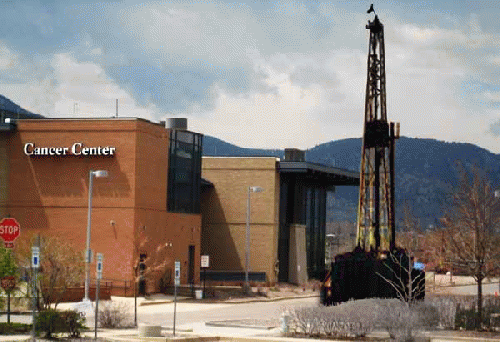
Fracking the Cancer Center by jdial, photo credit
I was under the impression that the tenor of this lecture series on hydraulic fracturing at the University of Colorado was to be neutral. Yet all but one speaker, scientist Gabrielle Petron, ranged from shoulder-shruggingly resigned to essentially aquiver over fracking. The new neutral, it seems, is see no, hear no, speak no, and negatives need not apply.
Where did Bernie Goldstein[1], a public-health physician, stand on this moiety? Well, he began his talk, titled Does Living Near Hydrofracturing Activity Put Our Health at Risk?, by announcing that there is no way we'll get over our need for fossil fuels in the next several decades, and that in that time every tight-shale formation in the US will entirely be drained of its bounty to fuel our every need. These continental tight-shale formations are ours, all ours, with no other nation able to get at them them (unlike the floor of the Gulf), so we can take our time. As for the Gulf, there we'd better get busy, before anyone else gets ideas about what is rightfully ours.
During the Gulf spill--remember that slow-motion, ongoing calamity?, which Goldstein wrote about, British Petroleum whose rig exploded was adamant that constituents of Corexit, the chemical applied by the ton to make the oil disappear (but not go away), remain unknown. Goldstein believes that industry hurts itself with excessive opacity around its practices; he said BP needn't have been so secretive. I find that sentiment puzzling since Corexit turned out to be more toxic than the gushing oil itself (a peer-reviewed study in Environmental Pollution reported that crude oil combined with Corexit becomes 52 times more toxic), disrupting the food chain of the entire region.
Meanwhile, back on the land ...
As to the burning, no pun meant, question of whether proximity to noxious fumes might have a negative impact upon one's health, well, it's complicated. First some geology. In these talks and elsewhere we've heard about shale gas and tight shale. They are both unconventional resources within which natural gas was fairly well corked until hydraulic fracturing released the genie. In both instances, shale gas and tight shale, natural gas is secreted in tiny pockets within layers of rock like air pockets in baking bread, as poetically told by Shell. There is need for chemicals to "slicken" and make penetrable the fluid going down, where it mixes with more bad company before it all eructates.
As Cornell University's Anthony Ingraffea points out, most other manufacturing from automobiles to Xeroxes is ensconced inside buildings within zoned industrial areas. Now the hydrofracturing industry locates their industrial spaces inside our fields and forests, beside and above our waterways, and increasingly proximate to our schools, hospitals, and homes.
Goldstein did not spend much time on the medical effects of fracking on people, ostensibly because there is not much data. Data is scarce because the industry is not providing it and actively prevents its egress. Although Goldstein soft-pedaled this question, other toxicologists are not so sanguine; this website provides information and advice to people whose lives have been disordered by gas extraction.
One did slip by. During three years of monitoring, McKenzie and colleagues at the Colorado School of Public Health found potentially toxic chemicals airborne near wells in Garfield County, Colorado, and concluded that it is worse to be closer than further from well sites.
At least that's settled.
Goldstein does have one quibble with fracking. What goes down may be unpalatable to folks other than Governor Hickenlooper, but what returns is worse--saltier than seawater, pregnant with metals, and often radiogenic. Goldstein thinks there is too much emphasis on formulas for fracking fluid and too little on what flows back, although, being from Pennsylvania, he envies our ability here in the West to insouciantly inject that nasty stuff back to the bosom of the earth. They can't do that there; geology won't let them. Geology might not let us do it anywhere, but it may take time to notice.
Flowback might be further complicated by what happens when chemicals are exposed to high underground temperatures. Toxicologies might change. Synergies might form and, gang-like, further imperil.
The doctor differentiated "accidents" such as a rig being hit by lightning or a raging bull and "incidents", which are accidents that would have been preventable had attention been paid. To prevent incidents, Goldstein allows, the industry needs vigorous oversight.
Speaking of which, there was a recent incident near Parachute, Colorado. It really wasn't so recent. It was some time around March 2013--it was not announced--that Williams Energy spilled over 240 barrels of a mysterious "liquid natural-gas product" into the ground. And speaking of oversight, the Environmental Protection Agency put the perpetrator, Williams Energy, in charge of the clean-up and of protecting surface water. Yet benzene levels in Parachute Creek have crept above levels that are safe to drink. However, the state doesn't consider the creek a source of drinking water (did someone tell the wildlife?), and no fines were levied. With oversight so vigorous, no wonder people chafe.
Public-trust issues positively plague the natural-gas industry. Take the psychosocial effects of fracking--discomfiture induced, for example, when people receive false or incomplete pre-lease information, somewhat like the pledges of a swain that disperse once the ink is dry. Did I mix my metaphors? If nothing else, contradictory assertions breed confusion. You'll hear that fracking has been around for 60 years, and you'll hear about the fantastic new watershed of fracking. Now that the easy pockets of gas have all been had, changes to technology were necessary to extract gas from non-porous shale. So we have high-volume slickwater hydraulic fracturing, a new and unconventional twist to an old and conventional practice. Sixty years of experience with this technology the industry does not have. It is more like ten.
If you're a landowner being courted for your mineral rights, you may hear a lot of things but miss hearing others. You'll hear that fracking, with its noise, pounding, dust, lights, fumes, and trucks, lasts but a few short weeks. Surely such distress could be tolerated for a few weeks. What you don't hear is the words "per frack". Since one site can contain twenty wells or more and each well can be fracked and fracked again, some landowners begin to feel that they may have been had.
You'll hear that there are no proven cases of groundwater contamination from fracking, and you'll see pictures of people igniting their faucets. The problem, Goldstein says, is in the focus. Drillers focus at the point of fracture, a mile or more beneath us, a point so removed it could not possibly foul groundwater. (That is debatable elsewhere.) When casings fail, when hoses break, when liquids splatter, that isn't fracking; those are accidents. Or incidents. Whatever they are, they are part of the process of hydrofracturing, and some of these incidents most assuredly have contaminated ground- or surface waters. Anyone making the assertion that fracking cannot contaminate water, is, to put it kindly, equivocating.
You'll hear industry profess that benzene is only one percent of fracking fluid. Doesn't sound like much. Let's see--One percent of five million gallons of water equals fifty thousand gallons. Per frack. That's quite a quaff of benzene. The legal limit of benzene in drinking water is five parts per billion and there's a reason for that (the reason being that, back in the good old days, people in the EPA actually did feel a duty to protect the public health, and corporations complied if grudgingly; how times have changed).
You'll hear that chemicals going into the ground will be disclosed so that communities can get baseline measures of that which must be monitored. That was planned for public land, as the Bureau of Land Management snarled its intent to impose strict new rules for fracking. Then, without warning, BLM untoothed itself by removing that requirement. As to pulling teeth, its own, it was not done yet. Rather than requiring drillers to test the integrity of cement casings in every well, BLM will consider it done when a driller samples one. Surely one sampling suffices.
Put that into your public trust and stoke it.
Will states step in to protect public health? In Pennsylvania, drillers must disclose to any health professional who inquires the identity and amount of any chemicals they use. But in return, such health professionals must sign confidentiality agreements that prevent them from revealing that information to anyone else--particularly patients. It's only fair, isn't it? It's the law in certain states and, if the industry has its way, gag orders will become ubiquitous. In Pennsylvania that provision was not in the original version of the legislation; it was added later, and many never even knew. That's what happens when lobbyists write legislation and ride legislators like chattel.
At the national level, following the oil-and-gas industry's exemption from the EPA's Toxics Release Inventory (informing communities about what companies are inserting in their air, soil, or water), as well as from EPA regulation under the Safe Drinking Water Act, EPA has asked drillers pretty please to release more information about the chemicals they use. Which they're happy to provide. Except, of course, for trade secrets. That's what happens when corporations own Congress.
Goldstein has one five-letter recommendation for anyone courted by would-be frackers: stall. Techniques are improving; practices and safety are getting better; we have solid oceans of shale beneath us; so be patient; be coy, but be available. And then, when the time is right, go for it. That's his advice.
Despite the record of previous speakers in this series, I thought an environmental toxicologist would be a little more circumspect about the effects of fossil fuels not only on public but on planetary health.
Maybe there's a reason that this man and the other invited speakers in this "neutral" exploration struck me as being so industry-friendly--because they are. After all, a sponsor of this event is AirWaterGas.org. The emphasis is on Gas and the joke's on me. The moderator of these talks, Patty Limerick, is the project's outreach leader. She has written books on water in the west, but somewhere along the line her water was flavored--or was it fracked--with Kool-Aid.
There is of course another possibility. Maybe all these people who, despite what is happening in front of us--freak-weather calamities, melting glaciers, overfished and poisoned oceans, slashed, burned, clear-cut, beetle-killed trees, dying amphibians and bees, mass animal extinction, acidification and ozone holes, desertification and floods, resource wars just starting, human overuse and overpopulation and corporatization and overconsumption going full tilt--have I left anything out?--those who despite all that now would unearth and exploit yet another now-abundant fossil fuel, pushing Peak Oil further out, warming the air that much more, sealing our fate and the fate of most life on this plundered planet--Maybe those people are right, and those of us who consider that continued and enhanced dependence on fossil fuels is unmitigated aggregate insanity, a cataclysmic and grievous error, the shameless unnecessary end of life as we know it, maybe it is we who are hopelessly benighted. You know where you stand.
For this final talk on whether living near hydrofracturing activity would put our health at risk, well, who's to say. But I'll wager that Bernie Goldstein--and every other speaker in this series--lives no where near hydrofracturing activities.
***
This article emerged from the last of nine planned lectures held by the Center of the American West, CU Continuing Education, Boulder County, and the AirWaterGas Research Network (of the National Science Foundation/Sustainability Research Network) on various aspects of hydraulic fracturing.
Past articles from this series:
Everything You Always Wanted to Know About Fracking But Should Be Afraid to Ask--An Overview
Fracking: Water Issues--Colorado-centric, But Applicable to All
Who the Frack's Really in Charge? (regulation)
Water-Free Fracking--Why Not? (LPG fracking)
Frack-Flavored Gas (trials of Garfield County, Colorado)
What the Frack Do We Know? (more on water)
Have Another Hit of Fracked Air
Frackonomics (it's the economy, y'all)
[1] Bernie Goldstein is Emeritus Professor and former Dean of the University of Pittsburgh Graduate School of Public health. An environmental toxicologist, his research interests have largely focused on the concept of biological markers in the realm of risk assessment. His publications involve blood toxicity, formation of cancer-causing substances after exposure to inhalants, aspects of public-health decision-making, and global issues in environmental medicine. He has also studied and written about the 2010 Gulf oil spill.
Authors Website: http://medicalink.com
Authors Bio:
Schooled in psychology and biomedical illustration, of course I became a medical writer!
In 2014 my husband and I and our kitty moved from Colorado, where Jerry had been born, to Canada, where I had been. (Born.)