| Back OpEdNews | |||||||
|
Original Content at https://www.opednews.com/articles/Little-Free-Libraries--A-by-Burl-Hall-130521-837.html (Note: You can view every article as one long page if you sign up as an Advocate Member, or higher). |
|||||||
May 21, 2013
Little Free Libraries: A Community Builder for the Future?
By Burl Hall
In today's world, there are several ways people are becoming more self-sufficient and less dependent on corporations and government. Some of these community movements are known as Transition Towns, Permaculture and there are others. This article explores this movement in relationship to a rapidly growing community based business, "Little Free Libraries".
::::::::
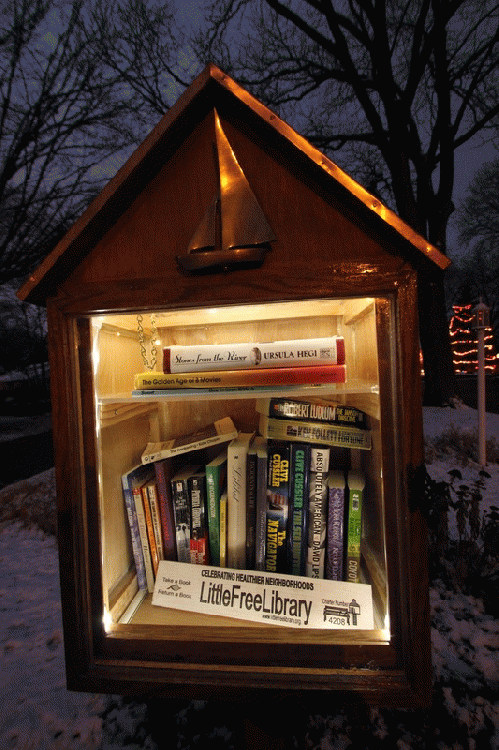
Little Free Library by Little Free Library
Ours is a world grounded in the philosophy of reductionism. Wikapedia identifies reductionism as a philosophical position which holds that a complex system is nothing but the sum of its parts, and that an account of it can be reduced to accounts of individual constituents. This can be said of objects, phenomena, explanation, theories, and meanings. The philosphy of reductionism is part and parcel of a more holistic movement that has saturated the western world since at least the time of Descartes, and, according to many, Plato. It is a fundamental meme of industrial-technological culture. It is this author's belief that reductionism has been used in accordance to the "divide and conquer"ethos as evidenced by the divisive arguments and theatrics of mainstream news shows on Fox, CNN, and others. It is in this fashion that they are able to keep the population mesmerized in drama shows, while also presenting commercials that are often sexualized and which place human beings into roles of being mindless clowns who maintain a physical model of a person who is anorexic. These advertisers count and define (confine) us as "consumers."
In modern days, reductionistic and divisive philosophy continues to remain unquestioned in the mainstream culture. However, in recent years, the development of systems thinking has provided methods for tackling issues in a holistic rather than a reductionist way, and many scientists understand the unity of the whole. These are people like physicist David Bohm, neurologist Carl Pribram, and psychiatrist Carl Jung. The beauty of understanding the work of people like Bohm, Jung and and Pribram is that one can see this pattern mirrored in the variety of expressions of the reductionistic mindset. In other words, behind all the various reductionistic ways of viewing the world, there is a pattern. While most people are pretty much unconscious of this pattern of looking at life, many philosophers, visionaries, and even economists and entrepreneurs are deconstructing the pernicious memes that blind us to holism.
This evolving holistic view is expressed beautifully by epistemologist Gregory Baeston who discusses our need to "identify the pattern that connects." As part of this pattern of not knowing the pattern, we have lost our ability to understand the wholeness of Nature and how everything works in its life and death for the sake of the planetary system. Everything relates. As Baeston asks: What pattern connects the crab to the lobster and the orchid to the primrose and all the four of them to me? And me to you?"
We, en mass, simply do not get the patterns that connect; we remain in thrall to a corporate-induced hypnosis. This occurs across the spectrum of our lives and includes how we interact in community with the rest of the world. In this world dominated by reductionistic philosophy--especially in politics, corporate behavior and behavioral sciences--we have diminished the power of individuals and their communities to become self sufficient and expressive. What has happened instead is that we have kindled and allowed a world to unfold in which we have become dominated by global market systems and large scale governance. We have succumbed to empire, blind to the fact that the emperor has no clothes. Reductionism via capitalism has conquered the world yet maintains a "this vs that" attitude as evidenced by the continuous conflicts in the middle east and throughout the world. We consider all pockets of resistance to our mass hypnosis as uncivilized, primitive, subversive, terrorist, or just plain wrong. We are induced to fear and, therefore, either obliterate or convert them to our orthodoxy.
There is hope; however. In today's world, we have visionaries of a more holographic reality that (a) are cognizant of their own patterns and (b) counter the unconscious and prevalent patterns exhibited by reductionistic thought. Some of these include movements such as Transition Town, Permaculuture, and Little Free Libraries. While to the observer locked into the reductionistic model of Nature can't see the pattern, those that see the holographic and can gaze upon these diverse expressions and find a unifying thread, in much the same way Baetson saw the pattern that connects lobsters, crabs, orchids, and primrose to us! Perhaps this is also reflected in many spiritual teachings regarding the "Flower of Life" throughout various mythologies of the world? (see link below for more information)
The connective purpose of these movements is to help people understand the relationship of part to whole while also serving to develop local communities that function harmonically with Nature. They also subscribe to empowering individuals within their communities, rather than fostering a dependence upon corporate-run governments.
One rapidly growing part of this new flowering is Little Free Libraries, whose primary goals are to:
Promote literacy and the love of reading by building free book exchanges worldwide.
Build a sense of community as we share skills, creativity, and wisdom across generations
Build more than 2,510 libraries around the world - more than Andrew Carnegie--and then more.

Little Free Library Beginning in Africa by Little Free Library
People are loving it. More than 500 new Little Free Libraries (LFLs) crop up monthly on lawns, along routes, and at busy intersections worldwide! The New York Times calls then "miniature lending libraries where anyone can take or leave a book under the honor system."
The originators of the Little Free Library are Todd Bol and Rick Brooks, both of whom have several decades of entrepreneurial and international experience. They first met in 2009 while exploring the benefits of green practices in small businesses, discovering that they shared a commitment to service and the quality of community life around the world. In so many ways, the concept of the Little Free Libraries mimick the holographic concept of the part mirrors the whole. The libraries also align with those recognizing the importance of understanding the local impact of global patterns.
Todd Bole is described as a pioneer in international trade, business and nursing education. It appears his talents go even deeper, for Todd also applies his carpentry and business skills when he built the initial library dedicated to his deceased mom, a librarian. Soon Todd used his craft to build creative multiformed LFLs tailored to each community's personality, while also fostering the spirit of an individual library to reach out into the community. Todd is thus described as a possibility thinker. If any readers who are also possibility thinkers want to contact Todd regarding the building of a library, the phone number and email is listed below.
Rick Brooks, his partner in the LFL venture, has helped raise funds for village libraries in Sri Lanka and Mexico. Rick has been a long time supporter of literacy, social empowerment, youth and community development. Rick facilitates contacts with media, academic and nonprofit colleagues as well as potential sponsors. He recently retired as an Outreach Program Manager in Continuing Studies, University of Wisconsin-Madison. 608-345-0750 Email address removed
According to Todd, once the Little Free Library is established in a state (or country), then can expect requests for five to ten more units to be stewarted by inspired individuals in different neighborhoods. More important than location, a library needs a strong community stewart who is able to communicate clearly about the library. Thus it appears that with the libraries, its not just about "location, location, location," but "person, person, person." Each thriving healthy Little Free Library requires a strong sterwart who is both a lover of books and community-minded. So we can add, it's all about "relationship, relationship, relationship!" Could this also become our motto in how we treat the environment, as well as each other? Or do we continue to lead the divisive ethos of reductionism which leads to isolation and alienation, fear of stranger-danger, and perhaps even the extinction of the human race?
Around each LFL neighborhood friendships sprout up like wild flowers. More than books are exchanged. The Little Free Libraries help community members to network with each other. The library becomes a community or neighborhood center. Indeed, according to Todd, people find that those that borrow books oftentimes leave goodies like cucumbers, plants and flowers in exchange for a wonder-full trip into the creative imagination of an author. How appropriate!! What are books if not food for thought? Thus, cucumbers are an appropriate "thank you" for giving one that inseminating priciple that books tend to give us. Of course, each person that is encouraged to take a book is also encouraged to leave a book.
The LFL system thrives on reciprocity. What a revolutionary concept! Could it be that "Little Free Libraries" are seminal to the generation of local commuty empowerment? Could this intensive intimacy of taking part in a natural process of relationship be an answer to the corporate "divide and conquor" mentality that has us bonded to the divisive mechanisms of television and computer screens? How much longer do we remain complacent and compliant with maintaining a zombie state of indoctrination? Could it be that Little Free Libraries are significant markers along the path towards reclaiming our freedom as well as fostering a sense of belonging and purpose in a community that includes not just people, but the entire ecosystem of which we are a part? Reciprocity among all members of an eco-system is much more prevalent in nature than competition. The fittest are those who fit in the best, not those who stand out and try to dominate the others.
The Little Free Library started when Todd decided to honor his mother soon after her death through building a Little Free Library. His wife June helped out by putting on a yard sale. As people came to the library, Todd states he found people talking to the LFL s as if they were a newly born puppy, hugging them, and sharing photos of family and friends taken with them.
As the buisness of doing a Little Free Library is organic, then so is how it developed. In essence, after the initial LFL was "planted" 7,000 libraries have taken ground across the world. That's almost triple the number they needed to fulfill their goal of matching their hero, Andrew Carnegie, in library building. Indeed, the statistics have 500 -- 700 new libraries being added per month. That's 500-700 more community or neighborhood centers or gathering places per month! Could we be experiencing the rebirth of the village green?
Mm, as I think about this, I wonder about supporting community theaters, concerts, etc to take us out of the corporate controlled arenas such as record labels and chain book stores. Think of how less alienating it is to go to a LFL and talk about one's passion vs pressing an order button on Amazon.com! Indeed, it appears that Little Free Libraries are holographic reflections of Transition Towns, Permaculture Gardening and other movements that kindle community, family, neihbor helping neihbor, and self reliance while diminishing the reliance on megalithic corporations and government.
In Global Warming and your Mental Health Alicia Sparks states:
If you keep up with news that's related to both your mental health and the environment, you might have stumbled across this Boston Globe piece: Climate Change Takes a Mental Toll. In it, Emily Anthes describes the mental toll events like global warming and natural disasters can take on us. The anxiety, trauma and depression such events (and even the possibility of such events) can cause some people seriously impacts the quality of their lives.
To that I would add that climate change is but one part of the holographic (or is it hell-ographic?) pattern inherent in constant worldwide warfare, high crime rates, corporate and government corruption, and the deterioation of well functioning communities and families. All these modern plagues, threatening us and our beloved earth, are part and parcel of one movement toward hell-on-earth. Climate change is related to our sense of alienation which is intimately related to our commercialism and our being dominated by corporate powers that have a stranglehold on the government. Our perception these global powers is that we are powerless in the face of their megalithic wealth, military might, and mass-media control. But, as programs such as the LFL teach us, we do indeed have power within ourselves and within our communities. Grassroots DO split concrete!
Our hands have an interesting build that reminds us where the power lies. If we point our finger outwards towards Capital Hill or towards Wall Street, we find that we have 3 fingers pointed right back at ourselves. The design of our hand's is God and Nature's way of saying we have the power, not those external to us. Those same hands can begin building new LFLs and other neighborhood structures and systems in the same vein. The power is within us within our communities. Legislating businesses to do good just doesn't cut it anymore. Being power-full in one's self and community is the only way to reclaim power.
The saying "Think global, act local" is not only true for growing and buying one's own food, but also for how we interact in our natural and human communities. The phrase refers to everything from food to reading to education to health care. As books can be a part of a local community--brought down to accessible, affordable, sustainable scale--so, likewise, can doctors, artisans, courts and education. Thus, LFLs are holographic reflections of a movement underfoot that has had an influence on science, spirutal teachings and philosophy. As these human-scaled, ergonomically designed, grassroots innovations proliferate, more people will become able to see the connections and understand the holographic patterns in how we relate to Nature and to each other. Perhaps, then, we can move beyond the "divide and conquer" ethos can make way to "unite and prosper." Prosper how? Dare we look at how much our materialism costs us in the deeper human values of feeling connected to self, family, community and Nature?
It is unfortunate that most people refuse to see religion according to its epistemological roots, which is religere, meaning to connect. Religious institutions, as they now stand. iare the furthest thing from true religion that one can get. The true form of religion is in programs like the Little Free Library. It is not religion in terms of its spouting a philosophy or theology. Rather it is in the development of community and the intimacy of a mind-enhancing read. Let's go back to "wherever two or more are gathered together in my Name." Would a good place for that be on your front lawn or at your nearby intersection? Would a good "temple" be your unique design for a Little Free Library?

Little Free Library Staff by Little Free Library
Links
Interview with Todd on Envision This!: http://www.blogtalkradio.com/envision-this/2013/05/19/little-free-libraries-right-in-the-neigborhood
To contact Todd regarding building and maintaining a Little Library: 715-338-2223
Todd's email: Email address removed
Little Free Libraries: http://www.littlefreelibrary.org/
World Series Consulting: http://www.worldspiritconsulting.com/
Species Extinction Rates: http://www.whole-systems.org/extinctions.html
Gregory Baetson: http://www.interculturalstudies.org/Bateson/index.html
Joseph Campbell: http://www.jcf.org/new/index.php
Carl Jung: http://en.wikipedia.org/wiki/Carl_Jung
Daniel Quinn: http://en.wikipedia.org/wiki/Daniel_Quinn
Chellis Glendenning: http://en.wikipedia.org/wiki/Chellis_Glendinning
Flower of Life: http://en.wikipedia.org/wiki/Flower_of_Life
Authors Bio:
Burl Hall is a retired counselor who is living in a Senior Citizen Housing apartment. Burl has one book to his credit, titled "Sophia's Web: A Passionate Call to Heal our Wounded Nature." For more information, search the book on Amazon.
Burl's philosophy entails the idea that "everything effects and causes everything thing else." His spirituality of Sophia i.e., Wisdom is universal as well as within each of us. He also sees the idea of Chaos as not being "all over the place" but as infinite relationships.
The question I present in my articles speak not so much towards the politicians, but how WE the people can empower ourselves within a planet that is healthy, wealthy and wise.