| Back OpEdNews | |||||||
|
Original Content at https://www.opednews.com/articles/How-The-One-Dollar-Coin-Ca-by-Clifford-Johnson-130515-443.html (Note: You can view every article as one long page if you sign up as an Advocate Member, or higher). |
|||||||
May 15, 2013
How The One-Dollar Coin Can Cure The Economy
By Clifford Johnson
This article, written for those well-informed re monetary policy, supports a longstanding proposal to replace all Federal Reserve one dollar bills with one dollar United States coins. It quotes at length a related lawsuit against the Treasury now before the Ninth Circuit court of appeal. The complaint and briefs on appeal are available under the Treasury menu at commondada.com.
::::::::
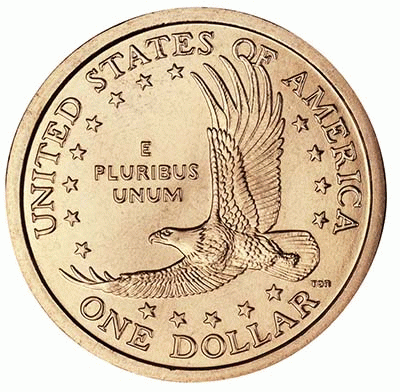
One Dollar coin, back by public
Look after the dollar and the trillions will look after themselves.
NEW YORK, Cooper Union, May 12, 2013 -- As the most recent debt ceiling deadline drew close, the extraordinary proposal to pay off public debt with a fistful of trillion-dollar coins momentarily gained traction. Pundits pointed out that, to avoid default, the President could unilaterally so order, based on the arguably controlling 14th Amendment mandate that "[t]he validity of the public debt " shall not be questioned." Obama was ultimately obliged to respond. He did so by squelching the idea conclusively enough to reinforce the popular perception of the trillion-dollar coin as an absurd and academic gimmick. This pamphlet construes the episode as an early teaching moment, on which to build.
The trillion-dollar coin proposal gave subtle notice that the government does not issue the nation's paper money; and it drew the nation one notch closer to realizing how, by similarly issuing trillions of dollars in paper and digital money, private banks garnish from the public amazing sums -- sums that operate as a hidden flat tax on the nation as a whole, which under the constitution should be used only for the general welfare, and would be, if those sums were instead issued by the government, the same way that it mints coins. This article proposes to advance the public's education by one more conceptual notch, re paper money. Fractional expansion of the currency through digitized credit accounting is a concept not reached. This focus on cash avoids theories as to banks earning the sums they garnish, by applying expertise in its distributions. Paper money issues wholly automatically, to meet global demands for ready cash.
However, the notch of understanding I propose is not modest. It is the jolting realization that banks routinely perform the trillion-dollar coin trick for themselves, by issuing the nation's paper money as banknotes; so that, in effect, simply deleting the smaller words "Federal Reserve Note" from all new and replacement paper notes would rapidly, dramatically and justifiably retire public debt. I have recorded a lyrical video noting how the words "United States" would then stand proud, true and alone. Treasured Notes, YouTube. Naturally, the public presently takes at face value the Treasury's misleading mantra that "United States Notes serve no function that is not already adequately served by Federal Reserve Notes," which appears three times on its website. Given the grandiose "United States" captions on both sides of every Federal Reserve note, to the bamboozled public this fundamental falsehood seems as true and trite as a tautology.
For the purpose of public education as to the game-changing, debt-dissolving advantages of true United States currency (coin/note/digital) over Federal Reserve currency (note/digital), the trillion dollar coin has been somewhat self-defeating. The immense value per coin, while garnishing headlines, by the same token seems so frivolous that central bankers (and their government minions and economic entourages) are even happy to draw attention to it. Without requiring any explanation, merely citing the trillion-dollar coin is enough to draw ridicule upon those who rationally support the underpinning possibilities of truly public money supplies.
But not all is lost. Through the trillion-dollar coin, the public has implicitly been exposed to the underpinning fact that there is something structurally different about minting coins, versus printing money. The foreclosed trillion-dollar coin debate can now be exploited to explain and explode an ongoing one-dollar "coin-swap" controversy, transforming the public's vague awareness of some key distinction between coins and notes into a concrete realization of the fundamental difference between United States currency and Federal Reserve currency. This message is heavily underscored by underhand anti-coin activism at the Federal Reserve. Why do you think the 1979 Susan B. Anthony dollar was so similar to a quarter that its production soon had to be halted? An ex-Mint chairman's grouse re more recent "barriers" to distribution is at http://financialservices.house.gov/uploadedfiles/hhrg-112-ba19-wstate-pdiehl-20121129.pdf .
In complete contrast to their perfunctory ridiculing of the trillion-dollar coin concept, the Federal Reserve and the Treasury are so afraid of what the public might learn from the one-dollar coin that for 22 years they have painstakingly mentored a series of 8 GAO reports that grossly understate the financial benefit that would automatically accrue to the government by replacing all one-dollar Federal Reserve notes with one-dollar United States coins. In the GAO reports -- or rather, in regularly attached Treasury and Federal Reserve letters of comments -- what began as a successful strategy of damning the dollar-coin by falsified faint praise, has become falsified direct damning.
In 2012, citing the arbitrary exclusion of seigniorage from CBO budget scores, the seventh GAO coin-swap report (GAO-12-307) contained a section headlined: "Without Counting Seigniorage, Switching To A $1 Coin Would Result In A Net Loss." The word "net" is inappropriate, since it imputes full inclusion. Next time, let the GAO add a section entitled: "Counting All Seigniorage Shows A Net Public Debt Reduction In Excess Of $58 Billion." Make no mistake. The GAO's coin-swap reports represent a hot battleground in a mostly undercover seigniorage war. Come to the front! "O! Ye who love mankind, stand forth!" (Paine, Common Sense.)
In 1989, the Federal Reserve gave the GAO a coin-swap costing model implant that included a trivial concessionary fraction of real seigniorage revenue. Ever since, the GAO has reproduced that tiny slice of the seigniorage pie, which it presents as the whole pie. To the Federal Reserve and Treasury, this once tolerated fleck of truth has grown into a grating and potentially fatal revelatory mistake. It is now far easier for central banking establishmentarians to blithely assert that all seigniorage should forthwith be disregarded in deference to a CBO accounting convention, than to explain decades of brazen suppression of the vastly larger dollar sums obviously at bar.
How could they possibly explain away a 22 year series of 8 reports that forever fails to state the principal amounts by which the public debt is directly reduced through seigniorage, even though it reports interest relief due on such reductions? The principle reductions necessarily come first, and of course dwarf the actually reported consequent interest relief. Explanation is especially difficult in light of government accounting standards promulgated by the GAO itself, which explicitly require a clear statement of both principal and interest gains and losses, in reporting net tax benefits. And both explanation and excuse are quite impossible in light of the interest relief understatement being no less than a factor of six arithmetical error.
In the 1840s, persistent coin-banknote conflicts resulted in a durable Independent Treasury Act under which the Treasury would not deal in banknotes, owing to incorrigible serial lootings of the public fisc by banks. Today, Ye Olde Seigniorage War is in small but significant part being fought over the puny but resilient one-dollar coin. The dollar coin is the private banking monopoly's Achilles heel, for it faithfully and indelibly preserves the structurally different accounting script under which true United States notes might again issue. The distinct and advantageous option of true United States notes is obfuscation-proofed by pragmatically defining Unites States notes as paper money issued per the accounting procedures under which coins are now issued.
I have narrowly targeted this Achilles heel in a litigation now on appeal in the Ninth Circuit, which seeks a finding of misrepresentation re the GAO's purportedly objective coin-swap net benefit estimates. Johnson v. United States Department of the Treasury, No. 12-16775. Links to the filings are under the Treasury menu at commondada.com. Here is paragraph 8 of the complaint, as drafted in January 2012 (since when there have already been another two such GAO reports):
8. Financial Misrepresentations. (i) Coin-Swap Question. A March, 2011 General Accounting Office report (U.S. COINS: Replacing the $1 Note with a $1 Coin Would Provide a Financial Benefit to the Government, GAO-11-281) answered the following question for Hon. Richard Shelby, ranking member, Committee on Banking, Housing and Urban Affairs, United States Senate: What is the estimated net benefit, if any, to the government of replacing the $1 note with a $1 coin?
(ii) Game-Changing Seigniorage. Answering this question requires costing the seigniorage benefits that automatically readjust when United States currency, coin or note, mixes with and/or replaces Federal Reserve currency. Thus, answering this question on the small scales of coinage implicitly answers it on every scale, including complete conversion of the currency. These benefits are in fact so high that they swamp the benefits that the GAO report instead labors to compute, as follows. Had the face-value seigniorage benefits been properly included in the GAO report, they would have trumpeted the huge and prompt debt reducing advantages of United States currency.
(iii) Model Falsehoods. The 2011 GAO report trustingly adopts a Federal Reserve model which impertinently presumes that the government must operate in debt, and which misrepresents that: (a) when a new $1 coin is put in circulation, the only government benefit is the relief from interest on $1 of debt; and (b) there is no government benefit when a $1 coin replaces a $1 note, because the interest relief from $1 is offset by the loss of interest from $1 in Federal Reserve profits returned to the government. In fact: (a) when a new $1 coin is issued, the government's account is credited with $1; and (b) when a $1 note is replaced by a new $1 coin, the government (when in debt) also obtains relief from interest on 81.5 cents, since the Federal Reserve owns only 18.5% of the debt held by the public.
(iv) Understated Totals. In conclusion, the 2011 GAO report estimates initial losses for four years due to start-up costs, and a net benefit after 30 years of only $5.6 billion, if that. In fact, because coins are United States currency, the government would also benefit from: (a) an early gain of $13.75 billion against the debt held by the public, from replacing the present 9.5 billion dollar bills with 150% as many coins; (b) a further gain in excess of $30 billion from coins added over the 30 years; and (c) a further $14.5 billion gain from 81.5% of the interest relief per note replaced by a coin. Hence, the net government benefit after 30 years would exceed $58 billion, as a matter of accounting fact.
(v) Treasury Cover-Up. In 1990, 1993, 1995, and 2000, GAO reports answered the coin-swap question using the same grossly false Federal Reserve model. Throughout, the Treasury provided guidance and comments that approved the Federal Reserve model as reasonably accurate, while knowing better by long rooted, ongoing accounting practice"
The literally gross and arithmetically slashed falsity of the long implanted Federal Reserve's model for answering the coin-swap question is revealed by the technically correct debate over the proposed trillion-dollar coin. In the last three years, the Federal Reserve has issued a couple of trillion new dollars to private banks (via so-called quantitative easing), during which time the public debt ballooned. Informed people now recognize that, had the United States itself issued a couple of trillion-dollar coins, the public debt would now be less by a similar sum, plus interest savings on that reduction. Yet the aforesaid official model outrageously insists that there is absolutely zero benefit to the government when it issues dollar coins, instead of the Federal Reserve issuing the same amount in notes.
Congress and the media swallow whole the GAO-laundered financial fraud. Last year, Senate Bill S. 2049 proposed to replace all one-dollar bills with one-dollar coins. Based on the grossly underestimated benefit to the government, which all parties accepted as reasonably accurate, the bill died in committee. The latest (eighth) GAO report was the primer for yet another congressional hearing last November, as usual rendered farcical by the bipartisan adoption of the GAO's gross underestimates.
My hope is that once the public is authoritatively informed by the courts, and by you and me, that the Federal Reserve, the Treasury, and the GAO have for decades gone to great lengths to cover up some niggling truth about the pesky little one dollar coin, it will ask itself why, and so come to realize that trillions of face-value tax dollars have long and invisibly been siphoned off to private banks. Perhaps this revelation will lead to new and experimental issues of true United States notes; to the gutting of the public debt; to the unsticking and smoothing of the economy.
Dream on? Not exactly. The one-dollar coin-swap controversy foreseeably entails an eventual tipping point in public awareness.
The question to press is not whether a hypothetical trillion-dollar coin is a joke. The question to press is whether an ongoing official concealment of over 50 billion tax dollars is a joke.
Authors Website: commondada.com
Authors Bio:
Clifford Johnson is a semi-academic naturalized Brit. He first entered the U.S. as a rah-rah Harkness Fellow. For theater, language, and also as a questionable ex-Brit, Johnson adopts a Tom Paine II persona. His activist credentials comprise serial terminations of employment and pro se litigations raising public policy questions.
Johnson claims to be the only person who has sued the Comptroller of the Currency for a failure to regulate a national bank -- the Bank of America -- which he did in the early 1980s.
Johnson's 15-minutes of fame came in the mid-1980s. Then a manager of computing at Stanford University, he sued the Pentagon, challenging the constitutionality of its nuclear hair-trigger "launch on warning" posture, for riskily and unconstitutionally delegating the decision to initiate nuclear Armageddon to a 3-minute computer-governed military drill.
Johnson is currently challenging the Treasury and GAO in federal court, for misrepresentations as to Federal Reserve versus United States currency. The case raises novel issues of law re the government's right to lie.