| Back OpEdNews | |||||||
|
Original Content at https://www.opednews.com/articles/Investigative-Journalist-T-by-Joan-Brunwasser-130403-93.html (Note: You can view every article as one long page if you sign up as an Advocate Member, or higher). |
|||||||
April 3, 2013
Investigative Journalist Tom Nugent Spotlights Medical Whistleblower Jim Murtagh
By Joan Brunwasser
The Wall St Journal suggest[ed] that Georgia judges have "gone wild" in recent years, with conflict of interest having become the order of the day. One of the lower-court judges who often ruled against Dr. Murtagh in a lawsuit involving Emory U. finally recused herself -- but only after it was eventually reported that she has married to a high-ranking Emory official. That's the kind of judicial abuse Dr. Murtagh has faced
::::::::
My guest today is Tom Nugent, Pulitzer Prize-nominated author and investigative journalist. Welcome to OpEdNews, Tom. Your piece Profile in Courage: A Beleaguered Georgia Physician Fights for Patients and Jobs - and Wins profiles my OpEdNews colleague, Dr. Jim Murtagh. What interested you about his story?
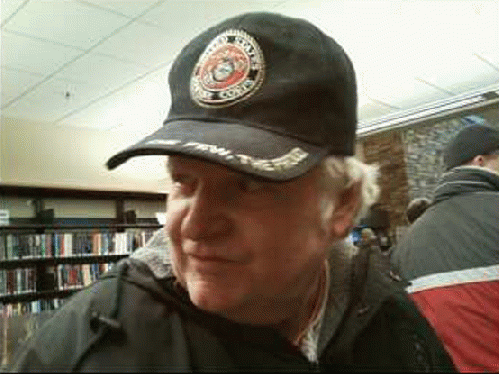
I've spent many years as an investigative reporter. I've written about the impact of coal mining on the lives of people in Appalachia for Mother Jones and more recently, the Huffington Post . I've reported on living conditions at Indian reservations for the Washington Post and the Chicago Tribune.
I wrote about auto-exhaust pollution problems for The Nation. And in most of these stories, there were whistleblowers involved. Most of them were courageous individuals who risked a lot to speak out publicly about abuses.
About twelve years ago, I learned from Dr. Donald Soeken, who has counseled whistleblowers for many years, about Dr. James Murtagh, who was fighting to prove that he had been the subject of reprisals after he agreed to assist federal investigators from the NIH. They were looking into alleged fraudulent manipulation of federal research funds at Emory University in Atlanta.
What convinced me that there was probably merit in Dr. Murtagh's case was the fact that Emory settled with him by giving him $1.6 million. That's a lot of money -- it told me that Emory was concerned enough about Dr. Murtagh's "reprisal" charges that they would pay a great deal of money to end the matter. So I went to work, and it soon became clear to me that Dr. Murtagh was a sincere whistleblower who was trying to live up to his oath as a physician. I started writing about his case and that has continued off and on for several years.
I'm afraid that many of our readers have never heard of Jim Murtagh or what happened to him when he blew the whistle. Can you fill us in?
Dr. Murtagh is a graduate of the University of Michigan Medical School. His outstanding credentials include a multi-year stint in Washington as a researcher in pulmonary medicine for the National Institute of Health. He was a leading researcher and a tenured professor in the School of Medicine at Emory University in Atlanta by the mid-1990s. But that's where the trouble started. Investigators from the NIH reportedly got wind of fraudulent manipulation of taxpayer-funded research monies by Emory researchers. Some of the alleged wrongdoers reportedly worked at Emory's sister institution, Grady Memorial Hospital in Atlanta, as did Dr. Murtagh.
Dr. Murtagh agreed to assist the NIH investigators, and soon after that, he was ordered to submit to an "M.D. peer review" by his colleagues. This highly controversial procedure was designed to uncover bad behavior among hospital doctors -- but it is also used frequently to silence whistleblowers who speak out against alleged abuses at hospitals. During his peer review, Dr. Murtagh was accused of violating strict "do-not-resuscitate" policies at Grady Hospital -- a grave form of misconduct in the world of hospital care.
But he swears he was never given a chance to face his accusers or answer their charges. Eventually, he sued Emory over the matter . . . and won a $1.6 million settlement -- although the university later claimed that he violated the terms of the settlement by "going public" with details about it. The fact that Emory agreed to pay this huge sum speaks volumes about the case, in my opinion.
Way back in 2000, Dr Murtagh began what has been a 12-year struggle to prove that the peer-review accusations against him were false, and that the peer review process was actually a reprisal for his whistleblowing. He recently won a major victory at the Georgia Court of Appeals, but it seems likely that his case will drag on for many more years. During much of the past decade, he contended that he couldn't find hospitals that would hire him (he claims to have been "blackballed" by Emory and Grady), and he often lived a precarious life as a physician who lived from paycheck to paycheck, while hoarding his precious dollars in order to pay endless legal fees.
Dr. Murtagh has long warned that we need to reform medical care in this country, and especially hospital-based peer review, and in an era when the cost of that care is going through the roof, he sounds increasingly like a prophet. Whether you agree with him or not, you have to admit that Jim Murtagh is one of the most courageous -- and tenacious -- whistleblowers of modern times.
I agree, Tom. What kind of message does the way Jim has been treated send to other whistleblowers who find themselves in a similar situation?
Well, Jim's 12-year odyssey as a whistleblower shows just how tough it is to walk the road of truth, freedom and the American way! Obviously, he has endured immense suffering during more than a decade of fighting to restore his reputation and find gainful employment. At the same time, however, I think his journey holds out enormous hope for all those who decide to speak out against waste, fraud and abuse in business and government.
For one thing, Dr. Murtagh has demonstrated -- up close and personal -- that it's possible to endure almost anything, if you truly believe in your cause. And his recent legal victory in Georgia, where an Appeals overturned a lower court ruling that had found against him -- now makes it likely that he will eventually prevail in the courtroom. I understand that he's planning to write a book about his struggle . . . and if that happens, his thrilling story has the potential to go on inspiring other truth-tellers far down into the future.
In the midst of all this, Jim has hosted conferences, is an active OpEdNews editor, and has been networking and developing a consensus with other whistleblowers. It's hard to imagine a person doing all that while, at the same time, trying to make a living and slogging through the court system to defend his professional reputation. Comment, Tom?
I think Dr, Murtagh has a remarkable ability to focus on the next project at hand, even when challenged to the max by peripheral problems that would leave most of us paralyzed and barely able to function. It's the same kind of quality I've noticed in professional athletes. I've written about pro football quarterbacks, for example, who have to process a huge amount of information very rapidly and then act on it -- without allowing themselves to be distracted by threatening or discouraging details in the moment (an onrushing, 280-pound linebacker, for example). I don't think this skill can be taught... the potential for developing it probably resides somewhere in the DNA.
I like your analogy with quarterbacks. This administration has touted transparency but they seem to be going after whistleblowers with unprecedented zeal. How do you explain that phenomenon?
The world of inside-the-beltway Washington for the most part runs on ruthless expediency. There are some valiant individuals struggling there to honor the values we are supposed to live by -- due process, the rule of law, no torture, no illegal surveillance, etc. -- but the structure, itself, is deeply flawed.
Whether the Dems or the Repubs are running the government, the ends usually justify the means, and the "system" will protect itself most of the time. So it's no surprise to find that the current executive branch is ready and willing to crack down on whistleblowers who challenge abuses that Official Washington routinely accepts as "business as usual".
Tom, back to your football analogy. You mention that it is hard to suit up as an NFL quarterback and face off against the most brutal 300 pound wrecking machine linebackers. But what about the officials? How can whistleblowers ever throw the ball down the field if the officials are making bogus calls to help the other team?
There's no doubt that there's something strange going on the Georgia court system. The Wall Street Journal pointed as much out recently, while suggesting that Georgia judges have "gone wild" in recent years, with conflict of interest having become the order of the day. Example: One of the lower-court judges who often ruled against Dr. Murtagh in a lawsuit involving Emory University finally recused herself -- but only after it was eventually reported that she was married to a high-ranking Emory official. It's pretty tough to get a fair trial when your judge is married to your opponent in a lawsuit -- but that's the kind of judicial abuse that Dr. Murtagh has faced for many years.
Agreed. Whistleblowers are heroes we can't live without and I for one am pulling for Jim. Thank you so much for talking with me, Tom. It was a pleasure.
***
Death at Buffalo Creek by Tom Nugent, W.W. Norton, 1973
An investigation into industrial causes of the disastrous 1972 flood in West Virginia. Reviewed front page, The Washington Post, Book World and 20 other U.S. reviews.
Authors Website: http://www.opednews.com/author/author79.html
Authors Bio:
Joan Brunwasser is a co-founder of Citizens for Election Reform (CER) which since 2005 existed for the sole purpose of raising the public awareness of the critical need for election reform. Our goal: to restore fair, accurate, transparent, secure elections where votes are cast in private and counted in public. Because the problems with electronic (computerized) voting systems include a lack of transparency and the ability to accurately check and authenticate the vote cast, these systems can alter election results and therefore are simply antithetical to democratic principles and functioning.
Since the pivotal 2004 Presidential election, Joan has come to see the connection between a broken election system, a dysfunctional, corporate media and a total lack of campaign finance reform. This has led her to enlarge the parameters of her writing to include interviews with whistle-blowers and articulate others who give a view quite different from that presented by the mainstream media. She also turns the spotlight on activists and ordinary folks who are striving to make a difference, to clean up and improve their corner of the world. By focusing on these intrepid individuals, she gives hope and inspiration to those who might otherwise be turned off and alienated. She also interviews people in the arts in all their variations - authors, journalists, filmmakers, actors, playwrights, and artists. Why? The bottom line: without art and inspiration, we lose one of the best parts of ourselves. And we're all in this together. If Joan can keep even one of her fellow citizens going another day, she considers her job well done.
When Joan hit one million page views, OEN Managing Editor, Meryl Ann Butler interviewed her, turning interviewer briefly into interviewee. Read the interview here.
While the news is often quite depressing, Joan nevertheless strives to maintain her mantra: "Grab life now in an exuberant embrace!"
Joan has been Election Integrity Editor for OpEdNews since December, 2005. Her articles also appear at Huffington Post, RepublicMedia.TV and Scoop.co.nz.