| Back OpEdNews | |||||||
|
Original Content at https://www.opednews.com/articles/SCOTUS-Is-Not-Us-The-DC-D-by-Marta-Steele-121128-271.html (Note: You can view every article as one long page if you sign up as an Advocate Member, or higher). |
|||||||
November 28, 2012
SCOTUS Is Not Us: The DC Debut of "Unequal Justice"
By Marta Steele
review of screening of and panel discussion about the film "Unequal Justice" at SEIU headquarters in Washington, DC November 27, 2012.
::::::::
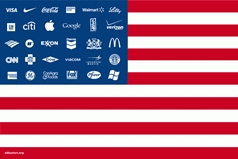
image courtesy of Reclaimdemocracy.org
The film "Unequal Justice" debuted in DC Tuesday evening at the SEIU building, sponsored by the Alliance for Justice (AFJ) and The Raben Group.
The [nonpartisan] Raben Group, in its own words, offers "a tailored suite of services including policy development, direct lobbying, coalition building, grass-tops campaigns, political counsel and strategic communications." The more than one hundred organizations that comprise the AFJ "work . . . to ensure that the federal judiciary advances core constitutional values, preserves human rights, and provides unfettered access to the courts for all Americans."
Surrounded by words from AFJ founder and president Nan Aron and then a four-person panel including moderator Linda Lipsen; consumer protection attorney Pam Gilbert; Erica Smiley, director of Campaigns for Jobs with Justice; and SEIU general counsel Judy Scott, the film brings to life three crucial US Supreme Court decisions that skewered the ideals of democracy.
The strong and unforgettable anecdotes, along with ascertainable facts, are food for the action that must follow, said Gilbert after the film. The first anecdote, told by Aron before the movie, concerned an appearance by Justice Samuel Alito at a fundraiser organized by conservative lawyers. Like a Tea Party adherent, Alito shouted out gun rights and his opposition to "entitlement" programs including Medicare and Social Security.
"Their agenda is big business and corporations," she said, referring back to the infamous Powell Memorandum, a secret document leaked to renowned journalist Jack Anderson in 1971 that laid out an agenda for taking back the conservative American dream from the late sixties left wing. And it has worked so well that we the people, the 99 percent, are in far worse economic straits than Powell's people ever were in the sixties. And cultural. And educational. The list goes on.
But not dumbed down enough to elect Mitt Romney to the presidency. Not even close. The ruggedly handsome Marlboro Man has seemingly been disappeared to the George W. Bush dimension.
The point of the film is that SCOTUS must be held accountable for its actions, Aron concluded.
Narrated by The Nation's editor and publisher Katrina van den Heuvel, the film first portrays a vehement protest by female Walmart employees over the unequal pay they receive compared with their male coworkers, who are always first in line for promotions while merit and ability take a back seat. Former Senator Russ Feingold and present Senator John McCain, authors of the campaign finance legislation that kept presidential candidates as honest as possible, next appear to comment on the disastrous Citizens United v FEC ruling, which McCain calls the worst SCOTUS decision in the twenty-first century. According to Feingold, Citizen United's harvest will exceed the excesses of the Guilded Age.
The Roberts Court is unconcerned with ordinary people, habitually ruling in favor of corporations, van den Heuvel adds, following up briefly with a profile of the pioneer conservative Lewis Powell, a Chamber of Commerce operative who was appointed by Nixon to SCOTUS two months after publishing the memorandum.
Then the catalyst of the heated demonstration that began the film takes center stage, the SCOTUS predictable pro-corporate ruling on Walmart v Dukes, a class-action suit brought by 1.5 million female employees of Walmart all over the world protesting their treatment by the third-largest employer in the world (exceeded only by the US government and then the Chinese military).
One employee said that her male coworkers earn twice what women do, and their complaints are dismissed because men have families to support. But so do the women.
One anecdote related later concerned a woman too intimidated to ask for time off when she began to experience what turned out to be the first warning signs of ovarian cancer. When she finally got to a doctor, the disease had progressed too far and she lost her life soon after.
And how could so many women from so many different store locations have the same complaint? was one sage question the Court asked. Walmart was too big to sue. Instead, the plaintiffs were told to press their charges in smaller groups or even individually.
In the case of Cleveland v Messing, innocent young lives were ruined by an anti-acne medication. One teenager suffered repeated surgery over five years, during which her entire large intestine was removed, among other agony and pain she suffered. In this case, because the culprit drug was generic, the manufacturer was ruled not responsible. Although 80 percent of the marketplace buys generic drugs, said Lipsen later, manufacturers are not even required to put warnings on their labels. Had the company been a name brand, it would have been impugned. The decision involved the usual conservative-liberal ratio of five cold hearts versus four anguished sympathizers.
Then, of course, Citizens United became the focus--it centered not on the McCain-Feingold legislation and the progression of campaign finance laws that had led up to it for decades, but rather on a derogatory film made about Hillary Clinton, then a presidential candidate. The plaintiffs questioned whether the filmmakers had the right to screen the film, especially so close to Election 2008.
In response, even though Citizens United was such a small operation, the SCOTUS decision, applying First Amendment rights to corporations as if each were an individual citizen, lifted the cap on how much money could be spent on campaign advertising. Justice John Paul Stevens, who delivered the dissenting opinion, called the decision "a kick in the teeth of democracy."
Class action suits, also targeted, were disempowered by newly imposed limitations, the sum result horrifying for all: SCOTUS had pushed aside the two other branches of the federal government to become the most powerful of them all.
Corporations are now using money to dominate the ballot box, van den Heuvel concluded. "Five Supreme Court Justices don't have the last word. We do."
The concluding pledge was that AFJ will fight back to redirect the Court toward the real citizenry, the real individuals, we the people. Several of the Justices are close to retirement age, including Ginsburg, Scalia, and Kennedy, so that in the next four years there is room for hope that change can veer this country away from complete corporatocracy.
*****
Jarring the audience, moderator Lipsen noted that the subject of SCOTUS was ignored during the 2012 presidential campaign. The Roberts Court accomplishes what it does by means of roadblocks including pretrial technicalities and procedural flaws, said Gilbert.
She quoted attorney Arthur Miller that SCOTUS doesn't even bar its doors; it shoots plaintiffs on the courthouse steps.
Referring to the origin of the inverse process, an increase in the negotiating power of the people, Scott recalled the National Labor Relations Act passed as part of the New Deal, to inject more capital into the economy.
Once Powell took the helm, he questioned whether unions and workers had too much power--24 percent of workers, not counting government employees, were unionized.
SCOTUS rulings followed to diminish them: they were no longer permitted to meet on private property and were next denied the right to bargain over a corporate decision to close down. The Court also ruled that undocumented workers have no rights according to the NLR Act.
Smiley noted the full agenda such injustice demanded: redefinition of the term "criminal," for example--to reapply that label to corporations rather than individual citizens. Walmart must be framed as the villain. In another anecdote, she told of a worker who collapsed after having worked three shifts in a row.
Walmart has the world's best logistics for "moving things," she said. The District of Columbia has successfully kept it out on the basis of negligence of workers' rights and environmental regulations. This year forty Mexican guest workers "sent Walmart into a tailspin." They could well empower the 1.5 million disenfranchised Walmart employees, Smiley said.
Gulf Coast workers have just begun to organize, and Walmart knows that they will win, just like striking employees of Ford and its supply chain.
When the Court tries Section 5 of the Voting Rights Act, activism will be of paramount importance, said Scott, as it was to the successful survival of the Affordable Care Act last summer. Gilbert noted that this was the smartest decision that Roberts ever made [to me it was blatant politics, period--MS].
Ending the panel discussion on a forceful note, Smiley noted that the Waltons own half the wealth of this country while its employees challenge the economy with their need for food stamps and other necessities of life.
Authors Website: http://www.wordsunltd.com
Authors Bio:
Marta Steele is an author/editor/blogger who has been writing for Opednews.com since 2006. She is also author of the 2012 book "Grassroots, Geeks, Pros, and Pols: The Election Integrity Movement's Nonstop Battle to Win Back the People's Vote, 2000-2008" (Columbus, Free Press) and a member of the Election Integrity movement since 2001. Her original website, WordsUnLtd.com, first entered the blogosphere in 2003. She recently became a senior editor for Opednews.com. She has in the past taught college and worked as a full-time as well as freelance reporter. She has been a peace and election integrity activist since 1999. Her undergraduate and graduate educational background are in Spanish, classical philology, and historical and comparative linguistics. Her biography is most recently listed in "Who's Who in America" 2019 and in 2018 she received a Lifetime Achievement Award from Who's Who.