| Back OpEdNews | |||||||
|
Original Content at https://www.opednews.com/articles/The-Inseparable-E-Couple-by-Martha-Rosenberg-120704-107.html (Note: You can view every article as one long page if you sign up as an Advocate Member, or higher). |
|||||||
July 4, 2012
The Inseparable E-Couple
By Martha Rosenberg
An informal survey on a college campus found the majority of incoming freshmen were using their cells to talk to--anybody--Mom! not to make new friends.
::::::::
Recently there was a fire on the train tracks of Chicago's metro that demonstrated how useful cells are in an emergency.
Attention passengers--there has been a fire on the train tracks and firefighters are on their way to assist you," said the PA system.
"There has been a fire on the train tracks and firefighters are on their way to assist us," 40 people relayed into their cell phones.
"Please remain in your car until further instructions."
"We're remaining in our car until further instructions," relayed 40 cell callers.
Passengers didn't talk to each other and discuss, perhaps, opening the side doors. They didn't demand a further and better explanation from train officials. They talked to the person who knows them as "It's me."
A week later, a driver, talking on his cell, almost struck a pedestrian also talking on her cell as she crossed the street. Both yelled at each other's idiocy which caused such a close call but neither hung up. They were too busy telling the person on the other end what that &%$@ idiot almost did.
Cells are supposed to help communication but they also dodge communication. An informal survey on a college campus found the majority of incoming freshmen were using their cells to talk to--anybody?--Mom!...not to make new friends. Increasingly doctors post "no cell phones" signs in their offices, having spent too much of their valuable time listening to, "have you looked in the second drawer" while trying to examine a patient. And raise your hand if you've had lunch or dinner with someone who preferred their cell's company to you? To them, it seemed more immediate.
Cells have been called the new cigarette because of their ubiquity and addictiveness (which has created a subcategory of cell-in-commode plumbing problems). When Roman Catholic bishops in Italy suggested people give up their cells for Lent, people said, essentially We're not that faithful.
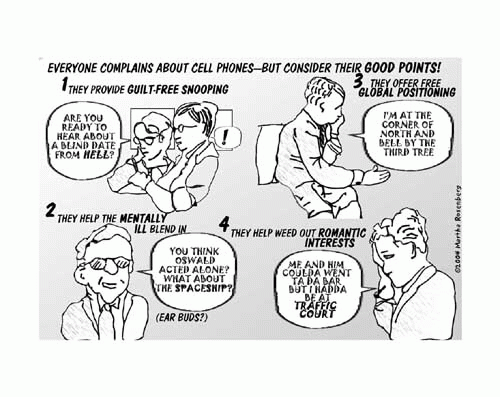
And, speaking of the word "said," what do cell phoners have against it? Why do they replace it with "all" (and I'm all what do you mean I'm late ), "like" ( I'm like what are you doing after work? ) or "go" ( So I go what are you doing and he goes... ) "Go" implies a demonstration or accompanying pantomime--yes, like almost getting hit by a car.
Why can't they use colorful verbs like observed, retorted, suggested, reminded, conceded, cautioned, asserted or responded for "said" if we have to listen to them? Why don't they talk about last night's date, a bounced check or their roommate or boss from hell instead of boring us with "Hi, it's me," "I'll be there in ten minutes," and "I'm at State and Lake."
Cells have been credited with helping emotionally disturbed people who talk to themselves blend in. But there are big differences. The conversation of emotionally disturbed people is usually more interesting, with a better narrative... and few would keep talking if they almost got hit by a car.
Authors Bio:
Martha Rosenberg is an award-winning investigative public health reporter who covers the food, drug and gun industries. Her first book, Born With A Junk Food Deficiency: How Flaks, Quacks and Hacks Pimp The Public Health, is distributed by Random House. Rosenberg has appeared on CSPAN and NPR and lectured at medical schools and at the Mid-Manhattan Public Library.