| Back OpEdNews | |||||||
|
Original Content at https://www.opednews.com/articles/US-Double-Standards-India-by-Yasmeen-Ali-120426-670.html (Note: You can view every article as one long page if you sign up as an Advocate Member, or higher). |
|||||||
April 26, 2012
US Double Standards: India's Ballistic Missile Test and Pakistan, the Whipping-Boy
By Yasmeen Ali
The US goes bananas when Korea tries (and fails) to test launch a medium-range ballistic missile, but just yawns when India, another country outside the nuclear pact, does the same thing, only successfully. What gives? asks TCBH contributor Yasmeen Ali of Pakistan.
::::::::
By Yasmeen Ali
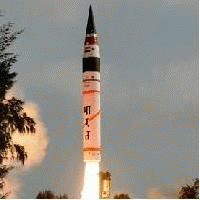
India's launch of a nuclear-capable MRBM missile barely evoke a US yawn
(Image by ThisCantBeHappening) Details DMCA
India's successful test of a ballistic missile with a range of more than 5,000 km, was
was uncriticised by the US.
Contrast this lack of concern with the America's obsessive concern about a suspected or potential nuclear program by Iran, or to US threats over the failed rocket launch by North Korea a few days earlier.
India has increased its military spending by 13% this fiscal year, to roughly US $38
billion, according to an April 20 article in The Independent (UK) titled, "India's nuclear
ambition must not be ignored"). Yet this has not raised US ire -- or even US eyebrows!
India, the bully of the South Asia region, has happily announced its entry in an
exclusive club within the comity of nations, having now demonstrated the capability to
hit a target at 5,000 kilometers.
The Chinese newspaper, Global Times (Beijing), hit out at Western countries for
displaying double standards for not condemning the test firing of the Agni-V, writing:
"The West chooses to overlook India's disregard of nuclear and missile control treaties,"
the editorial said. "The West remains silent on the fact that India's military spending
increased by 17 percent."
Double standards it is!
There is a club within a club, of countries of the world who can get away with
murder(literally), while others must behave or face the stick of the Master, with
Pakistan being the whipping boy of choice!
It is all about the geo-political interests of US in the region. At issue is the perceived need among politicians and military leaders in Washington to contain China and prevent it from possibly developing into a rival super power in near future.
The need is to find and support a country within the region that can act, or seem to act,
as a deterrent to China.
Obvious choice: India.
What the US has completely overlooked in this game of regional hegemony is that when
you let the genie out of the bottle, it will refuse to go back inside. It can, one day, turn
upon the master, once its heart's desire of being let out is fulfilled.
The US has a bad record of learning lessons from history. In the short- term interest of
countering Russian influence in Afghanistan back in the late 1970s and early 1980s, it
had created the Mujahedeen (now re-christened as the Taliban). Today, the specter of
that ghost still hounds them. But it's not really a ghost is it?
Now, blubbering in Afghanistan, caught in a trap of it's own making, the US does
not know how to extricate itself from this folly!
This dilemma has led to the need by US to involve India more in Afghanistan, which is a complete challenge to the vital interests of Pakistan, America's supposed "ally" in the so-called War on Terror.
The US, however, is overlooking the fact that the security environment in South Asia
has as always been guided by a traditional rivalry, Pakistan and India being the two
players. Ameria cannot simply wish away the reasons for three wars between India and
Pakistan. Reasons that no international forum has shown any interest in resolving.
According to a paper by Syed Shahid Hussain Bokhari, written for the Berkley Journal of Social Sciences and published in January 2011, the strategic balance in the region is maintained by nuclear deterrence and the role of major powers, primarily the US. He correctly states that a US tilt towards India will threaten Pakistan's national interests.
US support for India is driven by a desire to maintain hegemonic superiority over her
perceived rival in the region: China.
India has not accepted any legal constraint against nuclear testing , nuclear testing which might enable India to develop nuclear weapons with much larger explosive power than those currently in the country's arsenal and that in turn would allow important changes in Indian nuclear strategy. For example, larger bombs might allow India to target Chinese or Pakistani nuclear sites that were previously considered safe from attack.
That, of course, could drive Beijing or Islamabad "to develop new nuclear weapons
themselves or to change their currently restrained strategies for usof nuclear arms," as Michael A. Levi and Charles D Ferguson wrote in "U.S.-India Nuclear Cooperation A Strategy of Moving Forward," published in the Council Special Report, Council on Foreign Relations (2006: 11).
With a new Indo-US partnership apparently in offing , India will surely use her status
with the US against Pakistan, the country's traditional rival.
The equanimity with which the US has accepted the new ballistic missile firing by India
is an example of this. This new nexus will, at some point compel Pakistan, for the sake
of her survival and the need to counter India, into seeking options that the US has not
anticipated.
For America then, it could turn into a self-defeating exercise leading to a trap of
America's own making .
In such a dangerous game , the double standards being indulged in by the US are being
well read all over.
"India missile test has few critics, unlike North Korea,'' read the headline of a widely-
distributed AP story, which said the test caused barely a ripple -- even in China -- just
days after North Korea was globally vilified for its failed rocket launch.
The United States of America is a weakened nation today. After its long drawn-out war
in Afghanistan and with nothing to show for the effort (unless you count destruction of
that country and killing of countless civilians, and the urinating on dead bodies by
American troops as a pathetic assertion of victory), and the equally long and unsuccessful war on Iraq, America needs strategic partners to help her. This is particularly the case as the country, struggling with a weak economy, tries to maintain hegemony over China, the rising regional challenger to America's status in Asia and the Pacific region.
This challenge will likely lead to US efforts to form new alliances at the expense of old
ones, leaving Pakistan, the favorite whipping boy, tossed aside like used tissue, to fend
for herself.
Pakistan needs to recognize this reality, and should look for options as her standing and
security in the region is at stake!
The interesting paradox of US policy is the inbuilt mechanism of self-defeat. By leaning
completely towards India its control over Pakistan inevitably will weaken (why am I
reminded here of a parallel: America's role in the conflict between Israel and Iran?) This in turn will ensure the entrance of others into the region.
Unfortunately, America has over the years shown a predilection for short-term policies
over long-term strategy, and a total lack of principle in its international affairs.
Yasmeen Ali is a lawyer and law professor based in Lahore, Pakistan. She contributed this article to ThisCantBeHappening!, where this article first appears. She has her own blog in Pakistan at and can be contacted at yasmeen.a. Email address removed
Submitter: Dave Lindorff
Submitters Website: http://www.thiscantbehappening.net
Submitters Bio:
Dave Lindorff, winner of a 2019 "Izzy" Award for Outstanding Independent Journalism from the Park Center for Independent Media in Ithaca, is a founding member of the collectively-owned, journalist-run online newspaper www.thiscantbehappening.net. He is a columnist for Counterpunch, is author of several recent books ("This Can't Be Happening! Resisting the Disintegration of American Democracy" and "Killing Time: An Investigation into the Death Penalty Case of Mumia Abu-Jamal"). His latest book, coauthored with Barbara Olshanshky, is "The Case for Impeachment: The Legal Argument for Removing President George W. Bush from Office (St. Martin's Press, May 2006).